
Vectorized vs Event-Driven Backtesting: Which Approach Fits Crypto Strategy Testing?

Every backtest is a simulation, and every simulation has to decide how it walks through history. Two philosophies dominate: vectorized backtesting, which computes strategies across entire arrays of data at once, and event-driven backtesting, which replays the market trade by trade in sequence.
Most traders never choose between them consciously. The platform they use made the choice for them, and that choice quietly decides which strategies their results can honestly describe. Understanding the difference is one of the highest-leverage pieces of knowledge in crypto testing.
This article compares the two execution models directly, shows where each one breaks, and explains which jobs belong to which approach.
What an Execution Model Actually Decides
A backtest has to answer a sequence of questions: when a signal fires, at what price does the trade happen, how much capital does it consume, and what happens when the next signal arrives before the previous trade closes?
The execution model is the machinery that answers those questions. Vectorized and event-driven machines answer them in fundamentally different ways, and the differences show up exactly where trading logic gets complicated.
The Vectorized Model: Compute Everything at Once
Vectorized backtesting treats price history as arrays of numbers and computes signals across the whole array in a single pass. Instead of walking bar by bar, it asks: across all 1,800 daily bars, where is the condition true?
The strengths follow directly:
Speed at scale. Thousands of parameter combinations can be evaluated in the time an event-driven engine finishes one, which makes it the tool of choice for open-source research libraries like VectorBT
Clean research math. Signal research, indicator comparisons, and cross-sectional studies are natural fits for array computation
Sweep economics. Exploring a large strategy space is cheap, which is ideal for the screening stage of research
The limits are subtler, and they matter most for the strategies retail traders actually run:
Path dependence is hard. Stop losses, position sizing, and trade sequencing depend on what happened before, and arrays do not naturally carry that state
Fills get idealized. Array-based results tend to assume the signal price is the fill price, which flatters strategies that trade fast or trade breakouts
Look-ahead hides easily. A vectorized expression that accidentally includes the current bar's completed value can leak future information into past decisions
The Event-Driven Model: Replay the Market in Order
Event-driven backtesting walks through history in sequence, one event at a time. Each bar or tick arrives, the engine evaluates the strategy in the context of everything that already happened, updates positions, applies costs, and moves on.
Strengths:
Path-dependent logic works faithfully. Stops, trailing exits, position sizing, and capital constraints are handled as the sequence they actually are
Realistic fills. Orders execute against the data that existed at that moment, not against the signal that fired
Auditability. Every trade has a trail: what triggered it, what was held, what it cost, and what the result was
The costs:
Slower. Sequence processing is heavier than array math, and the gap grows with the size of a sweep
More engineering in code frameworks. In tools like Backtrader, the realism is something you build and maintain yourself
The Comparison Side by Side
The clearest way to see the trade-off:
| Dimension | Vectorized backtesting | Event-driven backtesting |
|---|---|---|
| How trades are computed | Signals computed across full data arrays at once | Market replayed in sequence, trade by trade |
| Speed | Very fast, especially across many parameter sets | Slower per run, scales linearly with detail |
| Path-dependent logic (stops, sizing, sequencing) | Approximated or restructured, error-prone | Handled directly as sequential state |
| Fill realism | Often idealized at the signal price | Fills simulated from the data at that moment |
| Look-ahead risk | High if expressions are not carefully constructed | Structurally low, since decisions use only past events |
| Best suited to | Wide screening, indicator research, parameter sweeps | Validation, execution-sensitive strategies, final checks |
| Typical user | Quantitative researchers in code | Traders deciding whether a strategy can actually run |
Which Approach Fits Your Testing
The honest answer is that serious processes use both, at different stages:
Screen with vectorized thinking. When the question is "does this family of ideas have any signal," breadth beats fidelity, and fast sweeps earn their keep
Validate with event-driven rigor. When the question is "can this specific strategy survive real execution," speed is worthless and fidelity is everything
Distrust any final answer that never passed stage two. A strategy that only ever ran vectorized has never been tested against the sequencing its live account will impose
This two-stage split is also the correct way to interpret competitor tooling: research libraries are screening instruments, and validation engines are decision instruments. Be suspicious of a process that uses one where the other belongs.
Where CoinQuant Fits
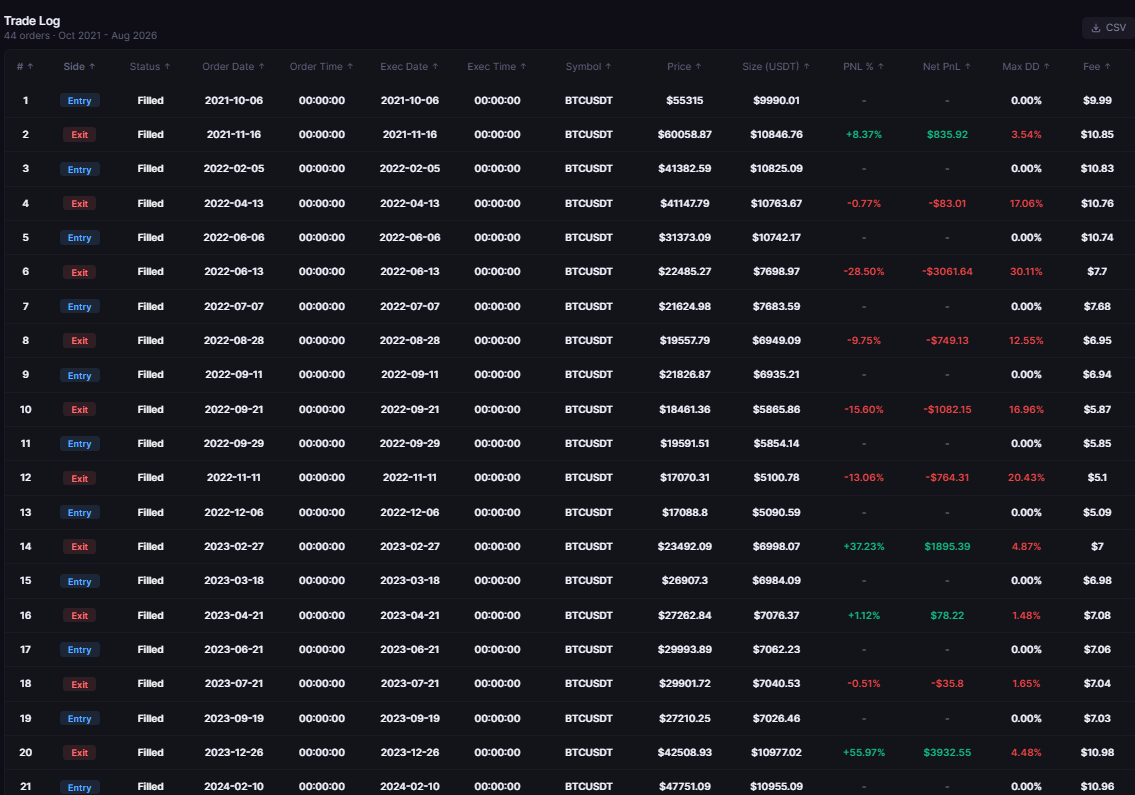
CoinQuant takes the execution side of this divide. Backtests simulate trades in sequence on tick-accurate data, the event-driven style of simulation, wrapped in a no-code workflow:
Trades are simulated as they would occur. Entries, exits, fees, and sequencing are processed in market order, so stop logic and path-dependent rules are not approximated
The data foundation is venue-level. Simulation runs on Kaiko-collected exchange data instead of a blended display price
Costs appear in the result. A 0.1% taker fee is modeled by default and reported on every run
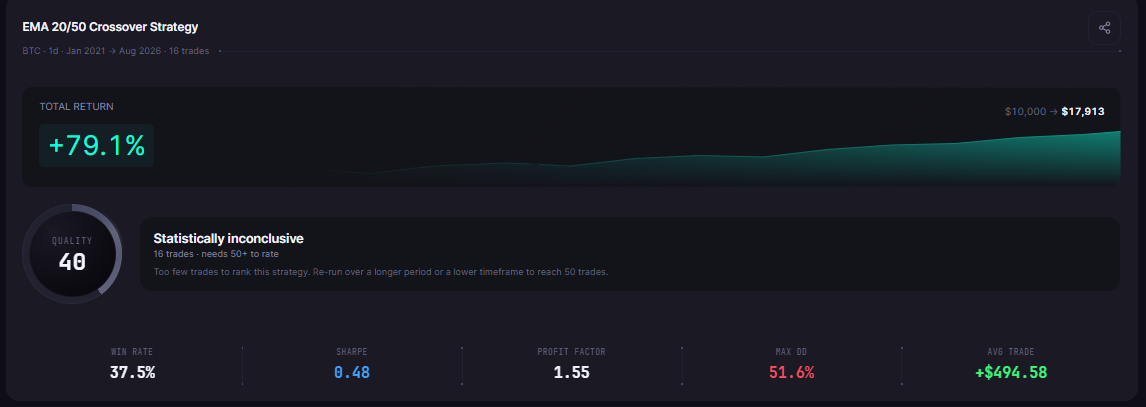
Metrics come standard. Return, drawdown, profit factor, Sharpe, trade count, and fees are reported together, so runs are comparable
For a trader without a quantitative engineering budget, that combination matters: the fidelity that used to require a custom event-driven framework is the default behavior of every backtest, and screening and validation happen in the same place.
Common Mistakes to Avoid
Treating raw speed as validation. Fast sweeps produce answers faster, not more trustworthy ones
Letting a vectorized screen pick the winner. Selection should happen on sequential, realistic results
Ignoring fill assumptions. If a backtest fills everything at signal prices, execution-sensitive strategies are being misrepresented
Building custom machinery for both stages. Most traders need a screening habit, not a second codebase
Forgetting that live trading is event-driven by definition. Your account will process events in order, so your final test should too
The Practical Lesson
Vectorized backtesting computes across full arrays for speed; event-driven backtesting replays the market in order for fidelity
Path-dependent logic, fills, and look-ahead safety are where the models differ most, and exactly where crypto strategies get tested hardest
Use vectorized thinking for screening, event-driven rigor for validation, and never skip the second stage
CoinQuant simulates trades in sequence on tick-accurate Kaiko-collected data, with realistic fees and a full metric set on every run
The execution model is the invisible decision behind every backtest number. Choose platforms, and pipelines, that can show you the trade-by-trade truth when it counts.
See why traders choose CoinQuant for execution-realistic validation. Start on CoinQuant
Disclaimer:
This content is for educational and informational purposes only and does not constitute financial, investment, or trading advice. All strategies and examples are for illustrative purposes and do not guarantee results. Always conduct your own research before making financial decisions.
