
Types of Backtesting Methods Compared: Walk-Forward, Vectorized, Event-Driven, and AI Agent (2026)

"AI agent backtesting" went from conference slide to standard prompt in about a year. The question traders now ask their assistants is the right one: how does it actually compare to the methods that came before?
Most comparisons stay fluffy. This one does not. It lines up the four method families that matter in 2026, names how each works, and states each one's limits, so you can pick the right tool for the question you are asking.
Types of Backtesting Methods at a Glance
| Method | How it works | Speed | Realism | Best for | Main limitation |
|---|---|---|---|---|---|
| Vectorized backtesting | Computes signals across whole arrays of historical data at once | Fastest | Lowest | Screening hundreds of ideas quickly | Fills and costs are idealized; path-dependent logic is hard |
| Event-driven backtesting | Replays the market bar by bar or tick by tick, processing each event | Slowest | Highest | Validating a strategy you intend to trade | Compute cost and build complexity |
| Walk-forward analysis | Splits history, tunes on one window, confirms on the next, repeats | Moderate | Depends on engine | Robustness testing before trusting a result | More runs to manage; window choices still influence outcomes |
| AI agent backtesting | An assistant defines, runs, and iterates backtests via an API or MCP connection | Fast iteration | Depends on platform engine | Iterating on ideas in plain English without coding | Needs a platform that exposes the loop; agent scope limits apply |
A useful mental model: vectorized answers "is there something here", event-driven answers "would this have actually filled", walk-forward answers "does it survive when the data changes", and an AI agent answers "how fast can we run this loop".
Vectorized Backtesting: Speed for Signal Research
Vectorized backtesting applies the strategy logic to entire columns of data at once, using array operations instead of a bar-by-bar loop. It is the fastest way to ask whether a signal has any relationship with future returns.
Its limits are structural. Because it skips the order-by-order simulation, it tends to assume fills that a real market would not have given you, and it struggles with rules that depend on the state of the position, such as trailing stops or partial exits. Vectorized results are hypotheses. Treat them that way.
Event-Driven Backtesting: The Realism Standard
Event-driven engines replay history in sequence: bar arrives, conditions evaluate, order fills, portfolio updates, next event. Nothing future leaks into the present, because the future has not been processed yet.
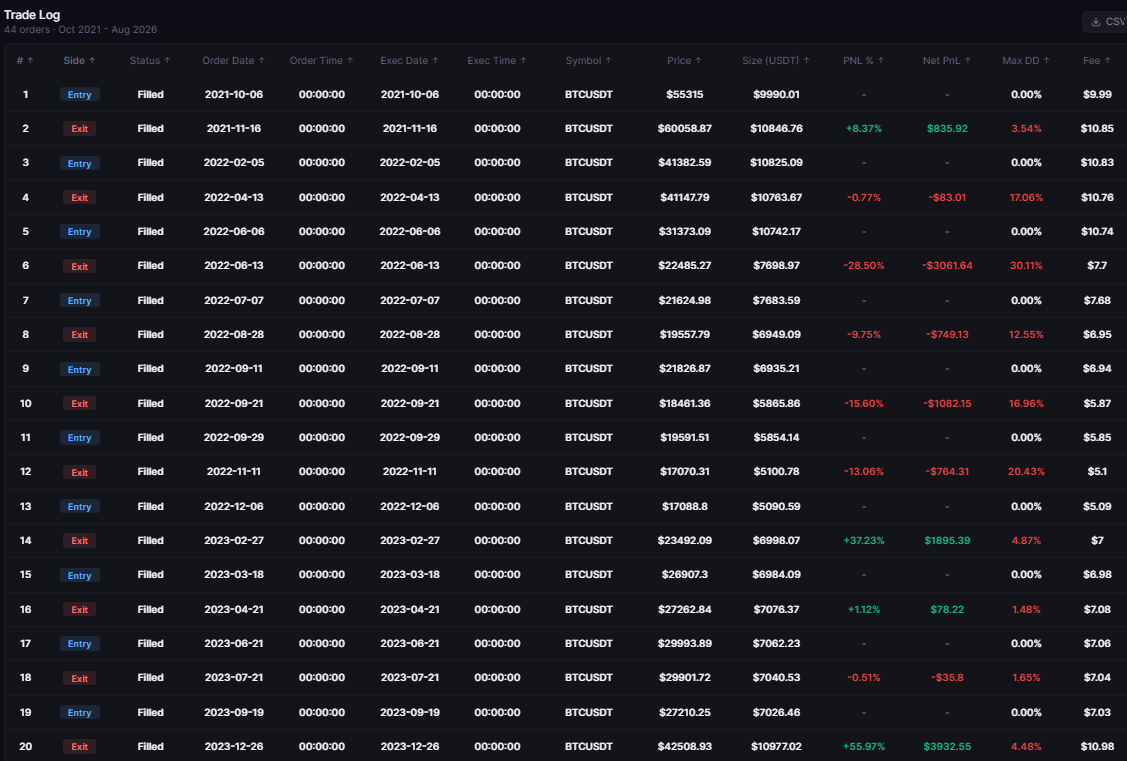
That fidelity is why event-driven simulation is the standard for strategies with real money attached. It captures sequential fills, fee charges per trade, and the small slippage between signal and fill that vectorized tools gloss over. The price is speed and, if you are building your own engine, development time.
On CoinQuant, this layer is the platform's engine rather than a project: backtests run on Kaiko-sourced exchange data with fees charged per fill and reported as a line item, which makes the realism easy to verify in the report.
Walk-Forward Analysis: The Robustness Layer
Walk-forward is less a separate engine and more a discipline applied on top of one. You divide history into consecutive windows: tune the strategy on the first, test it untouched on the next, then roll forward and repeat. The final picture is a chain of out-of-sample results, not one flattering curve.
It exists because single-window backtests are easy to fool. Tune enough settings against one stretch of history and something will always look brilliant there. Walk-forward makes that cheating visible, because each window is graded on data the tuning never touched.
The limitations are honest ones: you need enough history to divide into meaningful windows, you run many more tests, and the choice of window length still shapes the outcome. Walk-forward is a filter, not a verdict.
AI Agent Backtesting: Iteration Speed Without Code
AI agent backtesting puts an assistant in the operator's seat. You describe a strategy in plain English; the agent creates it on a platform, runs the backtest, reads the metrics, and iterates, all through a programmatic interface.
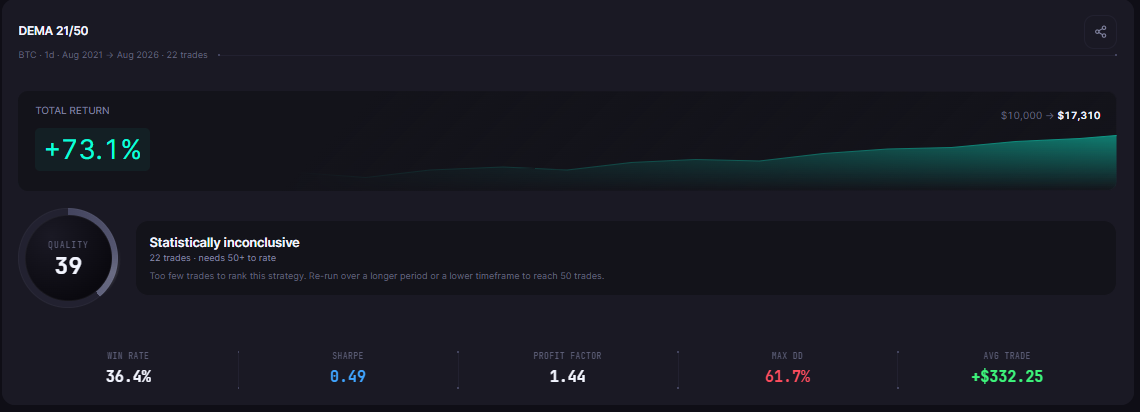
CoinQuant is built for this shape: a documented public API plus a skills pack let an external agent own the full loop, from prompt to strategy to backtest to metrics. We verified the workflow end to end, and the practical wins are real: an idea that used to wait for a developer's afternoon is tested in minutes, and the definition of the strategy stays readable instead of buried in code.
The limits deserve the same airtime. An agent needs a platform that exposes the loop; on CoinQuant the scope is research, not live trading, and service tokens are 30-day credentials, so the agent asks for a fresh one monthly. An agent also cannot replace out-of-sample discipline: it will happily iterate a strategy into shape against one window if you let it. The method accelerates the loop; the judgment stays with you.
The Head-to-Head: What Each Method Can and Cannot Do
| Question | AI agent | Walk-forward | Vectorized | Event-driven |
|---|---|---|---|---|
| How are rules defined | Plain English, agent compiles | Whatever the engine takes | Code or platform logic | Code or platform logic |
| Setup effort | Low, once connected | High discipline, moderate setup | Low to moderate | Highest |
| Iteration speed | Highest | Slow (many runs) | Fast for research only | Slow |
| Out-of-sample protection | Only if you enforce it | Built in by design | None by default | None by default |
| Fill and cost realism | Platform engine dependent | Platform engine dependent | Lowest | Highest |
| Where it belongs | Idea generation and fast iteration | Confirming robustness | First-pass screening | Final validation evidence |
Note what the table does not say: none of these methods is "the best". They answer different questions, and the strong workflow runs more than one.
How the Methods Stack in Practice
The pairing that holds up: an agent to iterate quickly, an event-driven engine to produce evidence, and walk-forward discipline to confirm the edge is not a window artifact. Vectorized tools can screen at the front, but nothing that ends up live should skip the other three.
That is also the honest answer to "how does AI agent backtesting compare to traditional methods": it does not replace them. It collapses the distance between having an idea and having a testable definition, then hands the definition to the same regime of evidence every serious method has always required.
Common Mistakes to Avoid
- Treating one method as the whole answer. Screening, validation, and robustness are separate jobs.
- Letting the agent iterate unchecked. Without a frozen confirmation window, fast iteration is just fast curve-fitting.
- Skipping event-driven validation. A vectorized or agent-generated result still needs a faithful fill-and-cost check.
- Running walk-forward once. One window split is a sample; vary the windows before believing the verdict.
- Ignoring what each engine charges. Realism is concrete: fills, fees, slippage, reported per trade.
The Practical Lesson
- Vectorized is for screening, event-driven for evidence, walk-forward for robustness, AI agents for iteration speed
- The agent era does not retire the old disciplines; it makes them easier to run consistently
- Every result deserves the method that can falsify it, not just the method that produced it fastest
- Stack the methods: iterate fast, validate faithfully, confirm out of sample
See why traders choose CoinQuant's event-driven, fee-aware engine for the validation step on CoinQuant
Disclaimer:
This content is for educational and informational purposes only and does not constitute financial, investment, or trading advice. All strategies and examples are for illustrative purposes and do not guarantee results. Always conduct your own research before making financial decisions.
