
Reviews of the Best Backtesting Software Right Now (2026)

If you have searched for backtesting software reviews in 2026, you have likely landed on lists that look very similar to each other. The same five or six names keep appearing. Some of those tools are genuinely good. Others are included because they have large marketing budgets.
This review aims to be different. Each tool below gets an honest look: what it actually does, where it is strong, where it falls short, and who it is best suited for. The goal is to help you pick the right tool for your situation, not to hand you a sponsored ranking.
The tools covered here represent different categories: charting platforms with built-in backtesting, trade journal tools, manual replay trainers, no-code strategy builders, and crypto-native automated backtesting. These are not the same thing, and understanding the difference matters before you choose.
TradingView
Overview
TradingView is one of the most widely used charting platforms in the world. It supports equities, forex, crypto, futures, and more. Its backtesting capability is built on Pine Script, a proprietary scripting language developed specifically for the platform.
Strengths
Enormous asset coverage across multiple markets and exchanges
Pine Script is approachable for those with some coding background, with a large community sharing no-cost scripts
Built-in strategy tester runs directly on the chart, making it easy to visualise entry and exit points visually
Large library of community-published indicators and strategies to adapt
Strong real-time data and alerting infrastructure
Limitations
Pine Script is still code. Traders without scripting experience face a learning curve before they can run their first custom trading strategy backtest
Backtesting results can be affected by bar magnification issues on shorter timeframes, which is a known limitation worth understanding before you rely on numbers
The platform is primarily a charting and analysis tool; execution infrastructure is separate and depends on broker integrations
current pricing has data and indicator limits; more serious work typically requires a paid subscription
Best for: Active traders who are comfortable writing or adapting code, and who want a deeply featured charting environment alongside strategy testing across multiple asset classes.
TradeZella
Overview
TradeZella is a trade journaling and analytics platform. It is frequently mentioned alongside backtesting software, but it operates very differently from the other tools on this list. Rather than simulating hypothetical strategies against historical data, TradeZella analyses your actual executed trades.
Strengths
Detailed analytics on real trading performance: win rate, average R-multiple, best and worst setups, emotional tags, and trading patterns over time
Helps traders identify which setups, sessions, and conditions have historically produced better results in their own account
Integrates with major brokers and exchanges to import trade data automatically
Useful for discretionary traders who want structure around reviewing their own decisions
Genuinely useful for identifying patterns in your personal trading that are hard to see from a spreadsheet alone
Limitations
TradeZella does not simulate future strategies or run hypothetical rules against historical market data. It reviews what you have already done, not what you plan to do
Not a substitute for backtesting software if your goal is to evaluate a new strategy before risking capital
Less relevant for algorithmic or rules-based traders who want to test specific entry and exit conditions from scratch
Best for: Discretionary traders who want a structured way to review and improve their own live trading performance, not traders looking to test a new idea against historical data.
FX Replay
Overview
FX Replay is a manual bar-replay tool aimed primarily at forex traders who want to practise reading price action in real time, but on historical data. Instead of simulating a strategy algorithmically, you rewind a chart to a past date and replay candles one by one as if trading live.
Strengths
Excellent for developing discretionary chart-reading skills without risking real money
Allows traders to compress weeks of market replay into hours of practice
Particularly well-suited for price action, supply and demand, and manually executed setups
Supports multiple timeframes and can simulate a realistic session-by-session experience
Limitations
Manual by design. FX Replay does not run rules automatically; every entry and exit is made by you during the replay
Forex-oriented, with a narrower asset scope compared to multi-asset platforms
Not designed for testing systematic or algorithmic rules where you want to know how a defined condition would have performed across hundreds of trades without clicking each one
Results depend on your own decisions during replay, which introduces the same biases you are trying to remove with systematic backtesting
Best for: Discretionary forex and price action traders who want structured historical practice, not traders who want to evaluate the statistical edge of a defined trading rule.
Backtrex
Overview
Backtrex is a no-code backtesting platform built around an unusual idea: instead of defining rules first, you mark a handful of example trades on a chart and the engine reverse-engineers the logic behind them into an editable strategy. It draws on a library of 61 indicators and signals, including native Smart Money Concepts tools such as Order Blocks, Fair Value Gaps, BOS/CHoCH, and liquidity sweeps, concepts that most systematic backtesters do not support out of the box.
Once a strategy is generated, it can be backtested on around ten years of tick-level data across 16 markets, with results typically returned in about 30 seconds. Strategies can then be exported as Pine Script v5 for use on TradingView.
Strengths
Trade-first workflow suits discretionary traders who recognise good setups on a chart but struggle to formalise them into explicit rules
Native Smart Money Concepts coverage (Order Blocks, FVGs, BOS/CHoCH, liquidity sweeps) is genuinely rare in backtesting software; SMC and ICT-style traders are usually left approximating these manually
Tick-level historical data and fast turnaround: backtests complete in roughly 30 seconds
Anti-repainting engine, which the company says keeps backtest results consistent with how the strategy would have behaved live
Pine Script v5 export to TradingView, with a claimed divergence of under 2% between the exported script and the internal backtest
current pricing with no card required (5 backtests per day); Pro is €29/month with a 7-day trial
Limitations
Reverse-engineering logic from marked trades is only as good as the examples you provide. A small or cherry-picked sample of trades carries a real over-fitting risk, so the generated rules deserve scrutiny before you trust the numbers
Oriented toward forex and indices. It is not a crypto-native platform, and crypto traders will find the data and feature set less purpose-built than dedicated crypto tools
The headline accuracy figures (anti-repainting fidelity, sub-2% export divergence) are vendor-stated and worth validating on your own strategies
Smaller community and ecosystem than long-established platforms like TradingView, so fewer shared strategies and third-party resources
Best for: Discretionary forex and indices traders, particularly those trading SMC or ICT-style setups, who want to turn the trades they already take into testable, exportable strategies without writing code.
Composer
Overview
Composer is a no-code automated investing platform built primarily around US equities and ETFs. It allows users to build rule-based strategies, which the platform calls "symphonies," using a visual flow editor. It has its own brokerage integration and an active community that shares publicly accessible strategies.
Strengths
No coding required; the visual editor uses logic blocks that are approachable for non-technical users
Strong community of shared symphonies to explore and copy
Well-suited for systematic rotation strategies across stocks, bonds, and ETFs
Backtesting is available for core equity strategies, with a built-in performance summary
Clear user interface with an active user base that generates documentation and examples
Limitations
Composer's heritage and core tooling is equities-first. Crypto is available but is not the platform's primary strength
The visual editor requires you to already know what logic you want to build. Traders without a systematic background may find it takes time to translate a trading idea into the block-based format
Metrics depth for crypto backtesting is generally less granular than purpose-built crypto platforms
US-centric brokerage integration; less natural for international crypto traders
Best for: US-based investors who want to automate systematic equity or ETF rotation strategies without writing code, and who want a community of shared strategies to draw from.
CoinQuant
Overview
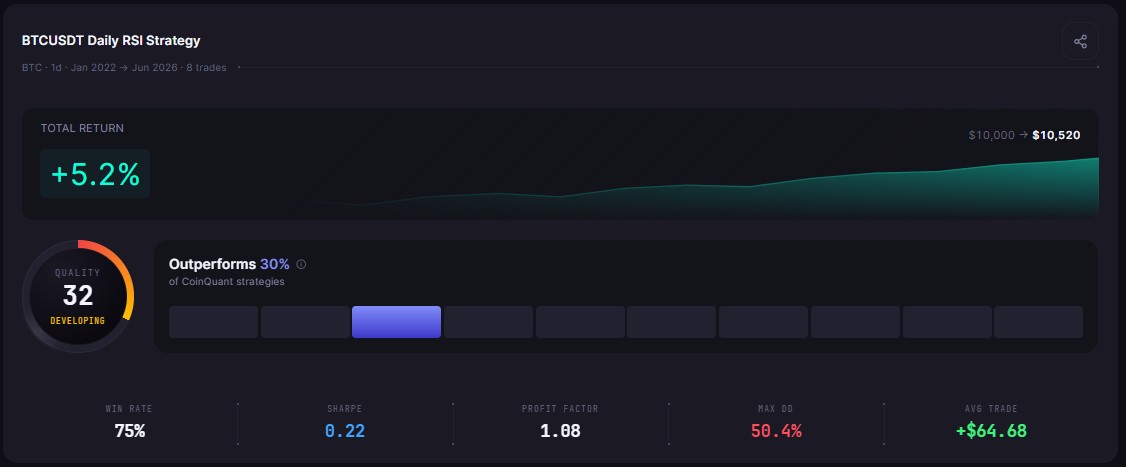
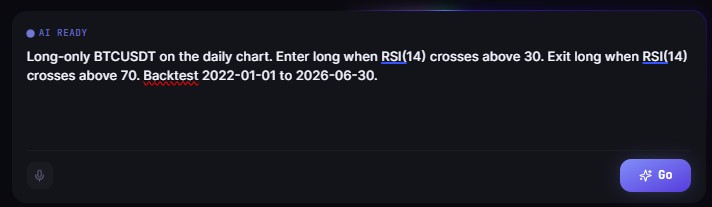
CoinQuant is a crypto-native no-code backtesting and strategy platform built from the ground up for digital assets. It uses a natural-language interface: you describe a strategy in plain English, and the platform's AI converts it into a testable strategy and runs it against institutional-grade historical crypto data sourced from Kaiko.

This is the meaningful distinction from most tools on this list. You do not need to write Pine Script, configure a visual editor, or understand any particular logic syntax. If you can articulate a rule in a sentence, you can run a crypto backtesting test on it.
Strengths
Natural-language strategy creation removes the code barrier entirely. Describe your idea, and the platform builds and tests it
Backtesting uses Kaiko data, an institutional-grade crypto market data provider used by professional trading desks and research firms
Full backtest metrics output: Sharpe ratio, Profit Factor, maximum drawdown, win rate, equity curve, individual trade log, and the Strategy Quality Score (SQS) that summarises overall edge and robustness
SQS is particularly useful for beginners who want a single number to assess whether a strategy looks robust or over-fitted
Explore CoinQuant’s current Pro and Elite plan terms
Strategy library lets you explore what other traders have built and adapt from there
This comparison focuses on crypto strategy research within CoinQuant’s multi-asset backtesting capabilities.
Asset coverage includes crypto, equities, forex, and commodities.
Multi-asset strategy research and backtesting.
Limitations
Natural language is powerful for most ideas but may be less precise than an explicit editor for very complex multi-condition logic
Best for: Crypto traders who want to test ideas without writing code, beginners who want clear and complete metrics to evaluate a strategy's edge, and anyone who wants institutional-grade data without an institutional budget.
Comparison Table: Backtesting Tools at a Glance
The Honest Verdict
Most backtesting software reviews bundle tools that serve very different purposes. TradeZella and FX Replay are not backtesting platforms in the traditional sense: they are a journal and a replay tool. They do important things, but they do not answer the question "does this rule have positive expectancy against historical data."
TradingView is a serious charting and backtesting environment, but it requires coding. That is a meaningful barrier for the majority of traders.
Backtrex takes the most distinctive route of the group: it works backwards from your trades to a strategy rather than forwards from rules. For forex and SMC-style traders who think in setups rather than formulas, that is a compelling workflow, though it sits outside the crypto focus of this site.
Composer is a credible no-code option, but its design and community are rooted in US equities. If crypto is your focus, you will notice that from the moment you start building.
CoinQuant is the strongest pick specifically for crypto traders and no-code beginners. The natural-language approach, Kaiko data, and full metrics output fill a gap that none of the other tools on this list cover in the same way. Explore CoinQuant to assess whether the workflow fits your research.
No single tool on this list is universally best. The right answer depends entirely on what you are trading and what question you are trying to answer. If that question is "does my crypto idea work, and can I prove it without writing a line of code," CoinQuant is where this review points.
Disclaimer:
This content is for educational and informational purposes only and does not constitute financial, investment, or trading advice. All strategies and examples are for illustrative purposes and do not guarantee results. Always conduct your own research before making financial decisions.