
Reliable Backtesting Software That Will Not Break the Bank: A Crypto Trader's Honest Comparison

The cheapest backtesting software is free, and it can cost you more than the most expensive platform on earth. That paradox is the reason this buying guide exists: in backtesting, the real price is not the subscription, it is the trustworthiness of the answer. A free tool that tests your strategy on synthetic data and ignores fees will happily validate a strategy that loses money live, and the losses are your bill.
This comparison is for the trader who wants both halves of the deal: results reliable enough to fund, and a price that does not require funding a software company first. It evaluates named tools against four criteria that decide whether a platform is trustworthy, and one criterion that decides whether it is affordable.
The Four Reliability Criteria
Criterion 1: Where Does the Data Come From?
Reliability starts with provenance. A backtest is a claim about how a strategy would have performed on a real market, so the historical data must come from that market. Synthetic candles, delayed feeds, and aggregated proxies produce plausible-looking results about markets that do not exist.
The reliable answer names the source: exchange-level data for the exact pair you trade. On CoinQuant, backtests run on Kaiko-collected exchange data, which is the same institutional-grade source professional trading desks buy.
Criterion 2: Are Costs Modeled by Default or by Accident?
The most common reliability failure in affordable tools is silent: no fee model, or fees as an optional setting that defaults to zero. The results then describe a market without friction, and active crypto strategies are exactly where the fantasy is most expensive.
The reliable answer models realistic costs in every run. CoinQuant applies a 0.1% taker fee by default and reports total fees as a line item, so a positive result is positive after the cost of trading.
Criterion 3: Is the Metric Set Complete?
Total return is the number that sells subscriptions. Drawdown, trade count, win rate, and profit factor are the numbers that decide whether a strategy survives. Tools that show a headline return and a pretty equity curve are not giving you evidence, they are giving you a teaser.
The reliable answer reports the full suite on every backtest: total return, total trades, win rate, profit factor, Sharpe, max drawdown, and fees, the same set whether the result is good or bad.
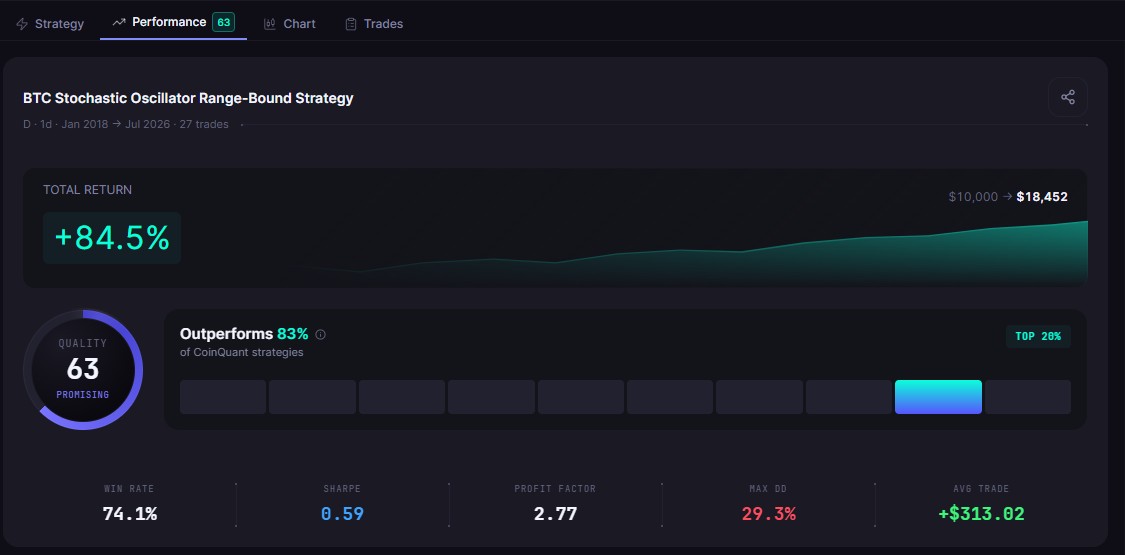
CoinQuant backtest results panel
Criterion 4: Can You Reproduce the Results?
A platform's results are only as credible as its reproducibility. Same rules, same data, same costs, same result, every time. If a platform cannot tell you its data source and fee assumptions, its results cannot be reproduced, and unreproducible results are not research.
The Affordability Criterion
Affordability is not the sticker price. It is the total cost of getting a trustworthy answer, and that total includes your time:
Open-source frameworks like Backtrader and VectorBT cost zero dollars and unlimited hours: you build and maintain the data pipeline, the cost model, and the analysis code yourself. For a developer with an existing environment, the time cost is manageable. For a trader without one, the free tool is the most expensive option on this list
Freemium charting platforms with testers give you testing on their data and their assumptions, with plan-dependent depth. The price is low and the ceiling is real: you validate on the platform's proxy of the market, not necessarily your venue's market
Enterprise-grade cloud platforms deliver institutional data and depth at institutional prices, which is overkill for a trader who wants to validate personal strategies
CoinQuant sits in the value band: institutional-grade exchange data and full metrics without an enterprise contract, on credit-based plans with no fixed cap on backtests
| Option | Data source | Costs modeled | Metrics | Price reality |
|---|---|---|---|---|
| Open-source frameworks (Backtrader, VectorBT) | You build it | You code it | You assemble them | Free license, paid in engineering time |
| Freemium charting testers (TradingView and similar) | Platform data, plan-dependent | Configurable, user's job | Partial suite | Low entry, plan limits on depth |
| Enterprise cloud platforms (QuantConnect and similar) | Institutional | Full | Full | Institutional pricing |
| CoinQuant | Kaiko exchange data | 0.1% taker by default | Full suite every run | Credit-based, no fixed backtest cap |
The Trade-Offs, Named Honestly
The reliable-and-affordable set is smaller than the marketing suggests:
Backtrader and VectorBT are the right answer for developers. If you have the skills and the time, open source is genuinely the cheapest path to trustworthy results, because you control everything. The reliability ceiling is your own discipline: your data pipeline, your cost model, your validation habits.
Freemium charting testers are the right answer for quick checks. For a first look at whether an idea has anything in it, the convenience is real. The risk is stopping there: treating a quick-check result as a funding decision.
CoinQuant is the right answer for traders who want institutional reliability without the enterprise overhead. The data and cost modeling are the parts that make a backtest trustworthy, and they are built in rather than assembled.
The trap is the tool that promises both convenience and reliability at free-tier prices, because the missing piece is usually the one you cannot see: the data, the costs, or both.
How to Decide in Five Questions
Do I want to maintain data pipelines and cost-model code? If no, open source is not actually free for you
Does the tool name its data source? If no, the results are not anchored to a real market
Are fees modeled by default? If no, the positive results are suspect
Does every run report drawdown, trade count, and profit factor? If no, you cannot judge the strategy
What is my time worth? The total price of a backtesting tool is subscription plus hours, and the hours are the hidden line item
Common Mistakes to Avoid
Buying on sticker price. The free tool that costs you a month of pipeline work is not the affordable one
Funding strategies validated without costs. If the backtest had no fee line, the strategy has not been tested
Confusing plan features with reliability. More indicators do not make the data more real
Stopping at the quick check. A freemium tester is for screening ideas, not for funding them
Paying enterprise prices for a personal validation workflow. Institutional data should not require an institutional contract
The Practical Lesson
Reliability is four criteria: named data source, modeled costs, complete metrics, reproducible results
Affordability is sticker price plus your time, and the time cost is the hidden half
Developers can build trustworthy open-source stacks; everyone else should buy a platform where reliability is the default
The value band exists: institutional data quality without institutional pricing
The reliable-and-affordable question has a real answer, and it is not the cheapest sticker. It is the tool where the data is real, the costs are modeled, and the metrics are complete, at a price that does not require an enterprise budget. For crypto traders, that combination is the entire point of the search.
Get institutional-grade backtesting without the institutional price tag. See what reliable costs on CoinQuant
Disclaimer:
This content is for educational and informational purposes only and does not constitute financial, investment, or trading advice. All strategies and examples are for illustrative purposes and do not guarantee results. Always conduct your own research before making financial decisions.
