
No-Code Backtesting vs Traditional Coding: The Honest Comparison for Crypto Traders
%2520(1).png)
If you have ever tried to backtest a crypto strategy, you have faced a choice: learn to code, or skip the backtest entirely. Most traders skip it.
That choice is no longer necessary. No-code backtesting platforms let you describe your strategy in plain English and get results in minutes, not days. But how does it really compare to coding your own solution?
This is an honest comparison: what no-code does better, where traditional coding still wins, and what the gap looks like when you run the same strategy both ways.
The Two Worlds of Strategy Testing
Every trading strategy backtest needs four things:
Price data: clean, accurate, from real exchanges
Strategy logic: entry rules, exit rules, position sizing
Execution simulation: fills, fees, slippage
Results analysis: metrics, equity curves, drawdowns
The difference between coding and no-code is in step 2: how you translate trading rules into something a computer can execute. Let us see that difference in practice.
What Traditional Coding Requires
Take a simple strategy: MACD crossover with a 200-period EMA trend filter on BTC/USDT 1-hour candles.
In Pine Script (TradingView), this strategy needs roughly 60 lines of code:
//@version=6 strategy("MACD + EMA200 Trend", overlay=true) fastMA = ta.ema(close, 12) slowMA = ta.ema(close, 26) macd = fastMA - slowMA signal = ta.ema(macd, 9) ema200 = ta.ema(close, 200) longCondition = ta.crossover(macd, signal) and close > ema200 exitCondition = ta.crossunder(macd, signal) if longCondition strategy.entry("Long", strategy.long) if exitCondition strategy.close("Long")
In Python with backtrader or vectorbt, the code is even longer. You need to:
Set up the data feed correctly
Define indicator calculations manually
Write order execution logic with position sizing
Handle commission and slippage models
Build output formatting for results
For someone who does not code, this is a full software project. For someone who does, it is a 2-4 hour task that introduces bugs, takes you away from trading, and must be repeated for every new strategy variation.
What No-Code Backtesting Requires
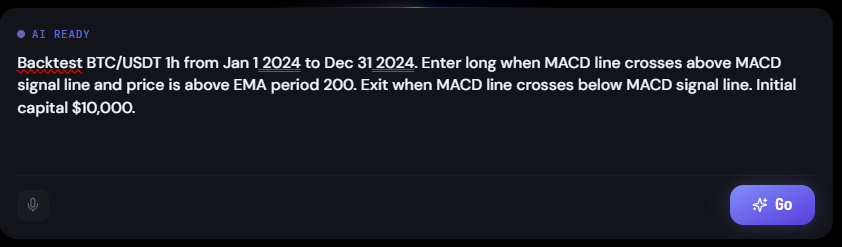
Same strategy. CoinQuant, the no-code AI trading platform. Type this:
Backtest BTC/USDT 1h from Jan 1 2024 to Dec 31 2024. Enter long when MACD line crosses above MACD signal line and price is above EMA period 200. Exit when MACD line crosses below MACD signal line. Initial capital $10,000.
That is it. No code. No syntax errors. No debugging data feeds. The results appear in under 60 seconds:
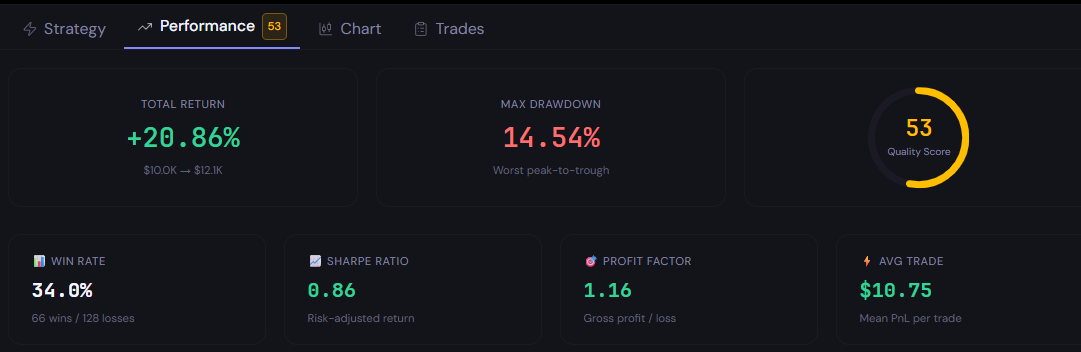
MACD(12/26/9) + EMA(200) trend filter | BTC/USDT 1h | 2024
Total Return: +20.9% ($10,000 to $12,086)
Sharpe Ratio: 0.86 (solid risk-adjusted return)
Max Drawdown: 14.5%
Win Rate: 34% (66% of trades were losses, but winners were larger)
Profit Factor: 1.16
Total Trades: 194
The Iteration Speed Gap
This is where the difference becomes dramatic. A trader testing strategies typically does not stop at the first attempt. You iterate. You tweak parameters. You change indicators. You test across timeframes.
Here is a real example of what that looks like, running the same concept (RSI-based entry) with three variations on CoinQuant, each in under a minute:
Iteration 1: RSI(14) Crosses Above 30, Exit at 70
Return: -1.0% | Win Rate: 51.6% | Max DD: 21.8% | Trades: 31
Verdict: loses money after fees. Do not trade this.
Iteration 2: RSI(14) Drops Below 30, Exit at 50
Return: +1.8% | Win Rate: 62.3% | Max DD: 17.4% | Trades: 61
Verdict: barely profitable. Better, but still not worth the capital at risk.
Iteration 3: MACD(12/26/9) + EMA(200) Trend Filter
Return: +20.9% | Win Rate: 34.0% | Max DD: 14.5% | Trades: 194
Verdict: profitable with manageable drawdown. Worth paper trading next.
Three strategy iterations. Three minutes of typing. In traditional coding, each iteration would mean:
Rewrite 40-60 lines of Pine Script or 100+ lines of Python
Debug syntax errors and logical mistakes
Wait minutes for compilation and execution each time
Context-switch between trading thinking and programming thinking
The no-code workflow keeps you in trading mode. You think about conditions and edge, not semicolons and tracebacks.
The Hidden Costs of Coding Your Own Backtester
Beyond time, coding a backtester introduces risks traders rarely account for:
Data quality bugs: If you code your own backtester, you are responsible for every aspect of the data pipeline: handling gaps, corporate actions, exchange-specific quirks. One mistake in your Pandas DataFrame can produce results that look correct but are completely wrong.
Look-ahead bias: It is surprisingly easy to accidentally use future data in your calculations. A common mistake: calculating an indicator on the entire price series and then backtesting the same series, which leaks future information into historical signals.
Survivorship bias: If you test against a curated list of assets, you are already biased toward what survived. Platforms built for this maintain historical delisted-asset data that most individual coders skip.
Execution realism: Realistic fee models, spread simulation, and slippage estimation require market microstructure understanding that goes far beyond basic Python. Getting these wrong can make an unprofitable strategy look profitable.
CoinQuant uses institutional-grade data (Kaiko for crypto, FMP for traditional assets) with real exchange tick data and realistic execution modeling. That infrastructure work is already done for you.
When Coding Still Wins
No-code is not a replacement for coding in every situation. Here is where traditional coding remains superior:
Ultra-custom logic: If your strategy uses a proprietary indicator or a completely novel signal that no platform supports, custom code is required.
Statistical research: If you need to run advanced statistical tests in a Jupyter notebook, code gives you full control over the analysis.
Production automation: If you are building a trading bot that executes live, you need code. No-code is for research and validation, not live execution.
But here is the honest truth: for 95% of crypto traders testing strategies, none of these apply. The strategies they want to test, MACD crossovers, RSI thresholds, Bollinger Band bounces, moving average systems, are exactly the ones no-code platforms handle natively.
The Bottom Line
No-code backtesting does not replace coding. It replaces the unnecessary coding that was keeping traders from testing their ideas.
If you can describe your strategy in plain English, you can backtest it. In minutes. Against real data. With real fees and slippage. The same strategy in Pine Script would take hours to write and debug. The same in Python would take even longer.
The iteration advantage alone changes how you think about strategy development. You test 10 ideas instead of 2. You kill losers faster and validate winners with more data. That is the actual edge.
Start Testing
Test any strategy in plain English. No code, no Pine Script, real exchange data. ready to start.
Disclaimer:
This content is for educational and informational purposes only and does not constitute financial, investment, or trading advice. All strategies and examples are for illustrative purposes and do not guarantee results. Always conduct your own research before making financial decisions.
