
Kryll Alternative (2026): Backtest-First Strategy Development vs Drag-and-Drop Bots

Kryll has one of the most recognizable strategy builders in crypto automation: a visual, drag-and-drop editor where you connect blocks instead of writing code. If you have searched for a Kryll alternative in 2026, you already know the editor is the draw. The question is what happens after you build: where do you test the strategy, and what does the test actually tell you?
This comparison looks at Kryll as it stands in August 2026 and at what CoinQuant does differently. The two products share a no-code philosophy and diverge on the most important step in the workflow: validation.
What Kryll Actually Is in 2026
Kryll is a drag-and-drop trading bot platform built around a visual strategy editor. You assemble strategies from blocks: price conditions, indicator conditions, order actions, and portfolio rules, connected on a canvas. No programming required.
The ecosystem around the editor includes a strategy marketplace where users publish and rent strategies, portfolio management tools, and a backtesting system. Kryll has been through a product reboot: its AI-assistant line KortexFlow is the new Kryll3 generation, a separate product from the classic platform.
The company also announced KryllOS, an open-source, self-hosted version of the platform where your API keys stay on your own machine. As of August 2026, KryllOS is on a waitlist and has not launched. The classic hosted Kryll platform remains the product users can actually run today.
What Kryll is not, yet, is a research platform. Its backtesting lets you simulate a built strategy, but the product is organized around building and running bots, with validation as one step inside that pipeline.
What CoinQuant Does Differently
CoinQuant is built the other way around. The strategy builder is plain English: you describe the idea in a sentence, and the platform converts it into backtestable rules. The backtest is the product, not a step along the way.
Every CoinQuant backtest runs on institutional-grade Kaiko data from major exchanges, with Bitcoin history back to 2017, and includes trading fees and slippage in the results. The report returns total return, Sharpe ratio, profit factor, max drawdown, win rate, and total trades for every run.
The result is a validation-first workflow. You test an idea, read the full metric report, change one condition, and re-run. Strategy development happens through iteration on evidence, not through assembling blocks and hoping.
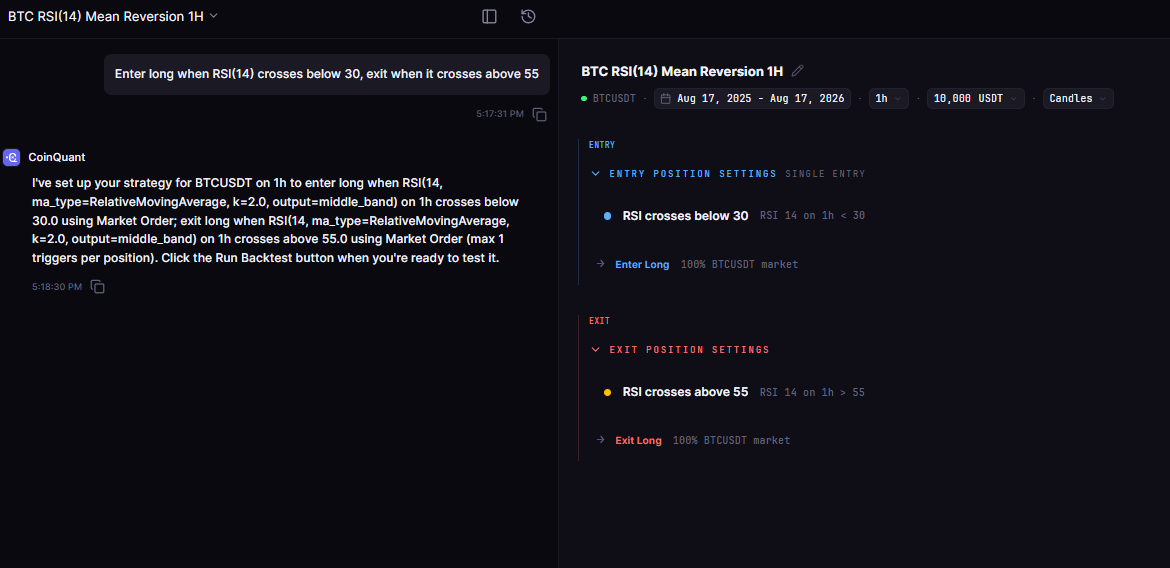
Side-by-Side Comparison
| Dimension | CoinQuant | Kryll |
|---|---|---|
| Strategy building | Plain-English description, AI converts to rules | Visual drag-and-drop block editor |
| Primary focus | Backtesting and strategy validation | Building and running trading bots |
| Backtest metrics | Sharpe, profit factor, max DD, win rate, total return | Basic backtest simulation |
| Data | Kaiko institutional data, BTC back to 2017 | Exchange-connected |
| Fees and slippage | Included in every backtest | Not consistently documented |
| Strategy library | Yes, tested strategies with full reports | Marketplace for renting community bots |
| Quality scoring | Yes (Quality Score per backtest) | No |
| Open-source option | No | KryllOS announced, waitlist, not launched |
| AI assistant | AI builds strategies from text | KortexFlow (Kryll3), separate product line |
The Validation Gap
The practical difference shows up in one question: how do you know the strategy works?
On Kryll, you build the strategy in the editor, then run its backtest to see the result. On CoinQuant, you describe the idea, run the backtest, and read a full statistical report: Sharpe ratio, profit factor, drawdown, win rate, and total trades, with fees and slippage already subtracted.
That report is the difference between knowing a strategy made money and knowing how it made money. Two strategies can have the same total return with completely different risk profiles: one wins often and loses small, the other wins rarely and loses big. The return number alone cannot tell them apart. The full metric set can.
CoinQuant also scores every backtest with a Quality Score that flags results built on too few trades or fragile curves. It is a direct answer to the overfitting problem that bot builders rarely address.
What to Look For in a Kryll Alternative
Whatever tool you evaluate as a Kryll alternative, three capabilities separate a research platform from a bot builder.
A real backtest report. The tool should return more than a profit number: win rate, profit factor, max drawdown, and Sharpe ratio, with fees and slippage in the math.
Comparable iteration. Changing one rule and re-running should produce a new report that sits next to the old one, so you can see what a single change did.
Honest sample sizes. The platform should tell you when a result is built on too few trades to trust, not just when it is profitable.
The deeper structural difference is what happens after the first test.
On a bot platform, a failed backtest sends you back to the block canvas to rearrange the logic by hand, then re-run, then read the new result. Each cycle is manual, and the comparison between attempts is mostly memory: what did the previous version return, and which block change caused it.
On CoinQuant, iteration is the product. You change one condition in the plain-English description, re-run, and read the full metric report again. Because every run returns the same metric set on the same data window, versions are directly comparable: the Sharpe and profit factor of attempt three sit next to attempt two, and the effect of a single change is visible immediately.
That loop is how strategies actually get better. The first version of almost any idea loses money. The versions after it, tuned on evidence rather than intuition, are where the edge appears. A platform that makes the loop fast and the comparisons honest is a platform that produces better strategies.
The Marketplace Difference
Kryll's marketplace is one of its strongest features: traders publish strategies and bots that others can rent or copy, which shortens the path from idea to running bot for beginners. It is a distribution feature as much as a research feature.
CoinQuant approaches sharing differently. Tested strategies live in a strategy library where every entry carries its full backtest report: the metrics that produced the result are visible alongside the rules. When a strategy is shared or reused, the evidence travels with it.
That difference matters for trust. A marketplace bot shows you what it does. A library strategy shows you what it did, with the fees subtracted and the drawdowns visible. The second is a much stronger basis for deciding whether to run something with your capital.
Who Should Use Which
Kryll is a reasonable fit if your goal is automated execution with a visual builder, you want access to a marketplace of community bots, or you are comfortable testing ideas inside the bot pipeline.
CoinQuant is the better fit if your goal is to validate a strategy before you commit to running it, you want full metrics on every test, or you iterate across many ideas and need fast, comparable evidence.
A useful test: write down your trading idea in one sentence. If the next step is choosing blocks, Kryll's editor fits. If the next step is a backtest report with Sharpe and profit factor, CoinQuant fits.
The Bottom Line
Kryll is a legitimate drag-and-drop bot platform, and its editor remains one of the most approachable in crypto. The KryllOS self-hosted vision is ambitious, but it is not available yet.
For traders who want to test strategies before running them, CoinQuant is the more complete answer. The plain-English builder, institutional data, fee-inclusive backtests, and full metric output cover the whole validation cycle, and CoinQuant offers a free trial for strategy research and backtesting. That is the reason traders searching for a Kryll alternative in 2026 end up comparing builders and research platforms: they are different jobs, and the research job needs a research tool. The same conclusion holds against other bot-first platforms, as our WunderTrading comparison shows.
Disclaimer:
This content is for educational and informational purposes only and does not constitute financial, investment, or trading advice. All strategies and examples are for illustrative purposes and do not guarantee results. Always conduct your own research before making financial decisions.
