
Crypto Strategy Automation Platforms: Honest Reviews (2026)

Every platform that lets you automate a crypto trading strategy makes the same general promise: set up your rules, let the bot run, and remove the emotion from your trading.
The gap between that promise and the reality depends almost entirely on one thing: can you actually backtest the strategy before you run it live?
This review covers the major crypto strategy automation platforms traders are evaluating in 2026, with a focus on what each platform does well, what it does not, and how each one handles the backtesting question.
What to Look for in a Crypto Automation Platform
Before comparing specific platforms, the evaluation criteria matter. A checklist for any automation platform:
Backtesting capability: can you test a strategy against historical data before deploying it live?
No-code access: can you build a strategy without writing Python, Pine Script, or any code?
Data quality: is the historical price data from a reliable source? How far back does it go?
Exchange connectivity: which exchanges does the platform connect to, and at what fee tier?
Transparency: does the platform show you what the strategy is doing and why?
Cost: what does it actually cost to run a strategy, including platform fees and exchange fees?
With those in mind, here is what the main platforms look like in 2026.
Platform Reviews
CoinQuant
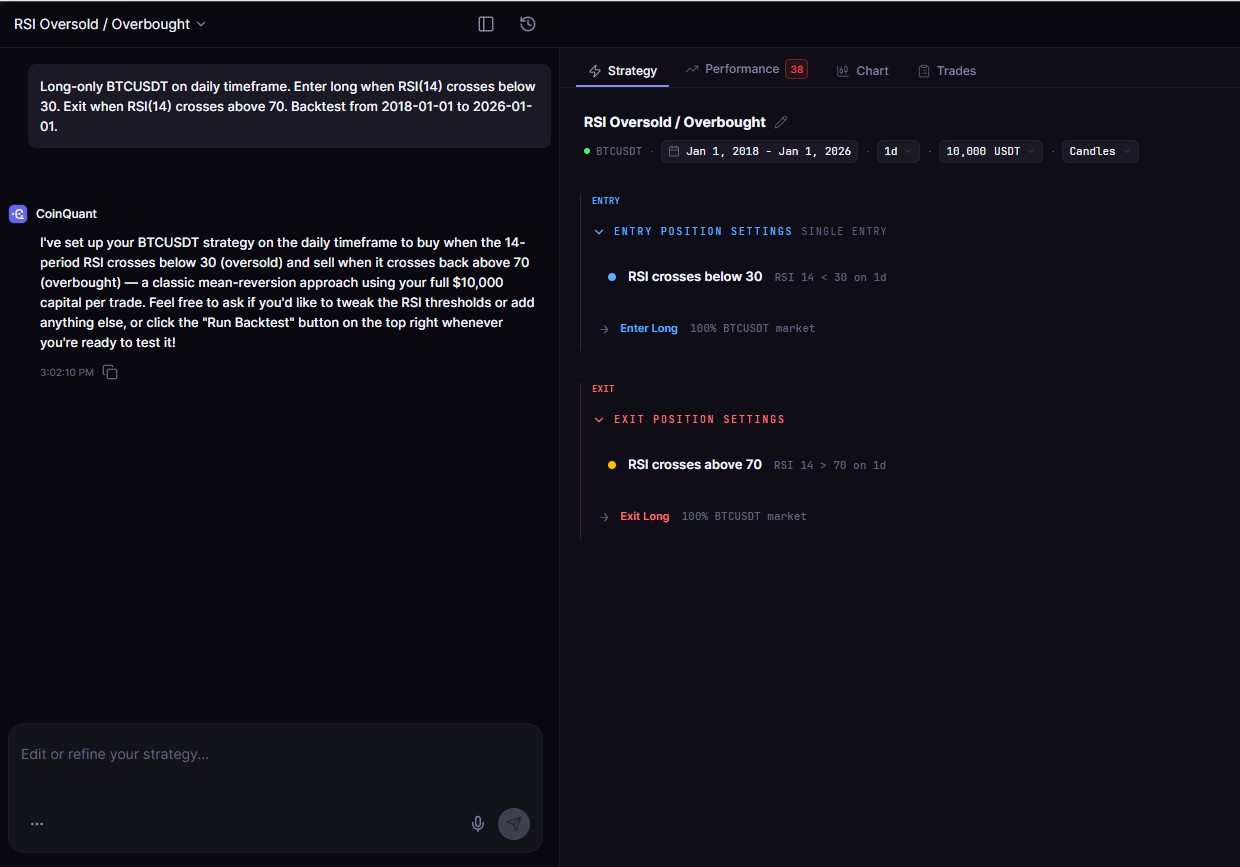
CoinQuant is built around backtesting first. The core workflow is: describe or build a strategy, run it against real historical data (Kaiko institutional feed, back to 2017 for Bitcoin), verify the results, and then decide whether to deploy. For current plan details and pricing, visit coinquant.ai/pricing.
The strategy builder requires no code. Conditions are set in plain English through a visual interface, and the AI layer allows natural-language strategy input: describe a strategy in a sentence and the platform converts it into a testable schema.
What it does well:
No-code strategy builder with AI input
Multi-condition strategies with multiple indicators and timeframes
Institutional-quality data (Kaiko) covering Binance, Coinbase, Kraken, and others
Full backtest results: return, win rate, max drawdown, equity curve, trade log
What to consider:
Focused on crypto (not stocks or forex)
Newer platform relative to some legacy tools
Cryptohopper
Cryptohopper is one of the longest-running crypto automation platforms. It connects to a wide range of exchanges and supports template-based strategies, social trading (copying other traders' signals), and a marketplace for buying signal subscriptions.
What it does well:
Large ecosystem of pre-built strategy templates and signal providers
Wide exchange support
Long track record in the market (launched 2017)
What to consider:
Backtesting is available but limited in depth compared to dedicated backtesting tools
Strategy logic is primarily based on indicator signals rather than rule-based conditions
Pricing involves multiple tiers plus signal subscription costs
3Commas
3Commas built its reputation on "Smart Trading" features: trailing take-profit orders, DCA (Dollar Cost Averaging) bots, and grid trading bots. Its interface is designed for traders who want preset bot types rather than fully custom strategy logic.
What it does well:
Easy setup for DCA bots and grid trading
Trailing stop features
Wide exchange connectivity
What to consider:
Limited custom strategy logic: you choose a bot type rather than define entry and exit conditions
Backtesting is basic; not designed for testing arbitrary strategy logic
Grid bots and DCA bots have performed differently in different market regimes
September 2026 note: 3Commas’ v1 deactivation should be part of any 2026 review. Users moving toward v2 built with WunderTrading do not get automatic strategy transfer, so the platform is also a rebuild and validation decision for existing users.
Coinrule
Coinrule targets non-technical users with a rule-based "if this, then that" interface for crypto automation. The appeal is simplicity: set a condition (RSI below 30), set an action (buy 10% of BTC), and the bot executes when the condition is met.
What it does well:
Very accessible interface for non-coders
Multiple strategy templates to start from
Good for beginners testing rule-based automation
What to consider:
Backtesting capability is limited; it is more of a simulation than a full historical backtest
No institutional-grade data feed for backtest accuracy
Scaling beyond simple rules requires a higher-tier plan
Head-to-Head Comparison
| Feature | CoinQuant | Cryptohopper | 3Commas | Coinrule |
|---|---|---|---|---|
| Backtesting depth | Full (historical, Kaiko data) | Limited | Basic | Limited |
| No-code strategy building | Yes (AI + visual) | Partial (templates) | No (bot types) | Yes (if/then rules) |
| Custom multi-condition strategies | Yes | Limited | No | Limited |
| Data source quality | Institutional (Kaiko) | Varies by exchange | Varies | Varies |
| Crypto-native | Yes | Yes | Yes | Yes |
| Exchange support | Major exchanges | Very wide | Very wide | Major exchanges |
| AI strategy input | Yes | No | No | No |
The Backtesting Gap
The clearest difference between platforms in 2026 is how seriously each one treats backtesting.
Platforms built primarily for automation (3Commas, Cryptohopper) treat backtesting as a secondary feature. They are designed to run a bot, not to verify whether that bot's logic would have worked historically.
CoinQuant is built around the backtest as the primary step. The logic: you should not run a strategy live until you know what it would have done on real historical data. That ordering, test first, deploy second, is the fundamental design choice that separates the platforms.
For traders who have experienced the cost of running an untested strategy live, that distinction matters a great deal.
How to Evaluate Any Automation Platform
Before committing to any platform, run this test:
Build the simplest version of a strategy you want to run (e.g., RSI oversold entry, RSI overbought exit)
Backtest it on at least two years of BTC daily data
Look at the total return, win rate, max drawdown, and equity curve
If the platform cannot produce those results, you are flying blind
The strategy's live performance starts with the backtest. A platform that skips or limits that step is not equipped to tell you whether your idea works. Automation without validation is just faster speculation.
The Bottom Line
The 2026 landscape for crypto strategy automation has matured, but the quality gap between platforms is still wide on the backtesting dimension.
For traders who want to understand whether a strategy works before deploying it, the evaluation starts with data quality and backtest depth. Platforms that automate first and validate second carry a hidden cost: the live losses from strategies that would have shown poor results in testing.
Disclaimer:
This content is for educational and informational purposes only and does not constitute financial, investment, or trading advice. All strategies and examples are for illustrative purposes and do not guarantee results. Always conduct your own research before making financial decisions.
