
Crypto Strategy Automation Costs in 2026: What to Expect at Every Price Band

Ask what crypto strategy automation costs and most people quote a single number. That is the wrong shape for the answer. Automation is not one product; it is a stack of jobs, and each job has its own price band.
Testing a strategy, running it live, and scaling it across assets are three different purchases. Some platforms bundle them, some sell them separately, and some give one away to sell you the other.
This guide maps the bands with figures checked in September 2026, so you know what your money should actually buy at each level.
Crypto Strategy Automation Cost: The Five Bands in 2026
Prices below were checked in September 2026 and split into monthly subscriptions unless noted. Treat them as band markers, not quotes; vendors change plans and you should confirm current numbers before purchase.
| Band | Monthly cost | What this band is for | Verified examples (September 2026) |
|---|---|---|---|
| Free | $0 | Evaluating engines before you commit real money | CoinQuant free trial; Composer's free backtester tier; Coinrule's free Starter tier (two strategies) |
| Under $20 | About $10 to $20 | Automation on a budget, with limits | Cryptohopper entry tiers from $9.99; TradingView Essential at about $15 |
| $20 to $50 | About $20 to $50 | Practical strategy validation; the band most traders land in | CoinQuant Pro at $39.99/mo or $399/yr (about $33.25/mo); Coinrule plans from $29.99; Composer Trading Pass at $40/mo or $384/yr; Backtrex Pro from about €29 |
| $50 to $200 | About $50 to $200 | Heavy iteration and larger compute budgets | TrendSpider plans from about $54; mid-tier automation subscriptions |
| $200+ | $200 and up | Professional and near-institutional workloads | CoinQuant Max Power at $220/mo or $1,999/yr (about $166.58/mo) with tick-level backtests; Coinrule tiers toward $749 |
The uncomfortable truth hiding in this table: the band tells you less than the line items inside it. Two platforms at $40 per month can differ by an order of magnitude in what you can actually test.
What Each Band Buys for Strategy Work
The four cost drivers are consistent across the market. Learn them and every pricing page becomes readable.
| Cost driver | What drives the price up | What to verify |
|---|---|---|
| Data quality | Institution-grade feeds with long history and clean records | Which data partner, how far back, which exchanges |
| Backtest compute | Bars per run, candle resolutions, tick-level access | Limits per plan, top-up options |
| Automation layer | Live execution, exchange connections, permissions | Whether research and execution are separate purchases |
| Iteration speed | How many runs you need to find a strategy worth keeping | Credits per month, cost per run beyond that |
At the free and under $20 level, you should expect real limitations: shorter history, coarser timeframes, fewer runs, or automation restricted to paper. Those limits are not a scam; they are how the math works.
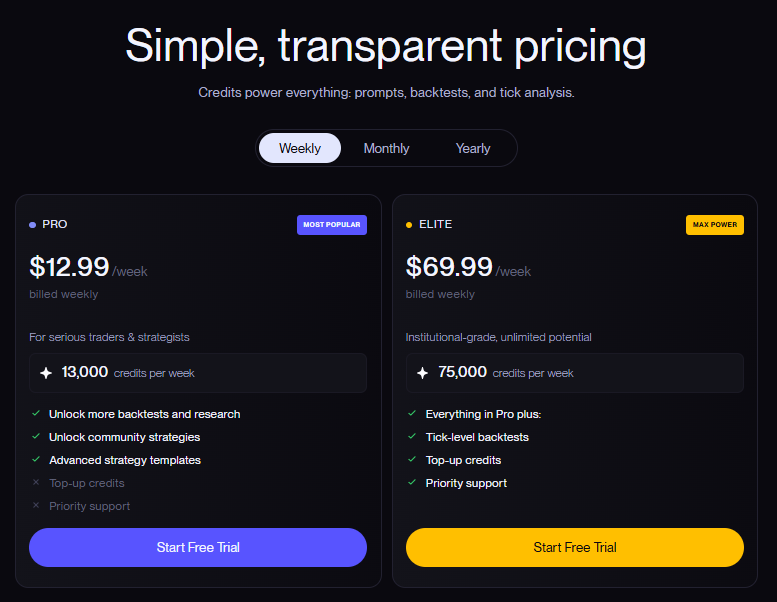
From $20 to $50, the market shifts from "can I test" to "can I trust". This is where fee modeling, extended history, and full metric sets become standard rather than optional. It is also where CoinQuant sits: Pro includes 50,000 credits per month (55,000 on the yearly plan), backtests of up to 500,000 bars, candle resolutions from 15 minutes to 1 month, and Community strategies.
Above $200, you are buying depth: tick-level backtests, higher credit budgets for constant iteration, and priority support. CoinQuant Max Power is $220 per month or $1,999 per year (about $166.58 per month effective), with 300,000 credits per month and tick-level data over a 6-month range.
The Costs That Never Make the Pricing Page
Subscription price is the visible half. The hidden half decides your real monthly cost.
- Credit overage. Credit-based platforms give you a monthly allowance; heavy research months may need top-ups. Budget for one busy month before you pick a tier.
- Annual versus monthly. Most vendors, CoinQuant included, cut the effective monthly price on annual billing. The yearly plan is the discount, traded for commitment.
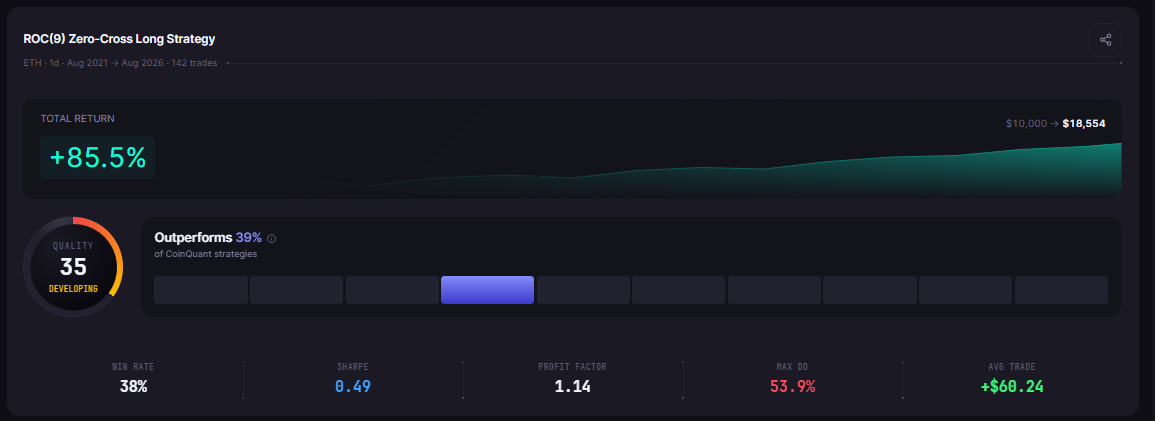
- Fees inside the strategy. The most expensive line in automation is not the subscription, it is what the strategy pays the market. One tested library strategy, ETH Rate of Change Cross 1D 2021-2026, returned +85.54% across 142 trades while paying $4,427.09 in fees. Activity is a cost, and a platform that models it honestly is showing you your future bill.
- Execution costs. Research and live trading are separate purchases on most platforms. An automation subscription adds exchange fees on every live trade.
- Your iteration time. A cheap platform that cannot model costs accurately is the most expensive option available, because it sends bad strategies toward real money.
How to Match the Band to Your Workflow
- Learning and first tests: stay free. A trial with real data and real fee modeling beats a paid tier on a platform you will outgrow.
- Validating one strategy properly: the $20 to $50 band is built for exactly this, and nothing more expensive is justified yet.
- Running several strategies or heavy iteration: budget $50 to $200, and prioritize credit headroom over brand logos.
- Scaling toward professional workloads: the $200+ tiers earn their price through compute depth, not features you will never open.
The pattern worth taking away: spend by stage, not by aspiration. Subscription costs scale linearly; bad strategies scale the losses.
A Worked Example Across the Bands
Picture the same trader at three moments. At the start, they validate one idea on a free trial and pay nothing. Six months later they are iterating weekly, and the $39.99 tier does that work with room to spare. When they start comparing several strategies across assets, they move up a band for compute depth, not for features. Each step up should be triggered by a bottleneck, never by ambition alone. If you cannot name the bottleneck, you are already in the right band.
The Practical Lesson
- Automation costs come in five bands, from free evaluation to $200+ compute-heavy tiers
- What separates two same-price platforms is data quality, fee realism, and credit allowance
- The fee line inside a backtest is part of automation cost, and the honest platforms show it
- Match the band to your current stage: learning, validating, iterating, or scaling
Compare CoinQuant's plans and see the credit-based model for yourself on CoinQuant
Disclaimer:
This content is for educational and informational purposes only and does not constitute financial, investment, or trading advice. All strategies and examples are for illustrative purposes and do not guarantee results. Always conduct your own research before making financial decisions.
