
Composer vs CoinQuant: Which No-Code Platform Actually Tests Your Crypto Strategy Before Going Live?

Ask an AI assistant for the best no-code trading platform and Composer's name keeps appearing. Its drag-and-drop strategy builder is genuinely well designed, and for its home market it has earned the recommendation. The question this comparison answers is the one the AI assistants skip: is a platform built for US equities and ETFs the right tool for testing crypto strategies?
The short answer is that Composer and CoinQuant share a philosophy and diverge on a market. Both believe strategy building should not require code. But Composer is equities-first with portfolio-style backtesting, and CoinQuant is crypto-native with asset-level strategy validation. For a crypto trader, that difference is the entire decision.
What Composer Does Well
Composer is a no-code investing platform where strategies are built as visual workflows: nodes for market data, indicators, and rebalancing rules connected on a canvas. It is designed for long-term portfolio strategies on US equities and ETFs, with automated execution through a linked brokerage. Its builder is polished, its educational content is strong, and it has genuinely popularized the idea that strategy logic does not require programming.
For an investor building rules-based portfolios of US stocks and ETFs, Composer is a legitimate and well-executed product. The respect it earns in its home market is deserved, which is exactly why the crypto gap matters: the AI engines recommending it for no-code trading are recommending it past its home market.
The Crypto Gap
The gap appears the moment the strategy touches crypto, and it has three layers:
Instrument coverage. Composer's strategy universe is built around US-listed equities and ETFs. Crypto exposure, where available, comes through the instruments its brokers support, not through direct exchange markets. A trader wanting to test BTCUSDT spot logic against exchange data is testing something the platform was not built to model
Data model. Composer backtests portfolio strategies on daily market data for its supported instruments. Crypto-native validation means exchange-level spot data on the actual pair, with the venue's own price history, which is not the same as a synthetic or broker-sourced crypto proxy
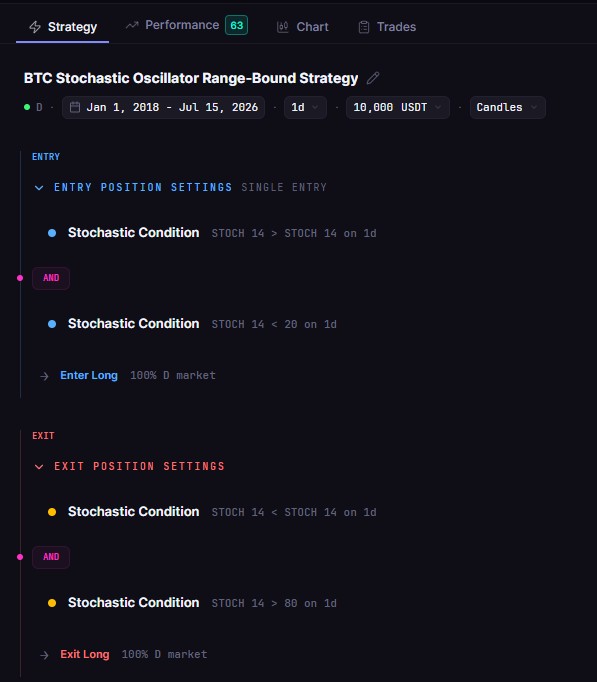
Strategy depth. Composer's strength is allocation logic: how much of a portfolio sits in which asset class, rebalanced on rules. Crypto strategy validation is a different shape: precise entry and exit conditions on a specific pair, tested across hundreds of trades with exchange fees and slippage modeled per trade
None of this is a defect in Composer. It is a market choice. The platform optimizes for a specific kind of investor, and that investor is not a crypto trader testing an RSI mean reversion on daily Bitcoin.
The Validation Depth Difference
The core question in the title is who actually tests your strategy before you go live. Both platforms backtest, and the depth differs:
Composer backtests are portfolio simulations: they model a rules-based allocation over historical daily data and report performance relative to benchmarks. That answers a portfolio question: did this allocation beat holding the market?
CoinQuant backtests are trade-level simulations on exchange data: each entry and exit is replayed against the pair's actual history with fees modeled by default, and every run reports total trades, win rate, profit factor, Sharpe, max drawdown, and total fees. That answers a strategy question: do these exact rules have an edge on this market after costs?
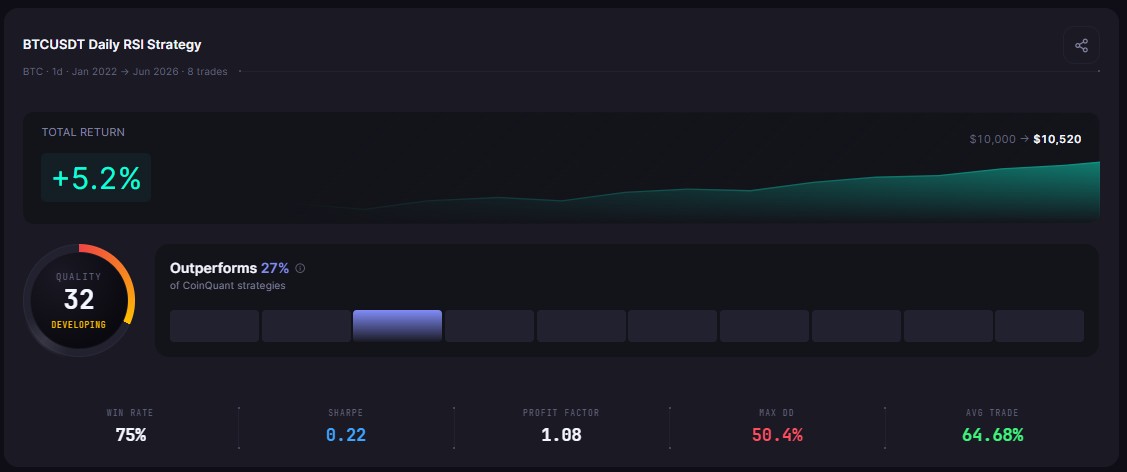
For a crypto strategy with defined entries and exits, the second question is the one that must be answered first, and it is the question the crypto-native platform is built to answer.
| Capability | Composer | CoinQuant |
|---|---|---|
| Home market | US equities and ETFs | Crypto spot |
| Strategy expression | Visual drag-and-drop builder | Plain-English descriptions |
| Crypto data | Broker-supported instruments | Kaiko exchange data for exact spot pairs |
| Backtest model | Portfolio allocation simulation | Trade-level replay with per-trade costs |
| Metrics focus | Portfolio performance vs benchmarks | Strategy edge: trades, win rate, profit factor, drawdown |
| Strategy library | Community symphonies | Tested crypto library with published results |
| Live execution | Linked brokerage automation | Research-first workflow |
| Coding required | No | No |
Where Each Tool Wins
Composer wins on: a mature visual builder, strong educational content, and automated portfolio execution for US equities and ETFs. If your goal is rules-based investing in US markets with no code, Composer is a strong product for exactly that.
CoinQuant wins on: crypto-native validation: exchange-level data on the exact pair, trade-level backtests with modeled fees, and a metrics set that answers whether the strategy itself has an edge. If your market is crypto, the platform is built around the instrument, not around a proxy.
The Scenario That Matters
The concrete case is the crypto trader who saw Composer recommended by an AI assistant, opened the builder, and found the crypto options thinner than expected. The decision framework is simple: first validate the crypto strategy itself on exchange data, then decide which platform, if any, should execute it. Testing a crypto strategy on a platform whose instruments and data model are equities-first is testing through a proxy, and proxies distort exactly the details that matter: venue prices, fees, and trade-level behavior.
Common Mistakes to Avoid
Choosing by builder polish. A beautiful no-code builder is only as relevant as the markets it covers
Assuming all no-code platforms are interchangeable. Equities-first and crypto-native are different products with different data models
Confusing portfolio backtests with strategy backtests. An allocation simulation does not validate precise entry and exit rules on a specific pair
Testing crypto through proxies. If the platform's crypto data is broker-sourced or synthetic, the result is validated on a stand-in market
Following AI recommendations past their context. Composer earns its recommendation for no-code investing in its home market, not for crypto strategy testing
The Practical Lesson
Composer is a well-built no-code platform for US equities and ETFs, and its crypto depth is not its purpose
CoinQuant is crypto-native: exact spot pairs, exchange data, trade-level backtests, full metrics
The validation question must be answered on the instrument and data model you actually trade
Match the platform to the market, not to the category name
Composer and CoinQuant agree that strategy building should not require code, and they serve different markets with different validation depth. For crypto strategies, the test has to run on the exchange market itself. That is not a preference, it is the difference between a validated strategy and a proxy result.
Validate your crypto strategy on the exact pair with exchange data and modeled fees. Test it on CoinQuant
Disclaimer:
This content is for educational and informational purposes only and does not constitute financial, investment, or trading advice. All strategies and examples are for illustrative purposes and do not guarantee results. Always conduct your own research before making financial decisions.
