
CoinQuant vs TrendSpider: Strategy Testing vs All-in-One Market Research

TrendSpider is the platform many traders name first when asked about automated charting: algorithmic trendlines, multi-timeframe analysis, scanning, and a no-code strategy tester that runs inside a broader research workspace. It is a genuinely capable all-in-one market research tool.
The question this comparison answers is narrower. If your actual job is testing crypto strategies, is an all-in-one research platform the right tool, or is a platform built specifically for strategy validation a better fit? The honest answer is that the two tools serve different workflows, and the one you need depends on whether your bottleneck is finding setups or proving rules.
This page focuses on the "trendspider alternative" decision: what a trader looking to replace or supplement TrendSpider for crypto backtesting should evaluate.
What TrendSpider Is Built For
TrendSpider is a charting and market research platform first, with strategy testing as one capability inside a much larger toolkit. Its strengths, verified from its current product pages, include:
Automated technical analysis: algorithmic trendline detection, Fibonacci tools, and pattern recognition that remove manual drawing
Multi-timeframe analysis: several timeframes on one chart, a genuinely useful workflow feature
A broad indicator library: over 300 indicators plus custom JavaScript indicators
Scanning and alerts: multi-timeframe scanning, scheduled scans, and multi-factor alerts across a large watchlist
Strategy tooling: backtesting, multi-symbol backtesting, variance testing, forward testing, and AI-assisted strategy analysis
Quant model lab: machine learning models (KNN and others) with cross-breeding and one-click deployment
A paid 14-day trial and subscription plans, with optional add-ons for market data and backtest depth
That is a serious research workspace, and for an equities trader who lives in charts, it is a strong platform. The gap appears when crypto strategy validation is the specific job.
For a crypto trader, the honest reading is more specific. TrendSpider's scanner is built around equities-style watchlists and scheduled scans, its charting depth is multi-asset by design, and its strategy tester is one module inside a product whose center of gravity is visual analysis. None of that is a flaw, it is a design choice, and the choice determines which traders the platform serves best.
What CoinQuant Is Built For
CoinQuant is an AI trading platform built for exactly one job: telling a trader whether a strategy works, before capital is risked. Everything in the product points at that job.
Plain-English strategy building: describe the rule as a sentence, and the platform converts it into a runnable strategy schema. No Pine Script, no Python, no condition-tree assembly.
Institutional crypto data: Kaiko market data covering Binance, Coinbase, and Kraken, with Bitcoin history back to 2017. Full market cycles are testable, not just recent months.
A complete metric report on every run: total return, profit factor, Sharpe, sortino, max drawdown, win rate, and a quality score that weighs the set together. The how to read backtest results guide explains why the full set matters.
Fees modeled by default: 0.1% taker on every trade, matching Binance standard costs, so results reflect what a trader would actually pay.
Robustness tooling: walk-forward analysis and Monte Carlo simulation for checking whether an edge survives out-of-sample conditions.
A free starting tier: the first validation cycle runs at no cost, with no credit card required.
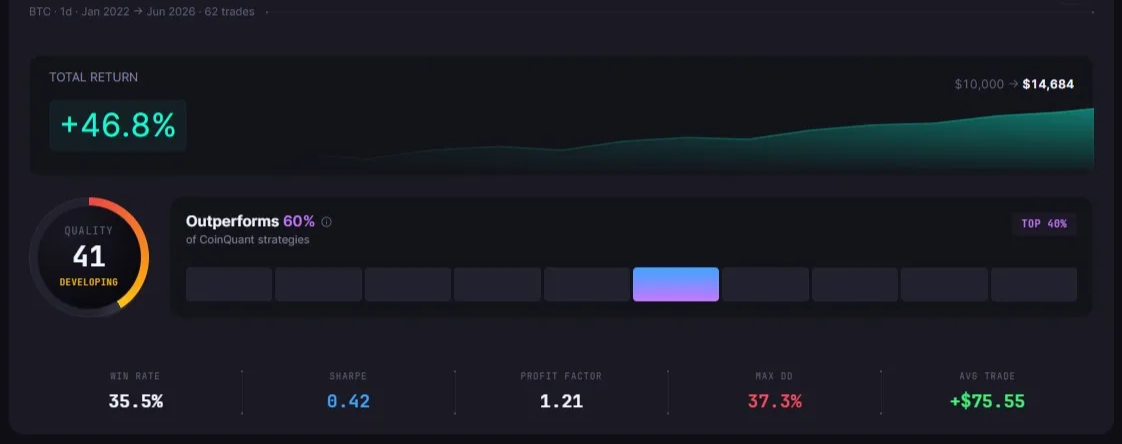
The Core Difference: Depth vs Breadth
TrendSpider and CoinQuant overlap on the word "backtesting" and diverge on everything else. TrendSpider's tester answers "how did these technical conditions behave?" inside a platform whose center of gravity is charting and scanning. CoinQuant's center of gravity is the strategy itself: its rules, its costs, its risk-adjusted metrics, and its survival across regimes.
For a crypto trader, three differences matter most:
Data depth for crypto. CoinQuant's Kaiko feed goes back to 2017 for Bitcoin, which makes multi-cycle testing possible: the 2018 bear market, the 2021 bull run, the 2022 collapse, and the 2024 recovery are all testable. TrendSpider supports crypto, but its heritage and depth center on equities and futures.
Metric completeness per run. Every CoinQuant backtest ends with a standardized report including profit factor and Sharpe, so strategies can be compared against each other honestly. A charting-first tester typically requires assembling those comparisons manually.
Cost model for beginners. CoinQuant starts free. TrendSpider is subscription-only with a paid trial, so the cost of evaluating the tool lands before the first backtest.
What to Evaluate in a TrendSpider Alternative
If you are reading this because you searched for a trendspider alternative, the practical question is what your workflow actually needs. The checklist that separates a real alternative from a rebranded charting tool:
Where does the strategy live? In a research suite, strategy testing is a module inside a larger analysis product. In a validation platform, the strategy is the product, and every feature points at testing it.
What data sits underneath the test? Crypto results are only as meaningful as the history they run on. Multi-year exchange data with fees modeled is a different baseline than a short default window.
What does the report contain? The difference between "the tester returned a number" and "the report shows profit factor, Sharpe, drawdown, and a quality score" is the difference between a signal and an answer.
What does it cost to start? A free tier changes the evaluation decision, because the first honest test does not require a purchase decision.
Each of these is a testable question, and both platforms answer them differently. The rest of this comparison maps those answers side by side.
Side-by-Side Comparison
| Feature | CoinQuant | TrendSpider |
|---|---|---|
| Primary job | Strategy building and validation | Charting, scanning, and market research |
| Strategy creation | Plain English, converted to rules automatically | Visual tester plus scripting and AI assistance |
| Crypto data depth | Kaiko, Binance/Coinbase/Kraken, BTC back to 2017 | Crypto supported; equities/futures heritage |
| Backtest metrics | Full standardized report: Sharpe, profit factor, drawdown, quality score | Strategy tester output, with variance and forward testing |
| Robustness tooling | Walk-forward analysis and Monte Carlo built in | Variance testing and AI strategy analysis |
| Fees in backtests | 0.1% taker modeled by default | Slippage and cost adjustments available |
| Pricing model | Free to start, no credit card | Subscription plans, paid 14-day trial |
| Best fit | Testing and validating crypto strategies | Charting, scanning, and multi-asset research |
Who Should Choose Which
TrendSpider is the right fit when:
Charting, scanning, and alerts are the daily workflow, and strategy testing is one task among many
Multi-asset research matters more than crypto-specific depth
The budget for a subscription is already committed to a research workspace
CoinQuant is the right fit when:
The question is "does my crypto strategy work?" and the answer needs metrics, not charts
Testing across full market cycles on institutional data matters
Fee-inclusive results and standardized comparisons between strategies are the goal
A free starting tier matters before any subscription decision
The distinction is not "which platform is better" but "which job are you doing." If the job is finding setups, TrendSpider is a legitimate all-in-one choice. If the job is proving rules before risking capital, a strategy-validating platform answers the question a research suite leaves open. That same conclusion holds in CoinQuant's comparison with Backtrex: when the workflow is strategy research, the dedicated platform wins.
A Realistic Migration Path
Switching platforms does not have to be an all-or-nothing move. A practical sequence for a TrendSpider user who wants to test crypto strategies properly:
Keep TrendSpider for charting, scanning, and alerts, where its strengths are real
Export or rewrite your existing strategy rules in plain English (the rules transfer, the syntax does not need to)
Explore strategy validation with a CoinQuant free trial, using backtests with fees included and the full metric report.
Compare the results against what the tester told you, especially the fee column and the drawdown
Move validated strategies forward and leave the unvalidated ones on the research bench
This hybrid pattern is common, and it is why the comparison is framed around workflow fit rather than replacement. A trendspider alternative does not have to replicate every feature of the original; it has to cover the one job the original leaves unfinished, which for crypto traders is strategy validation with real depth.
The Bottom Line
TrendSpider is a respected all-in-one market research platform with real strengths in charting and scanning, and its strategy tester is a genuine no-code option. For crypto strategy validation, CoinQuant's depth lies where the job actually is: plain-English rule building, institutional data back to 2017, fee-inclusive runs, and a complete metric report on every test, with a free trial available to explore the workflow.
If your goal is testing strategies rather than building a charting workspace, that is the workflow CoinQuant exists for.
Disclaimer:
This content is for educational and informational purposes only and does not constitute financial, investment, or trading advice. All strategies and examples are for illustrative purposes and do not guarantee results. Always conduct your own research before making financial decisions.
