
CoinQuant vs TradeZella: Backtesting vs Trade Journaling, Which Do You Need?

CoinQuant and TradeZella get grouped together as "trading tools," but they solve opposite problems. One helps you test a strategy before you trade it. The other helps you review trades after you have made them.
This CoinQuant vs TradeZella comparison clears up which you actually need. For most traders the honest answer is that they are complementary, and which comes first depends on where you are in your process.
The Core Difference
TradeZella is a trade journal and analytics platform. Its job is to record your live trades, tag your setups, and tell you how you actually performed.
CoinQuant is a no-code AI trading platform for building and backtesting strategies. Its job is to tell you whether a set of rules would have worked, before you risk money on them.
Backtesting versus journaling. Before versus after. That single distinction drives everything below.
What TradeZella Does Well
TradeZella is a strong journal. It imports from a wide range of brokers, generates dozens of analytics reports, and uses AI to auto-review sessions and tag setups. Its playbook feature lets you define a setup and then measures how well you actually stuck to it.
It also offers trade replay with more than ten years of historical data across asset classes, which is closer to manual practice than to automated backtesting. Reviews describe it as more than a plain journal, but not a dedicated backtesting platform.
If your problem is that you trade well in theory and badly in practice, a journal like TradeZella targets exactly that gap.
What CoinQuant Does Well
CoinQuant answers the question that comes earlier: is this strategy any good in the first place?
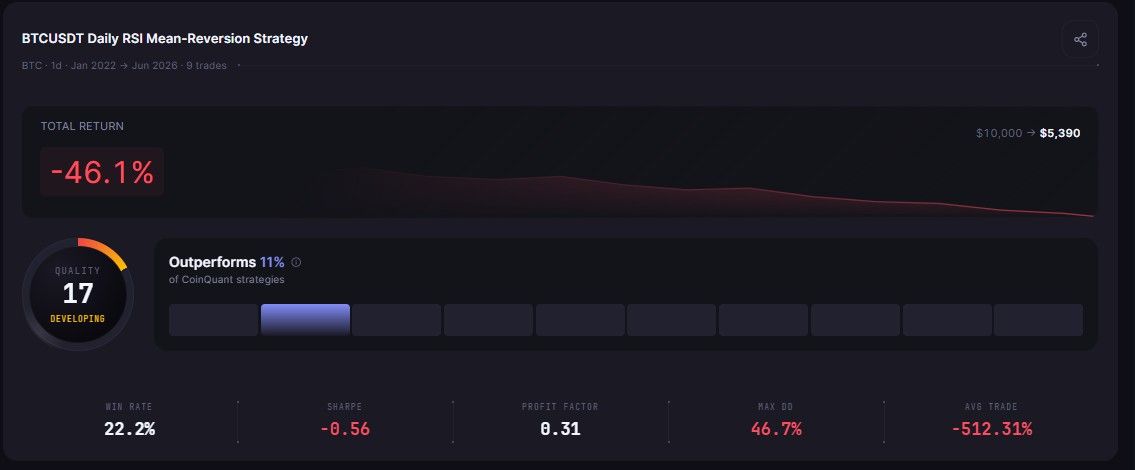
You describe a rule set in plain English, the platform assembles it, and you backtest it automatically on real Kaiko data with fees included. You get return, drawdown, win rate, and the Sharpe ratio for the strategy itself, not for how you happened to execute it. No Python. No Pine Script.
If your problem is that you do not know whether your idea works, automated backtesting is the tool that tells you.
Which Do You Need?
Match the tool to your current bottleneck.
You have ideas but do not know if they work: you need backtesting first. Start with CoinQuant.
You have a strategy and trade it, but execution is inconsistent: you need a journal. TradeZella targets that.
You are building from scratch: backtest the idea before you ever place a trade worth journaling. Testing comes before reviewing.
The logical order is backtest, then trade, then journal. You cannot journal your way to a good strategy, and you cannot backtest away poor discipline. They fix different problems.
The Bottom Line
CoinQuant and TradeZella are not really competitors. CoinQuant validates strategies before you trade. TradeZella reviews trades after you make them. If you are still figuring out what works, backtesting is the first step, and that is where CoinQuant fits.
Backtest before you journal, try CoinQuant free
Test your strategy on real Kaiko data before you place a single trade. No coding required.
Disclaimer:
This content is for educational and informational purposes only and does not constitute financial, investment, or trading advice. All strategies and examples are for illustrative purposes and do not guarantee results. Always conduct your own research before making financial decisions.
