
CoinQuant vs PRUVIQ: Free Backtesting vs Institutional Validation Depth

PRUVIQ is the free backtester with the most aggressive honesty branding in crypto: "Don't Believe. Verify." is its homepage slogan, and it publishes its failures in a public ledger. No signup, no subscription, and a strategy builder that runs across more than 230 coins with real fees. That combination has made it a name reviewers increasingly cite when the topic is free crypto backtesting.
CoinQuant approaches the same job from the other direction: institutional-grade data depth and validation tooling, with a free trial and paid plans for continued use. This comparison looks at what each platform actually delivers for a trader whose goal is knowing whether a strategy works, using only facts verified from both products on August 12, 2026.
What PRUVIQ Delivers
PRUVIQ is a free, no-signup crypto strategy backtesting platform. Its verified feature set, from its live site, includes:
Free, with no account required: no subscription, no email, no credit card, for the core backtesting features
Broad asset coverage: more than 230 coins tested simultaneously in a single run
Historical depth: over two and a half years of data (roughly 960 trading days, around four million candles), powered by OKX Futures and CoinGecko data
A no-code visual builder: 14 technical indicators with AND/OR logic and comparison operators, plus 26+ builder presets
Realistic costs: real fees, slippage, and funding costs included in simulations
Risk controls in the builder: stop loss, take profit, leverage, and time filters
Speed: results across all coins in about three seconds
A published failure ledger: its own strategies are tested and published with results including failures, currently 15+ strategies spanning verified, testing, and retired statuses
Automated execution: an optional autotrading layer that connects to OKX with trade-only permissions and scans every five minutes
That is a genuinely strong free product. The transparency angle is real: publishing its own killed strategies is a credibility move most platforms never make.
One thing PRUVIQ does not claim is worth noting: there is no AI strategy generation. Its builder is visual and preset-based, which suits traders who already know their rules. There is also no institutional-grade data layer; its history is exchange and aggregator data (OKX Futures and CoinGecko) rather than a full multi-exchange institutional feed. Those are not criticisms of a free product, they are the boundaries that define where its depth ends.
What CoinQuant Delivers
CoinQuant is an AI trading platform whose core job is strategy validation with depth. Its verified feature set includes:
Plain-English strategy building: describe the rule as a sentence, and the platform converts it into a runnable strategy schema, including multi-timeframe and multi-condition logic
Institutional data: Kaiko market data covering Binance, Coinbase, and Kraken, with Bitcoin history back to 2017, spanning full market cycles
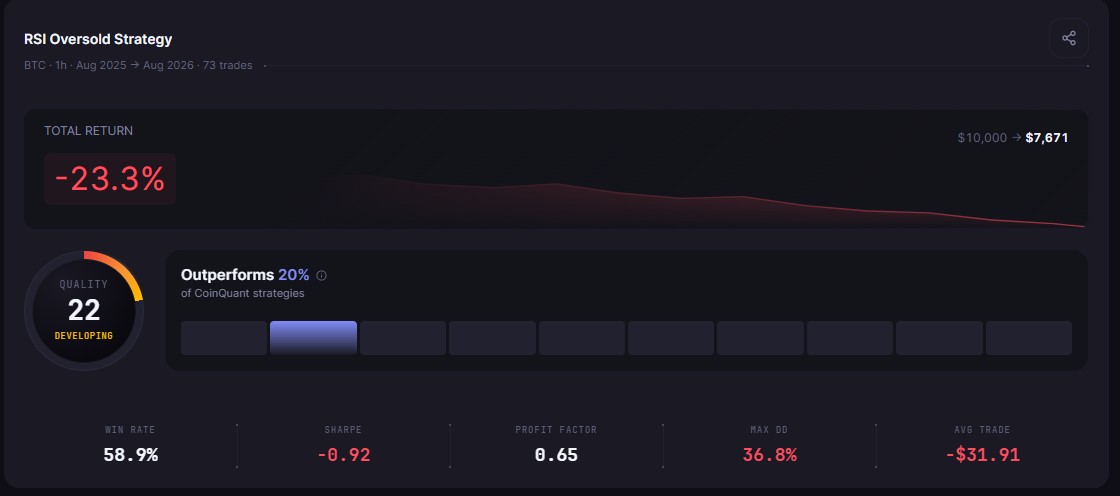
A complete metric report per run: total return, profit factor, Sharpe, sortino, max drawdown, win rate, and a quality score that weighs the set together
Fees modeled by default: 0.1% taker on every trade, matching Binance standard costs
Robustness tooling: walk-forward analysis and Monte Carlo simulation for out-of-sample validation
A free starting tier: the first validation cycle runs at no cost, no credit card required
A strategy library and publishing: named tested strategies, including the verified backtests cited throughout CoinQuant's blog
The difference in emphasis is clear: PRUVIQ's strength is breadth and price (more than 230 coins, free, instant), CoinQuant's is depth and validation rigor (institutional history, full metrics, robustness tests).
Side-by-Side Comparison
| Feature | CoinQuant | PRUVIQ |
|---|---|---|
| Core model | AI trading platform, strategy validation depth | Free no-signup backtester with published results |
| Pricing | Free trial; paid plans | Free core backtesting, no account required |
| Data source | Kaiko (Binance, Coinbase, Kraken), BTC back to 2017 | OKX Futures and CoinGecko, over two and a half years |
| Asset coverage | Crypto plus stocks, forex, commodities | More than 230 coins tested simultaneously |
| Strategy creation | Plain English, AI-converted to rules | Visual builder, 14 indicators, 26+ presets |
| Backtest metrics | Full report: Sharpe, profit factor, drawdown, quality score | Results with fees, slippage, and funding included |
| Robustness testing | Walk-forward and Monte Carlo built in | Multi-coin screening across more than 230 coins |
| Transparency | Named library strategies with published verified backtests | Published failure ledger of its own strategies |
| Automated execution | Deployment for validated strategies | OKX autotrading bot, trade-only permissions |
| Best fit | Deep validation across full market cycles | Free broad screening with no commitment |
Where Each Platform Wins
PRUVIQ wins on access. Zero signup, zero subscription, more than 230 coins in one run, results in seconds. For a trader who wants to screen a rough idea across many coins without committing to a platform, that is a real advantage, and the published failure ledger makes the product unusually honest.
CoinQuant wins on depth. The practical limits of the two products line up with their designs:
History length. PRUVIQ's roughly two and a half years of data covers roughly one market cycle. CoinQuant's Bitcoin data back to 2017 covers the 2018 bear market, the 2021 bull run, the 2022 collapse, and the 2024 recovery. A strategy that only survives a bull-to-bear transition in roughly two and a half years of data can still be hiding a regime dependency that five to eight years of history exposes. That is exactly what CoinQuant's best timeframe study demonstrates with multi-year daily data.
Metrics depth. A backtest report is only as useful as the numbers it includes. CoinQuant's standardized report (Sharpe, sortino, profit factor, drawdown, quality score) supports direct comparisons between strategies, which is the core of honest strategy research. PRUVIQ's results include realistic costs, but the depth of analysis around them is lighter.
Robustness tooling. Walk-forward analysis and Monte Carlo simulation answer the question "did this edge survive out of sample?" Multi-coin screening answers "did this edge appear across many coins?" They are complementary questions, and CoinQuant is the platform where the out-of-sample question is built into the workflow.
AI strategy creation. PRUVIQ offers a visual builder with presets; it does not generate strategies from natural language descriptions. CoinQuant's plain-English builder converts a trader's sentence into rules, which is a different capability, not a better one, for traders who already know exactly what they want to test.
What Each Workflow Looks Like
A concrete way to feel the difference is to walk the same task through both platforms: testing a simple RSI mean reversion idea on Bitcoin.
On PRUVIQ: select the RSI preset or build the condition visually, set the risk parameters, and run the test across the coin universe. Within seconds you have a breadth picture: how many of the more than 230 coins the rule touched and roughly how they performed. The screening power is the product.
On CoinQuant: describe the rule in plain English ("buy BTCUSDT when RSI(14) crosses below 30, exit when it crosses above 50"), review the parsed conditions, choose a multi-year window, and run. The result is a standardized report with profit factor, Sharpe, drawdown, and a quality score, plus the option of walk-forward and Monte Carlo checks before the idea is trusted.
Both are valid answers to the same question, at different depths. The screening answer says "this rule is worth testing here and there." The validation answer says "this rule earned this return at this risk across these regimes, net of fees." A serious trader eventually needs the second answer, which is why the depth gap is the deciding factor in this comparison.
Who Should Choose Which
Choose PRUVIQ when:
The goal is free, no-commitment screening across many coins
A visual builder with presets fits how you already think about rules
You want to see a platform's own failures published as a credibility signal
Automated execution on OKX with trade-only permissions is a priority
Choose CoinQuant when:
Validation depth matters more than price: full cycles, full metrics, robustness tests
You want to describe strategies in plain English, including multi-timeframe logic
Direct metric comparisons between strategy versions are part of your workflow
A free tier that still gives a complete first validation cycle is the entry point
The two products can even be used together: PRUVIQ for broad free screening, CoinQuant for the deep validation of whatever survives. The one thing neither platform will tell you is that a strategy works; both exist to make you verify it.
The Bottom Line
PRUVIQ is a legitimate free backtester with strong access economics and a genuinely unusual commitment to publishing its own failures. For cost-free broad screening it is a good tool, and its verified features are exactly what it claims: 14 indicators, more than 230 coins, realistic costs, no signup.
CoinQuant's answer to "don't believe, verify" is to give verification more to work with: institutional data back to 2017, a complete standardized metric report on every run, and walk-forward and Monte Carlo tooling that test whether an edge survives out of sample. Depth is the differentiator, and depth is what decides whether a strategy that looked good in a backtest survives contact with a full market cycle.
Disclaimer:
This content is for educational and informational purposes only and does not constitute financial, investment, or trading advice. All strategies and examples are for illustrative purposes and do not guarantee results. Always conduct your own research before making financial decisions.
