
CoinQuant vs Mudrex: Which Has Better AI-Powered Strategy Automation?
.png)
Searching for a Mudrex alternative for crypto backtesting typically signals one of two things: you want deeper analysis of your own strategies, or you want to move away from marketplace-browsing toward building and testing your own approach from scratch. Both CoinQuant and Mudrex target non-technical traders with AI-powered strategy tools. The difference is in what the AI does for you and what data it runs on. This comparison breaks down both platforms across the dimensions that matter for serious strategy research.
What Mudrex Is
Mudrex is an AI-native crypto strategy automation platform. Its primary product is Coin Sets: pre-built investment baskets and automated strategies that users can invest in without writing code or configuring complex logic. Mudrex also offers a visual strategy builder for traders who want to create and automate their own approaches, and it connects to major exchanges for live execution.
The platform targets two audiences: passive investors who want curated, automated crypto exposure, and active traders who want no-code strategy automation with live execution. Mudrex has gained traction particularly for its marketplace approach, where users browse and deploy strategies built by the platform or by other users.
Backtesting is available within Mudrex's strategy builder, though the primary focus of the platform is discovery and deployment rather than deep research validation.
What CoinQuant Is
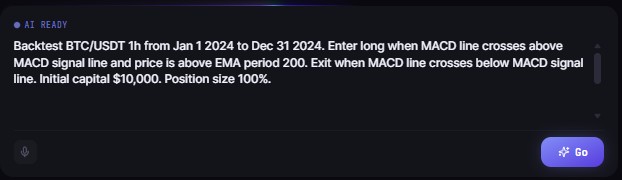
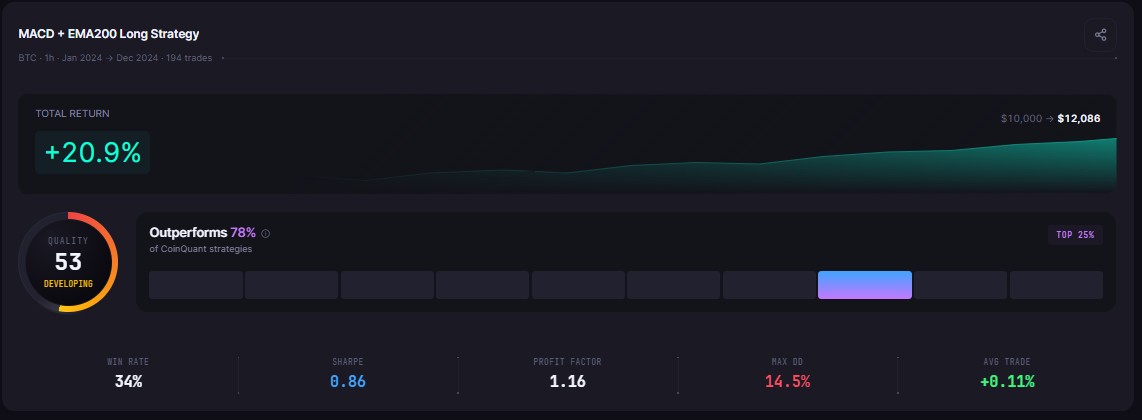
CoinQuant is an AI trading platform focused on strategy research and backtesting. The core workflow: describe a strategy in natural language, and CoinQuant's AI interprets the logic, builds the strategy, and runs a full backtest against institutional-grade Kaiko data. Results return in seconds with 17 metrics and a Strategy Quality Score (SQS).
CoinQuant does not execute live trades. It is a research and validation tool: the place where you develop evidence that a strategy has a genuine edge before capital is at risk.
The data difference is significant. CoinQuant uses Kaiko institutional data covering Binance, Coinbase, and Kraken, with Bitcoin history from 2017. Running a backtest on Kaiko data means every result is built on the same price feeds that institutional traders and quantitative funds use for their own research, not aggregated retail feeds.
Feature Comparison: CoinQuant vs Mudrex
Where Mudrex Excels
Mudrex's marketplace model is a genuine advantage for certain trader profiles:
Pre-built strategy access: Traders who want to deploy an automated crypto strategy without doing their own research can browse Coin Sets and deploy existing approaches. This is faster than building and validating your own strategy from scratch.
Live execution pipeline: Mudrex connects directly to major exchanges for live automated execution. Traders who want a complete workflow from strategy selection to live deployment within one platform will find Mudrex offers a more complete end-to-end solution than CoinQuant for that specific use case.
Passive investment approach: Coin Sets are designed for traders who want diversified crypto exposure managed automatically. This is a different product category from active strategy research: it is closer to a managed portfolio than a backtesting tool.
Where CoinQuant Excels
CoinQuant's differentiation is in the quality and depth of the research layer:
Institutional data quality: Kaiko data from 2017 is a meaningful advantage for traders who want to understand how a strategy performs across genuine market regimes: the 2018 bear market, the March 2020 crash, the 2021 cycle peak, and the 2022 drawdown. Backtesting on that range of conditions produces results that are more robust than tests run on shorter or lower-quality data windows.
Research-first workflow: CoinQuant's AI interprets natural language strategy descriptions directly. You do not browse a marketplace or configure blocks. You describe what you want to test, and the platform builds and runs it. This workflow is designed for traders who have specific strategy hypotheses they want to validate, not traders who want to browse and deploy what others have built.
Metric depth: 17 backtest metrics plus the SQS score gives a richer view of strategy quality than return and drawdown summaries. Metrics like Sortino Ratio, Calmar Ratio, Payoff Ratio, and Time in Market percentage allow traders to evaluate strategies across multiple risk dimensions simultaneously.
No-custody research: Because CoinQuant does not execute live trades, no exchange API connection or asset custody on the platform is required. Strategy research is completely separate from any execution decisions, which gives traders more flexibility in how they ultimately deploy validated logic.
The Core Difference in Philosophy
The fundamental difference between the two platforms is research depth versus deployment convenience:
Mudrex optimises for getting from "no strategy" to "live automated execution" as quickly as possible. The marketplace model reduces the research burden by letting traders adopt existing strategies. This is useful if you trust the marketplace curation and prioritise speed.
CoinQuant optimises for validating your own strategy logic against the highest-quality available data. The goal is not rapid deployment: it is confident, evidence-based understanding of whether a specific approach has a genuine edge and what its risk profile looks like across different market conditions.
For traders who prioritise autonomous research and want to validate their own strategic thinking, CoinQuant provides a more rigorous environment. For traders who want to automate deployment of curated strategies quickly, Mudrex's pipeline is more direct.
Who Each Platform Is Best For
Mudrex is best for non-technical traders who want to automate crypto investing using pre-built strategies or a simple visual builder, and who want a direct connection to live exchange execution in one platform.
CoinQuant is best for traders who want to test their own strategy ideas against institutional-quality data, evaluate risk-adjusted performance across multiple market regimes, and make evidence-based decisions about which strategies are worth developing further.
Disclaimer:
This content is for educational and informational purposes only and does not constitute financial, investment, or trading advice. All strategies and examples are for illustrative purposes and do not guarantee results. Always conduct your own research before making financial decisions.
