
CoinQuant vs LuxAlgo: AI Backtesting Assistant vs Full Strategy Platform

LuxAlgo recently launched an AI Backtesting Assistant: describe a strategy in plain language and it gets tested against historical data. That is a direct move into the territory CoinQuant has occupied since day one, and it makes the CoinQuant vs LuxAlgo comparison timely: two plain-language AI builders, two very different platforms underneath.
This article compares LuxAlgo and CoinQuant on the dimensions that decide which one fits a trader's workflow: what each platform actually is, how strategy building works, what the backtest results include, and what the pricing buys. No vague claims, just the concrete differences.
What Is LuxAlgo?
LuxAlgo is a charting and indicator ecosystem built on TradingView. It is best known for its large library of indicators and strategies, organized into packs such as Signals and Overlays, Oscillator Matrix, and Price Action Concepts, which traders add to TradingView charts.
Its newer AI layer, marketed as Quant, accepts a plain-language strategy description and returns tested logic, the same interaction model CoinQuant has used from the start. The key structural fact is that LuxAlgo remains an add-on inside TradingView: the indicators live on TradingView charts, and the backtesting runs in TradingView's environment, which means data, fees, and metric depth are constrained by what TradingView provides.
LuxAlgo's pricing runs from a free indicator library to paid subscription plans, and its own site describes a Premium tier whose AI credits grant a monthly allowance for building indicators and strategies in plain language. Current plans and credit amounts are published on LuxAlgo's pricing page.
What Is CoinQuant?
CoinQuant is an AI trading platform built for crypto strategy research. You describe your trading logic in plain English, set the asset, timeframe, and window, and CoinQuant converts the description into backtestable rules and runs them against institutional-grade Kaiko data covering Binance, Coinbase, and Kraken, with Bitcoin history back to 2017.
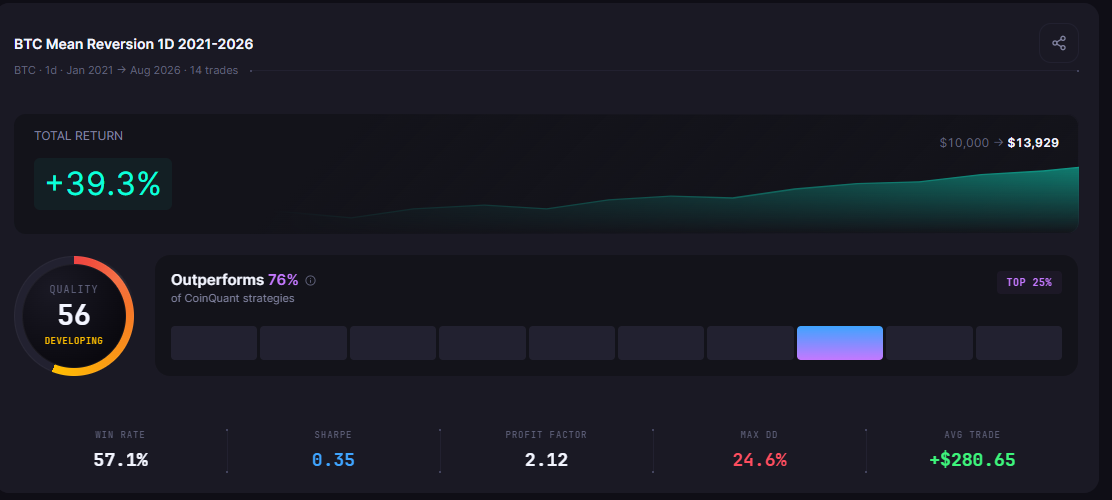
Every completed backtest returns the full metric set: total return, Sharpe ratio, profit factor, max drawdown, win rate, and total trades, with trading fees and slippage included in the results. The platform supports multi-timeframe, multi-asset, and multi-position strategies, and offers a free trial for strategy research and backtesting, with Pro and Elite as its paid subscription tiers.
CoinQuant vs LuxAlgo: Side-by-Side Comparison
| Feature | CoinQuant | LuxAlgo |
|---|---|---|
| What it is | Standalone AI trading platform for strategy research | Indicator and strategy suite inside TradingView |
| Strategy building | Plain-English description, AI converts to rules | Plain-language AI assistant (Quant) plus manual indicator setup |
| Coding required | No | No for AI path; Pine Script for custom work |
| Data source | Kaiko (institutional grade, crypto back to 2017) | TradingView feed |
| Fees and slippage in backtest | Yes, included in every result | Depends on TradingView backtest settings |
| Core metrics | Sharpe, profit factor, max DD, win rate, total return, total trades | TradingView strategy tester output |
| Strategy library | Yes, with community strategies and publishing | Indicator packs and community scripts |
| Free tier | No permanent free tier; free trial available | Free indicator library; AI credits on paid tiers |
| Pricing | Free, Pro $39.99/month, Max Power $220/month | Free indicator library; paid subscription plans with monthly AI credits |
The AI Assistant Question
Both platforms now accept a plain-language strategy description. The difference is what happens after the description is accepted.
On LuxAlgo, the assistant produces strategy logic that runs inside TradingView's tester. That is a genuine capability, and it was the missing piece in LuxAlgo's offering, which is why its launch was notable. But the testing environment is TradingView's: the backtest inherits TradingView's data granularity, fee modeling, and metric reporting.
On CoinQuant, the AI builder is the core of the platform, not an add-on. The description is validated into a schema, tested on Kaiko data with fees and slippage included, and reported with the full metric set. The same plain-English sentence produces a deeper answer on CoinQuant because the platform underneath the AI layer was built for strategy research, not for charting with a test button.
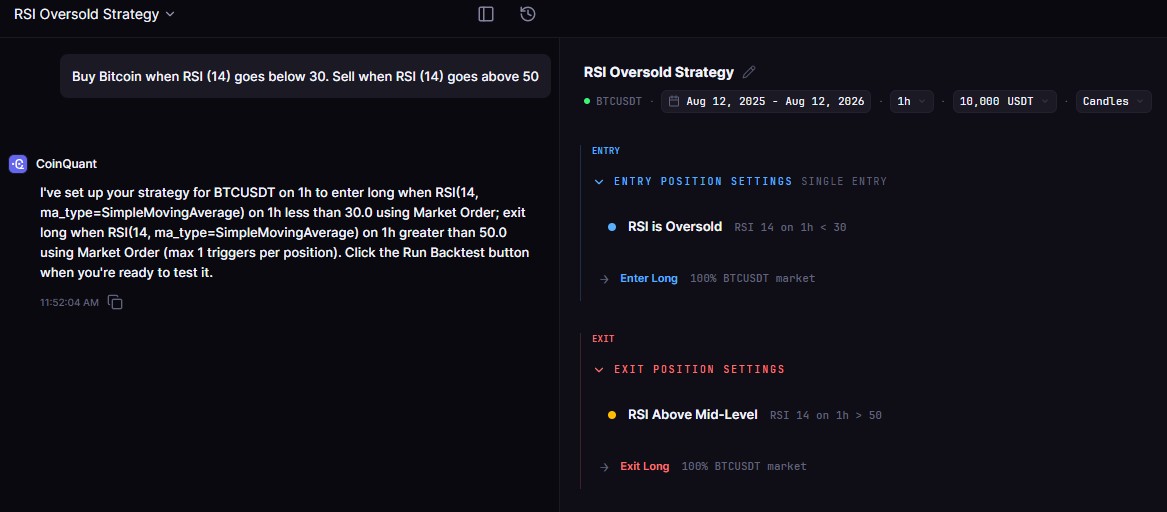
A concrete example shows the gap. The sentence "buy BTC when RSI(14) crosses below 30, sell when it crosses above 50" is a valid prompt on both platforms. On CoinQuant the output includes the strategy schema, a five-year backtest with 0.1% taker fees applied, and a report with Sharpe, profit factor, and drawdown. On a charting platform the same prompt produces signals overlaid on a chart, and the metrics depend on the tester's fee settings. For a trader deciding whether an edge exists, the first output answers the question; the second one starts a configuration project. The difference in what the platform does after the prompt is the real feature comparison.
Data and Metric Depth
The backtest quality question is where the platforms diverge most.
CoinQuant's data is Kaiko, the same institutional feed used by quant funds, with crypto coverage across major exchanges and Bitcoin data back to 2017. That depth makes it possible to test a strategy across the 2018 bear market, the 2021 bull run, the 2022 crash, and the 2024 recovery, which is exactly what a robustness test needs.
LuxAlgo's testing environment is TradingView's, which is a charting platform first. Its backtests work, and for indicator-level validation they are adequate, but the fee modeling, data provenance, and metric depth do not match a dedicated research platform. TradingView's strategy tester is a capable tool in its own right, and the comparison here is not about the tester's quality, it is about the defaults and the depth available: institutional data feeds, exchange-level fee schedules, and per-trade cost reporting are not part of a charting subscription, and every one of them changes the final number.
A strategy that looks profitable on a charting tester with default settings can look very different once 0.1% taker fees and realistic slippage are applied to every trade, and on high-frequency rules that difference is the whole result. That is why the data and metrics sections are the ones a serious trader should read twice.
The practical difference shows in the output. A CoinQuant backtest ends with Sharpe, profit factor, max drawdown, and win rate on the same screen. That set of metrics is what separates an evaluated strategy from a replayed chart, and it is the standard any serious validation workflow needs. For the wider context on what makes a backtesting platform capable, the AI agent backtesting platform guide and the TradingView comparison cover the surrounding landscape.
Who Each Platform Fits
LuxAlgo is a strong fit for:
TradingView users who want premium indicator packs on their charts
Traders who already work in TradingView and want an AI assist for strategy ideas
Users who value a broad library of charting tools over deep research metrics
CoinQuant is a strong fit for:
Crypto traders who want to validate strategy ideas against institutional data before risking money
Anyone who wants fees and slippage included in every backtest
Traders who need full metrics (Sharpe, profit factor, drawdown) to compare strategies
Users who want a strategy library and community strategies as part of the workflow
The Bottom Line
LuxAlgo's AI Backtesting Assistant is a meaningful addition to a respected indicator suite, and for a trader who lives in TradingView it is a natural upgrade. It is not a replacement for a strategy research platform. The backtest environment, data sourcing, and metric depth remain TradingView's, and the AI layer sits on top of that foundation.
CoinQuant provides the full research lifecycle: plain-English strategy building, institutional data, fees included, full metrics, and a strategy library, all in one platform. If the goal is to know whether a strategy works before risking money, CoinQuant answers that question with data depth and metric completeness that an indicator suite, however good, does not provide.
Disclaimer:
This content is for educational and informational purposes only and does not constitute financial, investment, or trading advice. All strategies and examples are for illustrative purposes and do not guarantee results. Always conduct your own research before making financial decisions.
