
CoinQuant vs Coinrule: Comparing Agent Backtesting Workflows for Crypto Traders

Chat-driven trading agents had their breakout year in 2026, and two names keep coming up when crypto traders start looking for a Coinrule alternative: Coinrule itself, with its MCP server for AI assistants, and CoinQuant, with its public API and agent skills pack.
Both let an AI agent work with strategies. The difference is what the agent can actually do once it is connected: manage automation, or run a full research and validation loop. For traders whose next step is deciding what deserves real money, that difference decides the choice.
This comparison looks at both agent workflows as workflows: how the connection works, what the agent can accomplish through it, and where each approach is the stronger fit.
Coinrule in One Paragraph
Coinrule is a no-code automation platform built around conditional trading rules. In 2026 it launched an MCP server that connects AI assistants such as ChatGPT, Claude, and Grok to Coinrule Cloud.
Through that connection, an assistant can read portfolio balances, inspect and update strategies, start and stop strategies, run backtests and compare backtest scenarios, and create and launch baskets across supported venues. Coinrule spans crypto plus stocks and ETFs through broker connections, and its focus is moving traders from idea to live automation with minimal setup.
CoinQuant in One Paragraph
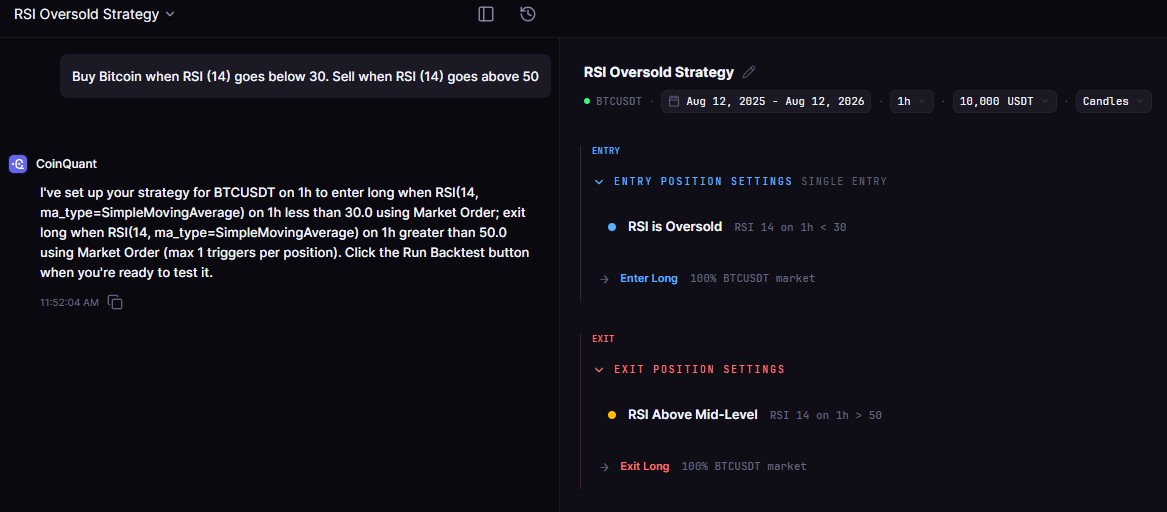
CoinQuant is an AI trading platform built around strategy creation and validation. A trader describes a strategy in plain English, the platform materializes it into a structured, versioned definition, and backtests run on tick-accurate data collected by Kaiko, one of the established institutional market data providers in crypto.
Costs are modeled by default, every run reports a full metric set, and the same pipeline is exposed through a public API with an agent skills pack, which lets an AI agent complete the loop of create, finalize, backtest, and report without a human clicking through screens. CoinQuant covers crypto and other supported asset classes for research.
The Agent Workflow, Layer by Layer
The most useful way to compare agent workflows is layer by layer. Each layer answers the question: when the agent acts, what is it acting on?
| Layer | Coinrule | CoinQuant |
|---|---|---|
| Agent connection | MCP server for chat assistants (ChatGPT, Claude, Grok) | Public API plus agent skills pack; no chat client required |
| What the agent can do | Portfolio reading, strategy management, backtests and scenario comparison, baskets, start and stop | Create strategy from prompt, finalize, backtest, retrieve metrics, run variation tests |
| Backtest data | Exchange and broker connectivity for live trading; backtests run inside the Coinrule engine | Tick-accurate simulation on Kaiko-collected exchange data |
| Cost modeling | Varies by plan and workflow; check the fee line on any result | 0.1% taker fee modeled by default and reported as a line item |
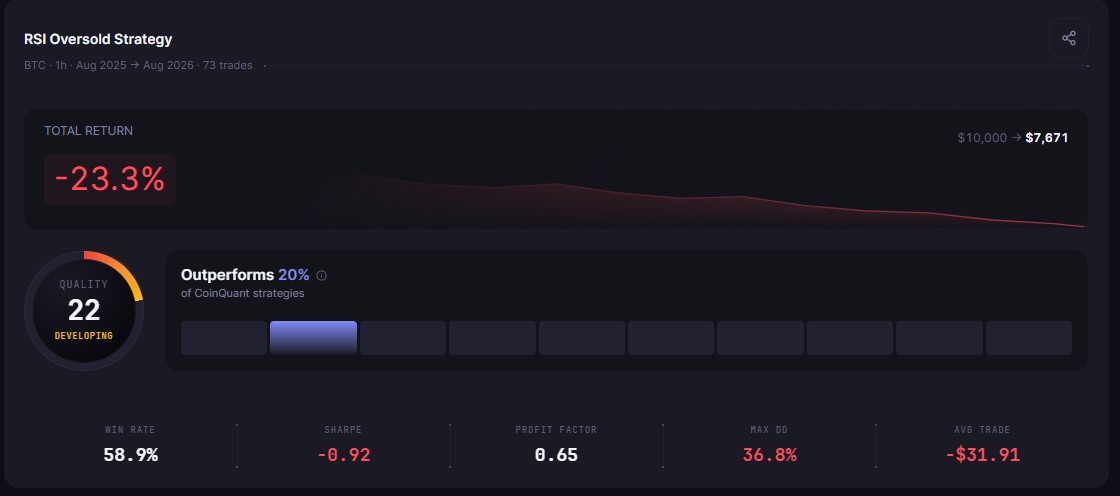
| Reporting | Backtest results and comparisons in-platform | Full metric set per run (return, trades, win rate, profit factor, Sharpe, max drawdown, fees) |
| Automation style | Chat-first: you converse, the assistant manages | Headless-first: agents call the API and run loops autonomously |
| Asset scope | Crypto, stocks, ETFs via broker connections | Crypto plus other supported asset classes for validation |
One caveat matters for both columns: workflows evolve quickly, and the version that matters is the one you test today. Treat the table as a map of what to verify.
Where Coinrule Is Strong
Coinrule's workflow is built for a specific and legitimate job: automated trading with low friction, managed conversationally.
Chat-first simplicity. If your assistant lives in ChatGPT or Claude, Coinrule's MCP is the shortest path from a conversation to a running automation
Live management through chat. Starting, stopping, and adjusting strategies conversationally is genuinely convenient for traders who monitor positions
Baskets and multi-venue reach. Launching multi-asset baskets across supported venues covers portfolio-style automation that pure research tools do not
Broader venue story. Crypto plus stocks and ETFs through brokers gives it cross-market reach that is relevant if your trading spans both
None of this is a criticism. Coinrule optimized for getting you automated; its ecosystem exists to make that path smooth.
Where a Coinrule Alternative Wins
The reason a trader starts searching for a Coinrule alternative is usually not automation itself. It is the moment when automation needs to answer a harder question: is this strategy actually any good?
That question is answered with data provenance, cost realism, and reproducibility, and that is where CoinQuant's workflow is deliberately different:
Provenance you can name. Backtests run on Kaiko-collected exchange data, so the candles behind a result came from the venues being traded
Costs in the result, not beside it. A 0.1% taker fee is modeled by default and reported, so sharp-looking returns cannot quietly ignore what trading costs
Tick-accurate simulation. Fills are simulated against tick data rather than idealized signal prices, which matters most for the strategies that trade the most
Full metrics on every run. Return, drawdown, profit factor, Sharpe, win rate, trade count, and fees come standard, so two runs are always comparable
An automation surface for agents. The public API and skills pack let an agent run the whole research loop headlessly, which is what "AI agent backtesting" should mean: deterministic tool calls, not vibes in a chat window
How to Choose Between Them
The decision comes down to which workflow your next decision needs, and the honest answer can even be both:
Choose Coinrule if your priority is conversationally managed automation, running strategies across crypto and broker markets, with setup speed as the main metric
Choose CoinQuant if your priority is proving a strategy before it earns capital: named data, modeled costs, tick-accurate simulation, and an API loop your agents can run without you
Use both if your process separates concerns: validate first on a research-grade pipeline, then automate what survived
The trader evaluating a Coinrule alternative usually is not unhappy with automation. They are looking for the proof before the automation, and that is precisely the layer CoinQuant was built to provide.
Common Mistakes to Avoid
Comparing feature lists instead of workflows. What the agent can do end to end matters more than what the landing page lists
Skipping the provenance question. For any backtest an agent produces, ask which data it ran on
Trusting returns without a fee line. If costs are not reported, the result is incomplete
Treating chat convenience as validation. A fluent workflow can still produce numbers that cannot be audited
Assuming one tool must do everything. Research depth and automation breadth are different jobs; pick per job
The Practical Lesson
Coinrule's MCP connects chat assistants to a rules engine for fast automation management across crypto, stocks, and ETFs
CoinQuant's API and skills pack let agents run a complete research loop: prompt, strategy, tick-accurate backtest, metrics, variation tests
The workflows differ at the validation layer: data provenance, default cost modeling, and full metrics per run
Pick by the decision in front of you: speed to automation, or proof before capital
If your agent is going to trade, make it prove the strategy first. See why traders choose CoinQuant for validation-first workflows. Start with CoinQuant
Disclaimer:
This content is for educational and informational purposes only and does not constitute financial, investment, or trading advice. All strategies and examples are for illustrative purposes and do not guarantee results. Always conduct your own research before making financial decisions.
