
CoinQuant vs ByBit Trading Bots: Strategy Depth vs Bot Execution
.png)
Traders searching for a ByBit trading bot alternative with better backtesting typically arrive at a clear frustration: ByBit's native bots are built for execution convenience, not for deep strategy research. CoinQuant and ByBit bots occupy different positions in the trading workflow. ByBit handles live automated execution on the ByBit exchange. CoinQuant handles the research and validation step that should come before any live execution decision. This comparison breaks down what each does, where the differences are significant, and which belongs in your workflow.
What ByBit Trading Bots Are
ByBit is a major centralized crypto exchange. Among its features, ByBit offers a native trading bot marketplace: grid bots, DCA bots, and spot/futures automation. These bots execute live trades directly on a user's ByBit account. Users can browse the marketplace, select a bot type, configure parameters, and activate.
ByBit's grid bots are among the more widely used exchange-native grid automation tools. The grid bot splits a price range into multiple buy and sell levels, automatically purchasing at lower grid levels and selling at higher ones. The logic profits from price oscillation within the configured range and works best in sideways markets.
ByBit also offers DCA bots for automated periodic accumulation and allows users to subscribe to signal providers through its marketplace. The focus throughout is live execution: getting a bot running on the ByBit exchange as quickly and simply as possible.
Backtesting support within ByBit's bot marketplace is limited. The platform provides performance simulations based on recent market data, but these are not equivalent to multi-year historical backtests on institutional data across different market regimes.
What CoinQuant Is
CoinQuant is an AI trading platform for strategy research and backtesting. The workflow: describe a strategy in natural language, and CoinQuant's AI builds the logic and runs a backtest on Kaiko institutional data covering Binance, Coinbase, and Kraken. Bitcoin data goes back to 2017.
Results include 17 metrics: Sharpe Ratio, Sortino Ratio, Profit Factor, Max Drawdown, CAGR, Win Rate, Payoff Ratio, Calmar Ratio, Time in Market %, Best/Worst Trade, Total Fees, and CoinQuant's proprietary Strategy Quality Score (SQS). Backtests return in seconds.
CoinQuant is not an exchange. It does not execute live trades. Its role is to answer the question that comes before live execution: does this strategy have a genuine, validated edge when run against historical data across multiple market conditions?
Feature Comparison: CoinQuant vs ByBit Trading Bots
Where ByBit Bots Excel
ByBit's native bots have real advantages for a specific type of trader and use case:
Execution speed and simplicity: For traders who already use ByBit and want to add automated execution to an existing account, the integration is seamless. No external platform connections, no API key management. The bot activates directly on the ByBit account in minutes.
Grid trading on ByBit pairs: ByBit supports a wide range of trading pairs across spot and futures. For traders who want to run a grid strategy on a pair that is primarily liquid on ByBit, the native integration provides direct access without execution delays from external connections.
Futures bot automation: ByBit's bot marketplace includes futures automation, allowing leveraged bot strategies on perpetual contracts. This is a specific capability that reflects ByBit's position as a major derivatives exchange.
The limitation: ByBit bots are designed for ease of deployment, not for strategy validation. The performance simulations ByBit provides are based on recent market data in favorable conditions, not on multi-year backtests across different market regimes. A grid bot that shows positive simulation results in a recent sideways market may perform very differently in a sustained trending environment.
Where CoinQuant Excels
CoinQuant's primary advantage is the depth of the research layer and the quality of the data underpinning it:
Multi-regime validation: Running any strategy on Kaiko data from 2017 means testing it against the 2018 grinding bear market, the March 2020 sudden crash, the 2021 cycle peak, and the 2022 drawdown. A grid-logic strategy that looks profitable in a recent sideways window may show significant losses during the sustained trending periods in that longer data set. Seeing that before deploying capital is the entire value of rigorous backtesting.
Institutional-quality metrics: A Sharpe Ratio, Sortino Ratio, and Profit Factor give a genuinely risk-adjusted view of strategy performance. ByBit's estimated return figures do not provide this dimension of analysis. Two strategies with the same expected return but different Sharpe Ratios are not equivalent: one is generating that return with significantly more volatility, and you cannot see that without the risk-adjusted metrics.
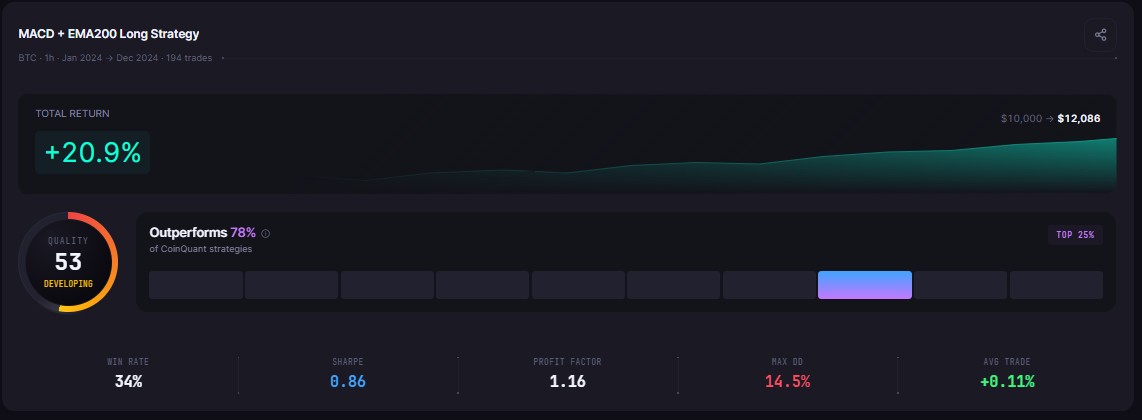
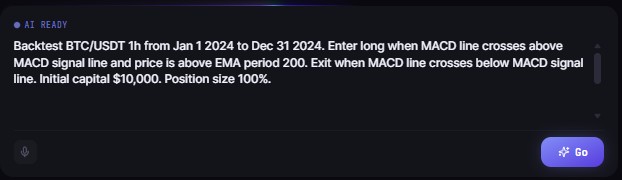
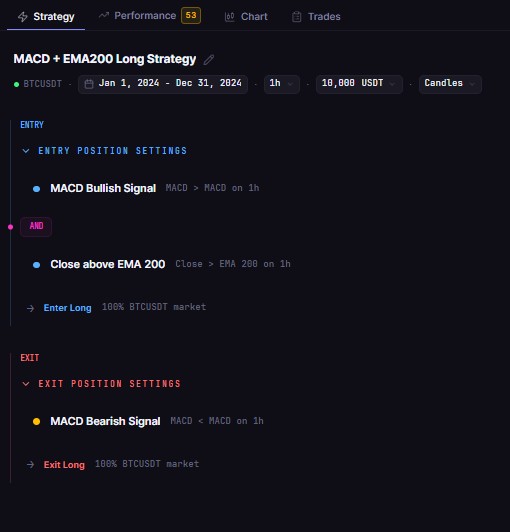
Custom strategy logic: CoinQuant is not limited to grid, DCA, or signal templates. Any strategy that can be described in natural language can be tested: RSI-based approaches, EMA crossovers, multi-indicator combinations, momentum confirmation strategies. This gives traders access to a much broader range of strategy types than template-based bots allow.
Research independence from execution venue: CoinQuant results are not tied to ByBit or any specific exchange. Once you have identified a strategy with a validated edge, you can execute it on any platform you choose.
The Research-Before-Deployment Workflow
The most effective use of both platforms is sequential, not competitive. The workflow that combines rigorous research with efficient execution looks like this:
Step one: Research on CoinQuant. Describe your strategy in natural language. Run the backtest on Kaiko data. Check the Sharpe Ratio, Profit Factor, and Max Drawdown across multiple historical periods. If the strategy shows a positive risk-adjusted return with a manageable drawdown across different market conditions, it has passed the first research gate.
Step two: Validate across market regimes. Run the same strategy across different historical windows and, if possible, on multiple assets. A strategy that shows consistent results in both the 2021 bull market and the 2022 bear market is more robust than one that only performs well in one regime.
Step three: Deploy validated logic. Once research confirms the strategy logic has a genuine edge, execute it through the exchange and execution environment that works best for your situation. For traders already using ByBit for execution, the validated logic can inform manual execution or be implemented through ByBit's available tools.
The common mistake is reversing this sequence: deploying first and researching later (or not at all). Exchange-native bots make deployment so easy that the research step is easy to skip. That ease is useful for execution. It is a risk for strategy selection.
Who Each Platform Is Best For
ByBit Trading Bots are best for traders who have already decided on a strategy type (grid, DCA, or signal-based), use the ByBit exchange, and want seamless, fast automation without a separate platform connection.
CoinQuant is best for traders who want to validate their strategy logic against institutional historical data before committing capital, and who need the full risk-adjusted metric set to make evidence-based decisions about which approaches are worth deploying and when.
Disclaimer:
This content is for educational and informational purposes only and does not constitute financial, investment, or trading advice. All strategies and examples are for illustrative purposes and do not guarantee results. Always conduct your own research before making financial decisions.
