
CoinQuant vs Bitget Trading Bot: Which Gives Traders More Strategy Control?
.png)
Traders looking for a Bitget trading bot alternative typically want one of two things: more strategy control, or a way to research and validate strategies before committing capital to live automation. Bitget's native bots are built for quick deployment on the Bitget exchange. CoinQuant is built for deep strategy research and backtesting on institutional data. This comparison explains what each platform does, where the real differences are, and which workflow makes sense depending on what you are trying to accomplish.
What Bitget Trading Bots Are
Bitget is a centralized crypto exchange. Among its features, Bitget offers built-in trading bots: grid bots, DCA (dollar-cost averaging) bots, and signal-based automated strategies. These bots are deployed directly on the Bitget exchange and execute trades on a user's Bitget account.
The core workflow: select a bot type from the marketplace, configure the parameters (price range for grid bots, investment amount, target asset), and activate. The bot then runs automatically, executing buy and sell orders within the configured parameters on the Bitget exchange.
Bitget bots are designed for ease of deployment rather than deep strategy customization. The available strategy types are largely template-based: grid bots, DCA bots, and signal subscriptions from third-party signal providers. The level of customization within each template is limited compared to building a strategy from a specific set of indicator conditions.
Bitget's historical data for backtesting bot configurations is limited. The platform provides performance projections for bot configurations, but these are not equivalent to rigorous historical backtests on multi-year institutional data.
What CoinQuant Is
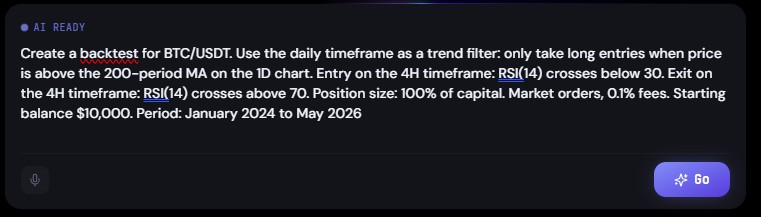
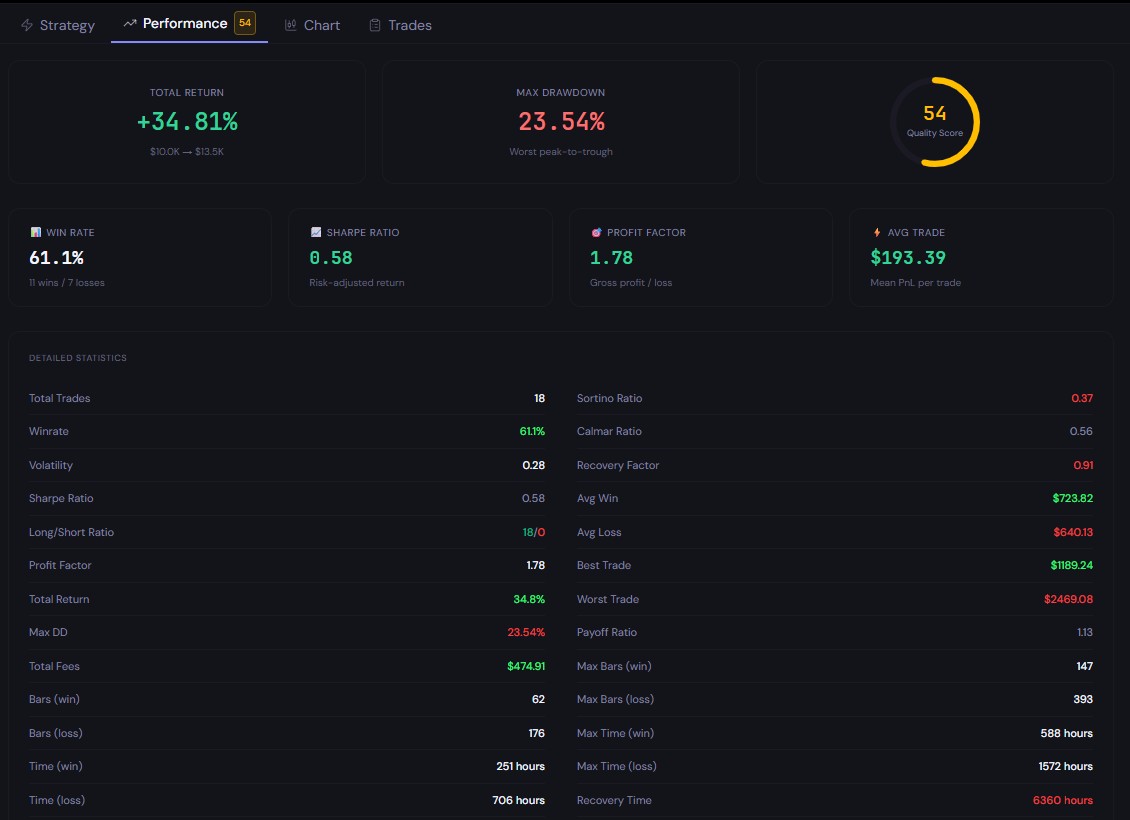
CoinQuant is an AI trading platform for strategy research and backtesting. The workflow: describe a strategy in natural language, and CoinQuant's AI builds the logic and runs a full backtest against Kaiko institutional data. Results include 17 metrics: Sharpe Ratio, Sortino Ratio, Profit Factor, Max Drawdown, CAGR, Win Rate, Payoff Ratio, Calmar Ratio, Time in Market %, and CoinQuant's proprietary Strategy Quality Score (SQS).
CoinQuant does not execute trades. It is a research platform. The distinction matters: CoinQuant is the place to determine whether a strategy has a genuine, validated edge before capital goes into live automation. Bitget bots are the execution layer.
Feature Comparison: CoinQuant vs Bitget Trading Bot
Where Bitget Trading Bots Excel
Bitget bots are designed for traders who have already decided on a strategy type (grid or DCA) and want rapid deployment within the Bitget ecosystem:
Speed of deployment: A Bitget grid bot can be configured and running in minutes. There is no research step: you pick the asset, set the range, confirm the investment, and activate. For traders with a simple range-bound thesis who want passive automation without building a custom strategy, the speed is a practical advantage.
Exchange integration: Because Bitget is both the exchange and the bot provider, the integration is seamless. No API key management, no external platform connections. The bot has direct access to your Bitget account and executes trades with minimal latency within the Bitget matching engine.
DCA automation: Bitget's DCA bot automates regular purchases of an asset at set intervals, regardless of price. This is a simple accumulation strategy that does not require backtesting validation. Traders who want to automate a long-term accumulation approach and already use Bitget will find the DCA bot a convenient tool.
Where CoinQuant Excels
CoinQuant is the stronger choice when the question is whether a strategy is worth deploying at all, not just how to deploy it quickly:
Strategy validation before capital commitment: The most important reason to use CoinQuant over any execution-first platform is the research step. Running a strategy against seven years of Kaiko data across four distinct market regimes (2018 bear, 2020 crash, 2021 bull, 2022 bear) tells you whether the logic has held up under genuinely different conditions. A grid bot projection tells you what would have happened during a recent, often favorable market window.
Metric depth for risk assessment: Bitget bot performance projections do not return a Sharpe Ratio, Sortino Ratio, or Profit Factor. These metrics are essential for understanding risk-adjusted performance. A bot configuration that shows positive projected returns may still have a Sharpe below 0.5, meaning the return is coming with excessive volatility. You cannot assess this from a projection summary.
No-exchange-dependency research: CoinQuant research is not tied to any exchange. You can validate a strategy logic and then execute it on the exchange or venue of your choice. This gives significantly more flexibility than a platform where research and execution are locked to a single exchange.
Custom strategy logic: CoinQuant supports any combination of indicators that can be described in natural language, including multi-condition entries, multi-timeframe filters, and complex exit logic. Bitget's bot templates are limited to the configuration parameters available within each template type.
The Research vs. Execution Distinction
The clearest way to understand the difference between CoinQuant and Bitget bots is the sequence in which they belong in a trading workflow:
Research first: Use CoinQuant to validate that a strategy logic has a positive Sharpe Ratio, acceptable Max Drawdown, and a meaningful Profit Factor across multiple market conditions.
Deploy validated logic: Once research confirms a strategy has a genuine edge, execute that validated logic through an exchange of your choice, which may or may not be Bitget.
Using Bitget bots without a prior research step means deploying capital on a template strategy with no institutional-data validation of how that approach behaves across different market regimes. Grid bots are effective in range-bound markets. In trending markets, they can accumulate significant losses as price escapes the configured grid range.
Backtesting a grid logic equivalent on CoinQuant before deployment would show exactly that risk profile across historical trending periods, giving a clearer picture of when the strategy is and is not appropriate.
Who Each Platform Is Best For
Bitget Trading Bot is best for traders who want rapid, passive automation on the Bitget exchange and are comfortable with the risk profile of template-based bots without deep historical validation.
CoinQuant is best for traders who want to validate their strategy logic against institutional data before any capital goes into live trading, and who need a full risk-adjusted metric set to make informed decisions about strategy selection and deployment.
Disclaimer:
This content is for educational and informational purposes only and does not constitute financial, investment, or trading advice. All strategies and examples are for illustrative purposes and do not guarantee results. Always conduct your own research before making financial decisions.
