
Cloud-Based vs Desktop Backtesting Software: Which Is Better for Crypto Traders?
.png)
What Cloud-Based Backtesting Means
Cloud-based backtesting software runs in a web browser. Nothing is installed on your machine. The platform provider hosts the data, runs the computations, and delivers results through an interface you access via URL.
The data is managed on the provider's side: exchange price feeds, order book data, and volume history are maintained, updated, and stored without any action from the user. When you run a backtest, you are querying data that is already clean, current, and organized.
Strategy creation on cloud platforms tends to be higher-abstraction. Most modern cloud backtesting tools offer visual builders, no-code interfaces, or natural-language inputs rather than requiring users to write scripts. The barrier to running a first backtest is measured in minutes.
Cloud platforms update automatically. New features, data additions, and bug fixes reach every user simultaneously with no manual install required. Access is device-agnostic: you run the same backtests from a laptop, a desktop, or a tablet. The computational work happens on the provider's servers.
What Desktop Backtesting Means
Desktop backtesting software is installed directly on your machine. Platforms in this category include MetaTrader 4 and 5 (MT4/MT5), Amibroker, TradeStation Desktop, and QuantConnect run locally.
The key characteristic is that both the software and the data live on your machine or on infrastructure you control. Backtests run using your own CPU and RAM. You are responsible for sourcing, downloading, formatting, and maintaining the historical data you test against.
Desktop tools tend to offer more granular control. Professional quantitative researchers often prefer desktop environments because they can customize the backtesting engine itself, plug in proprietary data, run backtests offline, and integrate with private data pipelines that would never go through a cloud provider.
The tradeoff is complexity. Setting up a desktop backtesting environment from scratch takes significantly more time and technical knowledge than creating a cloud-based account.
Cloud-Based vs Desktop Backtesting Software: Side-by-Side Comparison
Where Cloud-Based Backtesting Wins for Crypto

The data problem is the defining issue for crypto. Crypto trading data comes from dozens of exchanges, updates every second, and covers hundreds of trading pairs. Keeping that data current on a local machine is a significant operational burden that most individual traders underestimate.
A complete, accurate dataset for serious backtesting would require:
Historical OHLCV data from multiple exchanges going back years.
Volume and trade data at multiple timeframe resolutions.
Regular downloads to keep the dataset current, 24 hours a day, seven days a week.
Data cleaning to handle exchange outages, anomalies, and format changes.
Cloud platforms absorb all of this. The provider maintains the data pipeline. When you run a backtest on a cloud tool that uses institutional data feeds, you are testing against the actual historical record of what happened on those exchanges, not a reconstructed approximation.
No installation friction means you can go from strategy idea to first backtest in minutes rather than hours. For traders iterating through multiple strategy variations, the speed difference compounds significantly over time.
Accessibility from any device is practically valuable. Traders are not always at a fixed workstation. The ability to review a backtest result or adjust parameters from a different machine without transferring files is a real workflow advantage.
Automatic updates mean you are always on the current platform version. For institutional data providers, this also means the data feed is continuously maintained without any user intervention.
Where Desktop Backtesting Still Has an Advantage
Desktop tools retain advantages in specific situations:
Maximum compute control: When running extremely large backtests, Monte Carlo simulations, or parameter optimization across thousands of combinations, local hardware running uninterrupted can outperform shared cloud infrastructure. Quantitative researchers working at this scale often prefer desktop environments.
Proprietary data integration: If your edge depends on a private data source, a custom order book feed, or non-public information, desktop environments let you integrate that data without routing it through a third-party cloud provider.
Data privacy requirements: Institutional traders with compliance or confidentiality requirements around their strategy data may have constraints that make cloud platforms unsuitable.
Existing infrastructure: Professional quant teams who already have established MT5 or Amibroker setups with curated historical data may see less benefit from switching to cloud tools for new strategy work.
For most individual crypto traders, these advantages are theoretical rather than practical. The majority do not have proprietary data, do not run multi-million-parameter optimizations, and do not have institutional compliance requirements. The cloud case applies to them directly.
The Specific Crypto Data Problem with Desktop Tools
The data burden for crypto is materially heavier than for traditional financial instruments.
A stock trader using desktop software can source end-of-day data from a few providers, update weekly, and have a serviceable dataset for strategy testing. The data structure is stable and the coverage is well-established.
Crypto is different:
Data lives across many exchanges: A strategy tested on Binance produces different results than the same strategy on Coinbase. Multi-exchange testing requires maintaining separate datasets for each exchange.
Exchange history depth varies: Binance launched in 2017. Coinbase in 2012. Kraken in 2011. Sourcing and maintaining clean multi-year data from multiple exchanges requires either a professional data vendor or significant manual effort.
Exchange anomalies are common: Exchange outages, flash crashes, and data gaps occur regularly in crypto. Professional data vendors clean these. Raw exchange feeds do not.
Updates are required continuously: Crypto markets run 24 hours a day, seven days a week. There is no market close to batch-update from. Keeping a local dataset current requires continuous feed management.
These operational costs are the reason institutional crypto traders pay for data from providers like Kaiko rather than building their own pipelines. Cloud backtesting platforms that partner with institutional data providers pass those clean, current datasets directly to retail traders without requiring them to build the infrastructure.
CoinQuant's Cloud Advantage for Crypto Backtesting

CoinQuant is a cloud-native AI trading platform that uses Kaiko institutional data as its backtesting foundation. Every backtest runs against clean, professionally maintained historical data covering Binance, Coinbase, Kraken, and other major exchanges, with records going back to 2017.
The workflow requires no installation, no data downloads, and no local data maintenance. You open a browser, describe your strategy in plain language, and run the backtest. No coding required. No Python. No Pine Script.
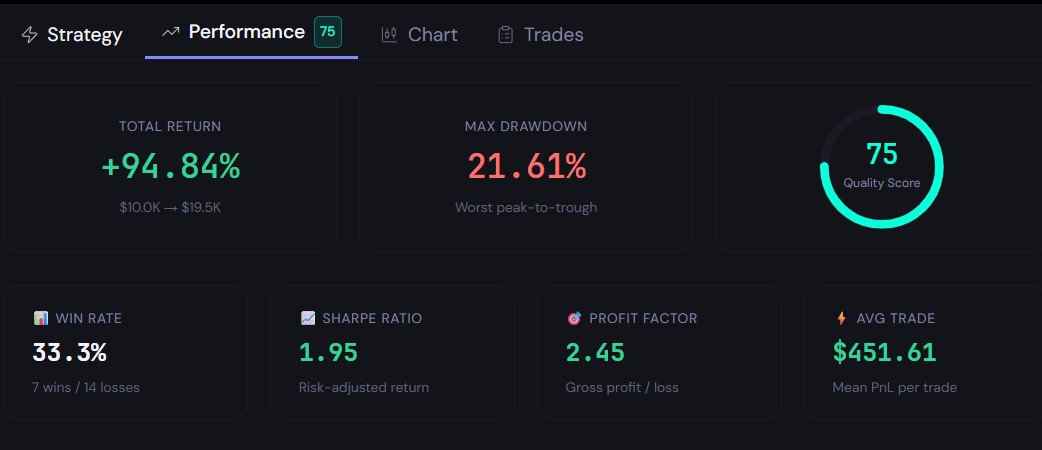
Results include the full set of professional performance metrics: total return, CAGR, win rate, max drawdown, Sharpe ratio, Sortino ratio, profit factor, and individual trade records. The same metrics that institutional trading desks use to evaluate strategies are available to individual traders without any infrastructure investment.
For crypto traders who want serious backtesting results without the operational overhead of maintaining a local data environment, cloud-native tools with institutional data partnerships represent a better starting point than desktop alternatives built primarily for traditional financial markets.
.png)
Which to Choose
Choose cloud-based backtesting if you want to get from strategy idea to backtest result quickly, you trade on major crypto exchanges, and you do not want to maintain your own data infrastructure. The current pricing on CoinQuant gets you started in minutes.
Choose desktop backtesting if you have proprietary data, run extreme-scale parameter optimizations, have compliance requirements that prevent cloud processing, or have an existing professional quant setup that would cost more to migrate than to maintain.
For the majority of individual crypto traders, cloud-based backtesting solves the real problem: getting accurate, institutional-quality historical data into a fast, accessible testing environment without operational complexity.
Try CoinQuant: Cloud-Native Backtesting
Run professional-grade backtests directly in your browser against Kaiko institutional data from 2017. No installation, no coding, no data downloads required.
Disclaimer:
This content is for educational and informational purposes only and does not constitute financial, investment, or trading advice. All strategies and examples are for illustrative purposes and do not guarantee results. Always conduct your own research before making financial decisions.
