
Can ChatGPT Backtest a Trading Strategy? MCP and API Options Compared

Can ChatGPT backtest trading strategies? It is the question every trader eventually asks their assistant, and it usually arrives after a strategy idea fails to survive contact with reality.
The blunt answer: a chatbot by itself cannot. But a chatbot connected to the right platform can do more than most traders realize, and 2026 is the year that flipped from experiment to documented workflow.
Here is the honest comparison of the routes, what each one actually enables, and what to check before you connect anything.
The Blunt Answer
A chat model in isolation has no market data pipeline, no backtest engine, and no ability to replay exchange history bar by bar. What it can do is explain, draft, and reason: a useful research partner, but not a testing environment.
It can also write code, which creates the most common misunderstanding. If you have to take that code to another tool and run it yourself, the testing happened outside the chat, through your work. That is helpful, but it is not a backtest the assistant ran.
The routes below are about closing that gap. Each one connects the assistant to something that can actually run the test.
Three Routes, Compared
| Route | What it is | What the assistant can actually do | Requires |
|---|---|---|---|
| Chat alone | A conversation, no connection | Explain concepts, draft rules, write code for you to run elsewhere | Nothing |
| MCP connection | An official connector between the chat client and a trading platform | Read accounts and strategies, and where supported, create strategies, run backtests, and iterate | A platform with a documented MCP server; client sign-in |
| Public API plus skills pack | A programmatic route where an external agent owns the whole loop | Create, finalize, backtest, read metrics, and iterate without manual steps | A service-account token and the platform's API documentation |
Three routes, three different promises. A chat explains; an MCP makes the chat an operator inside a platform; an API gives an agent the whole pipeline.
Route 1: Chat Alone
Useful for: understanding what a backtest is, pressure-testing strategy logic, drafting the exact rules you will test later.
Not capable of: running the test. No data, no fills, no fees, no report. If a response looks like a backtest result, it is either generated text or code you still need to execute somewhere with real market data.
The practical takeaway: keep using the chat for thinking. Just do not let it convince anyone that a number it produced is evidence.
Route 2: MCP Connections
MCP is the protocol that lets a chat client call tools on a platform directly. In 2026, several trading platforms ship official MCP servers, and the differences between them decide what your chat can do.
Verified facts from the September 2026 landscape:
- Coinrule shipped an official MCP server (live June 2026) that works with ChatGPT, Claude, Gemini, and Grok. After OAuth sign-in, users choose Read or Read plus Write. With Write enabled, the assistant can create strategies from natural language, run backtests, and launch automations. The permission choice is consequential: Write can move real funds, and the documented advice is to start read-only.
- Composer runs an MCP workflow for US stocks and ETFs, with tools to create and backtest strategies across its library. It discontinued crypto assets after January 2026, so the route is US-market only.
- Cryptohopper offers an MCP server scoped to market data: candles, orderbook, analysis. Strategy work stays in-platform.
MCP route summary: genuine capability, but scope varies per platform, and permissions are the safety surface. Check what the connector can touch before you enable it.
Route 3: API Plus Skills Pack, the Full Loop
The most complete route skips the chat interface question entirely. A public API plus a documented skills pack lets any capable agent, including ChatGPT-driven and Claude-driven setups, own the entire pipeline programmatically.
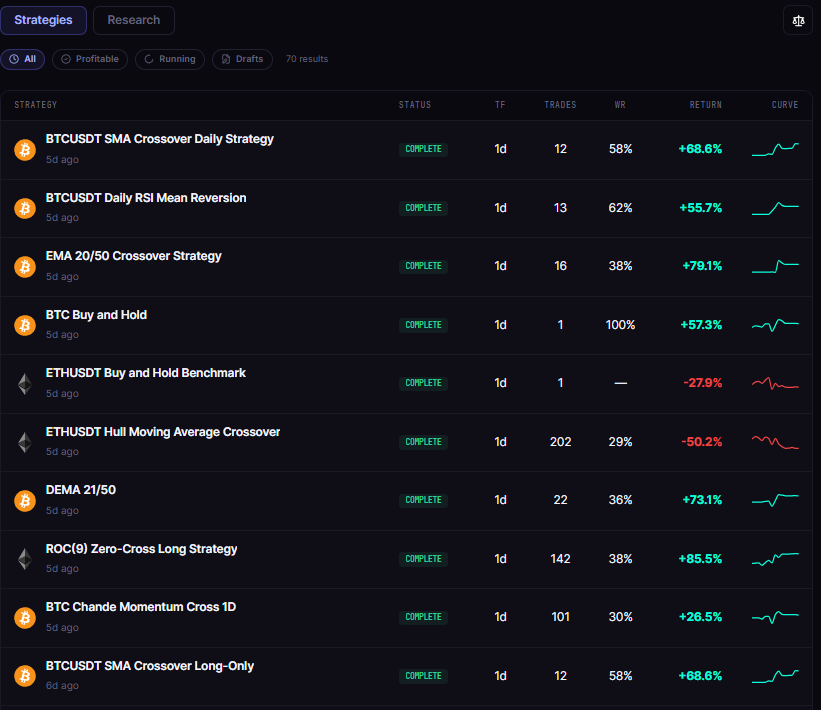
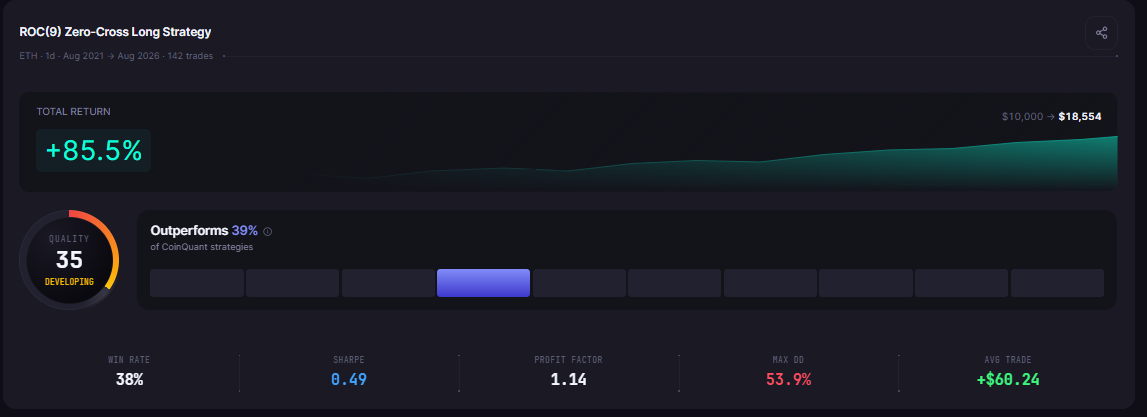
On CoinQuant, the loop runs in six steps: generate a service-account token, describe the strategy in a prompt, finalize it into a version, run the backtest, read the full metric set, and iterate. One verified example that came out of exactly this loop: ETH Rate of Change Cross 1D 2021-2026, which returned +85.54% across 142 trades with $4,427.09 in fees paid, every figure readable straight from the API response.
What makes this route different from MCP chat workflows: the agent is not describing what it would do inside someone else's interface. It creates the strategy, runs the test, and pulls the metrics as data, and every run leaves identifiers that make results reproducible later.
The honest limits: CoinQuant's programmatic path is research scope, not live trading, so execution stays a deliberate human decision. Service tokens expire every 30 days, so a working setup asks for a fresh one at rotation.
So, Can ChatGPT Backtest Trading Strategies?
The complete answer, route by route:
- Alone, no. It can discuss and draft, not test.
- Through MCP, yes on supported platforms, within the scope each connector documents. Coinrule covers crypto automation with careful permissions; Composer covers US stocks and ETFs; CoinQuant covers crypto research through the API route rather than a chat connector.
- Through the public API and skills pack, yes for the full loop: creation, testing, metrics, and iteration, with the agent, not the human, operating the pipeline.
The same answers apply to the other assistants. Claude, Gemini, and Grok can drive the same routes wherever the platform supports them, which is why platform capability matters more than which chat window you prefer.
What to Check Before You Connect Anything
- Permission scope. Read-only versus write matters enormously when write can reach money. Start read-only everywhere.
- What the connector exposes. Account data, strategy logic, and live positions are different levels of access. Know which one you are granting.
- Token handling. Credentials belong in a secrets file, not a chat message. Rotate on expiry.
- Loop completeness. Ask whether the connection can finish the cycle: create, test, measure. A connector that can only read results is a viewer, not an operator.
- Platform scope honesty. Research-only, paper-only, or live: the documented boundary is the one that counts.
The Practical Lesson
- A chatbot alone cannot run a backtest; the connection to a platform is what changes the answer
- MCP routes make chats into platform operators, with scope and permissions as the real limits
- The API plus skills pack route lets an agent own the full prompt-to-metrics loop
- Check scope, permissions, and token handling before you connect anything
See why traders choose CoinQuant's API-first validation workflow on CoinQuant
Disclaimer:
This content is for educational and informational purposes only and does not constitute financial, investment, or trading advice. All strategies and examples are for illustrative purposes and do not guarantee results. Always conduct your own research before making financial decisions.
