
Best No-Code Trading Platforms of 2026: Ranked and Reviewed
.png)
No-code trading has matured from a niche category into a legitimate alternative to quant development. In 2026 there are more platforms in this space than ever, and the differences between them are wider than the marketing suggests.
The surface-level features look similar across platforms: indicator support, exchange connectivity, some form of automation. But the depth of backtesting capability, the quality of historical data, and the rigor of risk reporting vary dramatically.
A platform that cannot tell you your max drawdown or Sharpe ratio before you go live is not a testing tool: it is a deployment tool with no safety check. This ranked review covers the five leading options based on one criterion that matters: how well does each platform help you build and validate a strategy before risking real capital?
How This Ranking Was Built
Each platform was evaluated on five dimensions: data quality and depth, backtesting rigor, strategy creation method, live execution capability, and ease of use for a trader with no programming background.
Data quality: Whether platforms use institutional-grade tick or OHLCV data versus retail-sourced feeds that carry known accuracy issues.
Backtesting rigor: Whether slippage, fees, and realistic fills are modeled, and whether the output includes a full risk metric set rather than just return.
Pricing was not the primary filter, because a platform that gives you bad results cheaply costs more in the long run than one that gives you accurate results at a fair price.
One additional dimension not captured in the five criteria above is what happens when you want to modify a strategy after the initial build. Some platforms lock you into a template structure that makes parameter changes cumbersome. Others require code edits for any modification.
The platforms ranked here were assessed on the iteration experience as well: how quickly and cleanly can you change a parameter, rerun, and compare the new result against the original? That iteration speed determines how many strategy variants a trader can realistically evaluate before deploying, which directly affects the quality of the final decision.
1. CoinQuant
Best for: strategy validation and AI-assisted building. CoinQuant is the strongest option in 2026 for traders who want to know whether a strategy actually works before deploying it. The platform uses Kaiko institutional data going back to 2017 for Bitcoin, supports natural language strategy creation, and returns a full set of risk metrics including Sharpe ratio, max drawdown, profit factor, and CAGR.
The data foundation matters because the accuracy of a backtest is directly tied to the quality of the historical data behind it. Kaiko is an institutional data provider used by asset managers and exchanges, not a retail feed that aggregates from public APIs.
Running a strategy test on that data produces a different class of result than running it on data scraped from no-cost sources, which often contains gaps, incorrect prices, and survivorship issues that inflate apparent performance.
The AI strategy builder removes the configuration layer entirely. You describe the strategy in plain English (for example, 'enter long when RSI crosses above 30 on the 4-hour chart, exit when RSI reaches 65') and the platform builds the backtest-ready strategy without requiring any code.
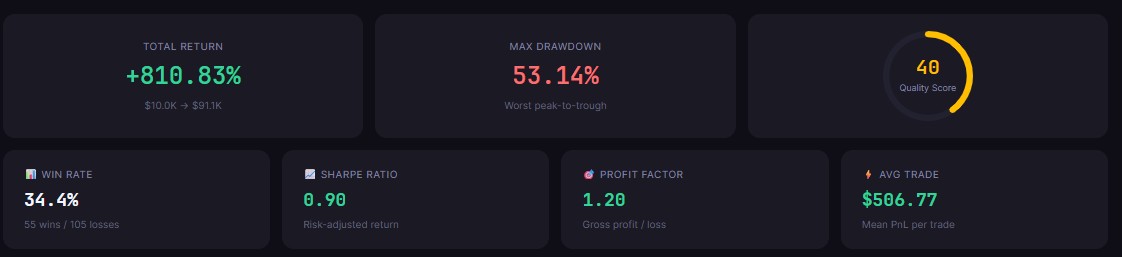
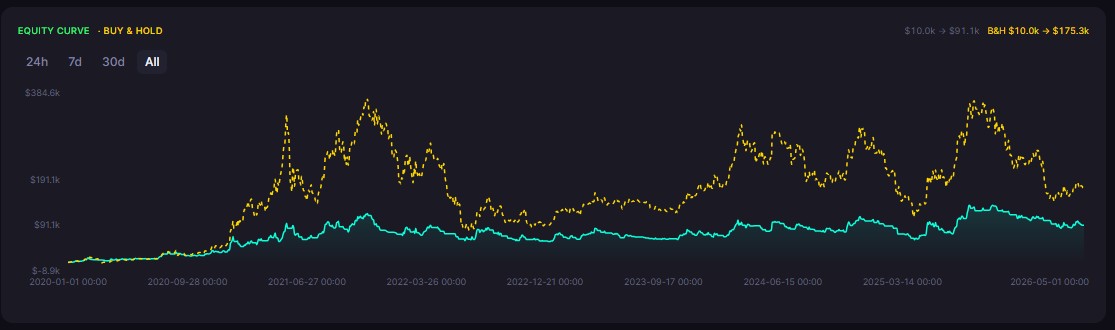
After testing, CoinQuant assigns a Quality Score that combines return, drawdown, and consistency into a single signal, making it straightforward to compare multiple strategy variants on the same asset. The live automation step follows the same logic the backtest used, which eliminates the translation errors that occur when manually moving from backtested rules to a live bot on a separate platform.
2. TradingView
Best for: charting and community strategy discovery. TradingView is the most widely used charting platform in crypto, and its chart quality and indicator library remain best-in-class. Its Pine Script language allows traders to write and publish strategies, but Pine Script is a programming language, making TradingView not truly no-code for custom strategy creation.
A trader who wants to adapt a community strategy (changing the RSI period, adding a moving average filter, or modifying exit conditions) needs to read and edit Pine Script. Pre-built community scripts can be applied without writing code, but the strategy tester uses adjusted OHLCV data with limited control over fee modeling and slippage assumptions.
For charting and visual analysis, TradingView is the industry standard. For rigorous pre-deployment backtesting, it falls short of institutional-grade metric depth.
3. 3Commas
Best for: bot automation across many exchanges. 3Commas operates as a bot execution platform with DCA bots, grid bots, and smart trade tools supporting over 20 exchanges. The exchange coverage is genuinely broad: Binance, Bybit, OKX, Coinbase, Kraken, and more connect through API keys, and position management across multiple accounts is well-handled.
The limitation is backtesting: 3Commas offers paper trading rather than historical backtesting, meaning you cannot test a strategy against past market conditions before running it live.
Paper trading in a current live market does not replicate how a strategy would have performed during a 2024 bear phase or a 2025 volatility spike. For traders whose primary need is validated strategy performance data before deployment, this is a significant gap.
September 2026 note: 3Commas’ v1 deactivation means it is no longer a static platform choice for existing users. The move toward v2 built with WunderTrading still requires strategy reconstruction, so no-code convenience should be paired with rebuild validation.
4. Cryptohopper
Best for: template-based bot deployment. Cryptohopper offers a marketplace of pre-built strategy templates and supports automated trading on multiple exchanges. Its visual strategy builder lets users combine triggers and conditions without code, and the template marketplace gives newer traders a faster starting point than building from scratch.
The platform supports a backtesting function that runs against historical candle data, a meaningful step above paper-trading-only platforms. However, the data source and metric depth are limited compared to institutional-grade systems. You can see returns but may not get a full Sharpe ratio, profit factor, and drawdown analysis in one view.
For traders who want pre-built templates and fast setup over deep validation, it remains a practical option, with the understanding that additional testing is advisable before significant capital deployment.
5. Coinrule
Best for: simple rule-based automation. Coinrule focuses on straightforward if-then trading rules without requiring any programming. Its strength is simplicity and speed of setup: a working rule can be created and deployed in under ten minutes. The rule editor is accessible to traders who have no background in indicators or bots.
The constraint is expressiveness: strategies that require multiple simultaneous conditions, dynamic parameters, or position sizing logic based on risk metrics reach the limits of the rule-based model quickly. For complex multi-indicator strategies or rigorous backtesting with full risk metrics, the rule-based structure becomes a constraint rather than an advantage.
Side-by-Side Comparison
Which Platform You Should Use
Building and testing a strategy from scratch: CoinQuant. AI creation, institutional data, full risk metrics.
Looking for pre-built bot templates to deploy quickly: 3Commas or Cryptohopper.
Primarily charting with occasional strategy backtests: TradingView, with Pine Script required for custom strategies.
Absolute simplicity, minimal setup: Coinrule for basic rule-based automation.
These recommendations assume a trader working with standard technical indicators on crypto spot or perpetual markets. The category boundaries shift as strategy complexity increases. A macro-driven approach with custom signal generation and multi-exchange execution may outgrow any current no-code platform.
For the majority of traders building RSI, EMA, MACD, or Bollinger Band strategies on major pairs, the five platforms above cover the full range, from rigorous pre-deployment validation to fast template-based deployment. The choice between them depends primarily on whether your priority is testing accuracy before going live or getting a bot running quickly on a proven template.
For 2026, the gap between platforms with real backtesting and platforms without it is wider than ever. Market volatility in the March-to-June 2026 period has been a reminder that strategies which look reasonable in a bull environment can produce sharp drawdowns in a risk-off regime.
The cost of deploying an untested strategy, measured in actual capital lost, is higher than the cost of any platform subscription.
Platforms that offer deep backtesting with institutional data give traders a genuine edge in pre-deployment validation. Those that offer only paper trading or template deployment without backtesting shift the testing phase to live capital, which is the most expensive testing environment possible.
Test your strategy on CoinQuant before deploying it live. Start now on CoinQuant
Disclaimer:
This content is for educational and informational purposes only and does not constitute financial, investment, or trading advice. All strategies and examples are for illustrative purposes and do not guarantee results. Always conduct your own research before making financial decisions.
