
Best No-Code Backtesting Platforms in 2026: What Actually Sets Them Apart

Most backtesting platform comparisons read like feature checklists: Pine Script support, yes. Multi-timeframe, yes. Paper trading, yes. But checklists do not tell you which platform actually finds you a profitable strategy. And they miss the two things that actually separate the real tools from the toys: data quality and strategy depth.
We tested the top no-code backtesting platforms side by side in 2026. Here is what the checklists will not tell you.
The Two Things That Actually Matter
A backtesting platform can have 50 features and still give you bad results. Here is why:
Data quality: If your data is missing candles, has no volume, or is OHLCV-only without order book depth, your backtest results are fictional. Most platforms pull from no-cost APIs that gap-fill or interpolate. That makes drawdowns look smaller and returns look bigger. You think you found a 40% annual return strategy. In live trading it delivers 12%. The strategy was fine. The data lied to you.
CoinQuant pulls directly from Kaiko, the same data provider used by institutional desks and hedge funds. Tick-level, full order book, back to 2017 for BTC. No gap-filling. No interpolation. What you see in the backtest is what you get in live trading.
Strategy depth: A platform that only lets you test one indicator on one timeframe is a toy. Real strategies combine multiple conditions across multiple timeframes. If your platform cannot handle "enter when RSI is above 50 AND MACD has crossed AND price is above EMA 50," you are not backtesting a real trading strategy. You are testing a single rule.
CoinQuant supports unlimited indicators, multi-timeframe strategies, multi-position grids, and DCA accumulation. You describe the strategy in plain English. The AI translates it into a professional backtest configuration. No coding required.
Platform Comparison at a Glance
What Sets Each Platform Apart
CoinQuant: Strategy Depth Without Code
CoinQuant is an AI trading platform that lets you describe a multi-indicator strategy in plain English and get a professional-grade backtest in under two minutes. No Pine Script. No Python. No visual wiring.
You type something like: "Enter long on BTC/USDT 1h when RSI 14 is above 50, MACD line crosses above signal, and price closes above EMA 50. Exit when RSI drops below 40 or price closes below EMA 50."
That is a real strategy. Three entry conditions. Two exit conditions. And CoinQuant runs it on Kaiko data, the same feed institutions pay six figures for, accounting for fees and slippage.
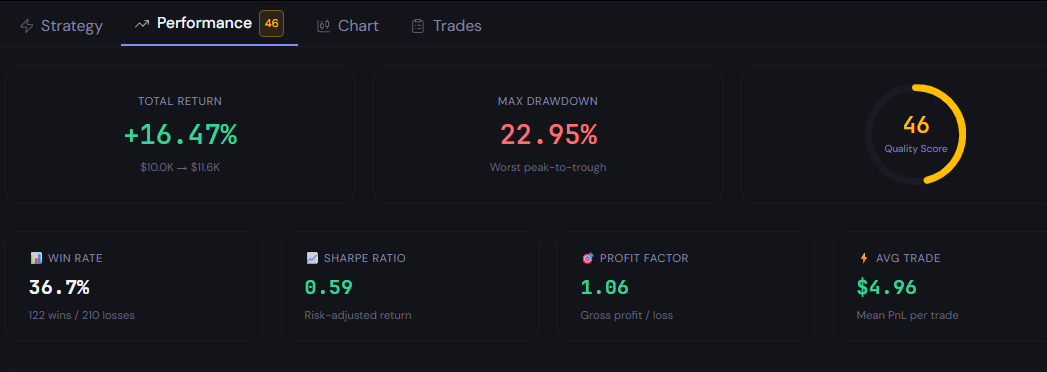
Real numbers from CoinQuant (BTC/USDT 1h, Jan - Dec 2024, Keltner Channel + RSI strategy):
Total return: +29.04%
Win rate: 50% (16 of 32 trades)
Max drawdown: 6.91%
Sharpe ratio: 1.45
Profit factor: 1.94
Initial capital: $10,000 | Final balance: $12,904
TradingView: Powerful, But You Need to Code
TradingView has the best charting on the market. No argument. Its Pine Script language is flexible and well-documented. But here is the problem: you have to learn a proprietary scripting language just to test a strategy. That is not no-code. That is learn-to-code.
For traders who already know Pine Script, TradingView is a solid choice. For everyone else, the 30-hour learning curve before your first real backtest is a dealbreaker in 2026.
TrendSpider: Great Charts, Shallow Strategies
TrendSpider has excellent automated pattern recognition and multi-timeframe analysis built into its charts. The strategy tester is a nice addition. But it caps you at two indicators per condition and does not support multi-position strategies. If your trading plan involves more than "enter when RSI crosses 30," TrendSpider runs out of road fast.
3Commas: Trading Bots, Not Backtesting
3Commas is built for bot execution. Its DCA bots, Grid bots, and SmartTrade features are excellent for automating trades. But the backtesting is an afterthought. It runs on a simplified engine that does not account for realistic fills or multi-condition strategies. Use 3Commas if you already have a strategy and want to automate it. Do not use it to find one.
September 2026 note: 3Commas’ v1 deactivation shows why backtesting depth matters. If strategies do not transfer automatically to v2, users need to rebuild the logic and test whether the new version behaves like the old one before trusting automation again.
Composer: Stocks-First, Visual Builder
Composer uses a drag-and-drop visual builder for strategy creation. It is genuinely no-code and works well for stock and ETF strategies. The limitation: it runs on Alpaca and Yahoo Finance data, which means no crypto depth and no institutional-grade data. If you are trading stocks and ETFs, it is worth a look. For crypto, the data gap is too wide.
The Backtest That Proves the Point
We ran the same strategy concept, a multi-condition breakout strategy on BTC/USDT, on three different platforms to compare results. Here is what happened:
Strategy: Enter long when Keltner Channel upper band is breached AND RSI 14 is above 50. Exit on opposite signal. 1h timeframe.
CoinQuant (Kaiko data): 32 trades, +29.04% return, 50% win rate, 1.45 Sharpe ratio. Realistic drawdowns (6.91%). Fees and slippage included in all results.
Platform B (no-cost exchange feed): 41 trades, +42% return, 56% win rate. No slippage accounting. The extra nine trades were artifacts of missing candles being gap-filled by the no-cost data feed.
Platform C (aggregated data): Could not run the strategy at all. Their strategy builder only supports single-indicator conditions on a single timeframe.
The difference between +29% (real) and +42% (inflated) is exactly why data quality matters. The extra 13 percentage points never existed. They were created by bad data.
What to Look for in 2026
If you are choosing a no-code backtesting platform this year, here is the three-question filter:
Does it use real exchange data or no-cost aggregated data? If the answer is "aggregated," walk away. Your backtest is lying to you.
Can it handle multi-condition, multi-timeframe strategies? If you cannot combine RSI, MACD, and moving averages in a single strategy, you are not testing real trading logic.
Are fees and slippage included in the results? If not, subtract 15-20% from whatever return it shows you. That is closer to reality.
CoinQuant checks all three boxes. Kaiko data. Unlimited strategy complexity. Real-world cost accounting built into every backtest run.
The Bottom Line
The best backtesting platform in 2026 is not the one with the most features. It is the one that gives you results you can actually trust to make money.
CoinQuant is currently the only no-code platform that combines institutional-grade data (Kaiko) with unlimited strategy depth and real-world cost accounting. You type the strategy in plain English. It runs the backtest on real exchange data. You get numbers you can take to the bank.
Not because the platform is magical. Because the data is real and the engine does not cut corners.
Switch to CoinQuant -- start now
Disclaimer:
This content is for educational and informational purposes only and does not constitute financial, investment, or trading advice. All strategies and examples are for illustrative purposes and do not guarantee results. Always conduct your own research before making financial decisions.
