
Best AI Agent Backtesting Tools That Won't Break the Bank: 2026 Guide
.png)
The market for affordable AI agent backtesting tools has changed significantly in the past two years. Access to institutional-quality backtesting was previously gated behind expensive subscriptions, coding prerequisites, or complex API setups. In 2026, several platforms offer serious backtesting capability at low cost or no-cost-to-start tiers. The differences lie in what type of strategy input each accepts, what data quality underpins the results, and how deep the metric set goes. This guide breaks down the leading options, compares them on the dimensions that matter for serious strategy research, and clarifies which is right for which type of trader.
The Key Criteria for Evaluating Backtesting Tools
Before comparing platforms, it helps to define what matters. Not all backtesting tools deliver the same quality of output. The five criteria below separate tools that produce meaningful results from those that produce results that look convincing but may not reflect real trading conditions.
Platform Comparison: AI Agent Backtesting Tools in 2026
CoinQuant
CoinQuant is an AI trading platform that accepts natural language strategy descriptions and runs backtests against Kaiko institutional data. The input is a sentence. The output is a full metric set: 17 metrics including Sharpe Ratio, Sortino Ratio, Profit Factor, Max Drawdown, CAGR, and a proprietary Strategy Quality Score (SQS).
The data advantage is concrete: Kaiko data covers Binance, Coinbase, and Kraken, with Bitcoin history from 2017. That covers the 2018 bear market, March 2020 crash, 2021 bull run, and 2022 drawdown. Running a strategy across those four regimes tells you significantly more than a recent 6-month window.
No coding is required. No Python, no Pine Script. You describe the strategy, the AI builds it, and results return in seconds. The platform is ready to start.
TradingView (Pine Script Backtesting)
TradingView is the most widely used charting platform among retail traders. Its Pine Script language allows traders to write strategy code that can be backtested directly on chart data. The backtesting module returns key metrics including net profit, max drawdown, Sharpe ratio (on higher plans), and trade-by-trade breakdown.
The constraint: Pine Script is a coding language. Writing a reliable strategy script requires learning the syntax, understanding how TradingView's strategy framework handles orders and fills, and debugging any errors in the logic. For traders without a coding background, the entry barrier is significant.
TradingView has a current pricing with limitations on the number of indicators, real-time data, and bars of history available. The backtesting is solid, but accessing long historical windows and advanced metrics requires a paid subscription.
QuantConnect
QuantConnect is an open-source algorithmic trading platform that runs strategy backtests in Python and C#. It is used by professional quants and algorithmic traders at institutional and retail levels. The platform provides access to extensive historical data, including crypto, equities, forex, and futures.
The metric depth is excellent and the data quality is high. The constraint is the coding requirement: QuantConnect strategies are written in Python or C#. For traders without programming experience, QuantConnect is inaccessible without significant upfront investment in learning the language and the platform's framework.
QuantConnect has a cloud tier, which makes it affordable but not zero-code.
Backtesting.py (Python Library)
Backtesting.py is an open-source Python library for building and running strategy backtests. It is code-first, requiring Python programming knowledge. The output can be comprehensive if the trader builds out the analysis, but it requires manual work to produce the metric set that CoinQuant returns automatically.
Cost: no-cost. Accessibility: limited to traders with Python proficiency.
Full Comparison Table: 2026 AI Backtesting Tools
Where Each Platform Excels
.png)
CoinQuant excels when the goal is accessible, rapid strategy research without coding. Traders who want to test multiple strategy ideas quickly, compare metric sets across approaches, and evaluate risk-adjusted performance on institutional data will get the fastest iteration cycle on CoinQuant. The absence of a coding prerequisite means the time from strategy idea to backtest result is measured in seconds, not hours.
TradingView excels for traders who already know Pine Script or are willing to invest in learning it. The platform's ecosystem is large: there are thousands of publicly shared scripts that traders can study and adapt. If you want to build complex multi-condition strategies with precise order logic and already have coding ability, TradingView's backtesting environment is well-developed.
QuantConnect excels for professional-level algorithmic trading research. Traders building institutional-quality strategies across multiple asset classes, running portfolio-level simulations, or needing maximum flexibility in strategy logic will find QuantConnect's Python environment most capable. The price is the learning curve and setup time.
Backtesting.py is best suited to Python developers who want full control over the backtesting logic and are comfortable providing their own data feeds. It has no platform overhead but also no platform assistance.
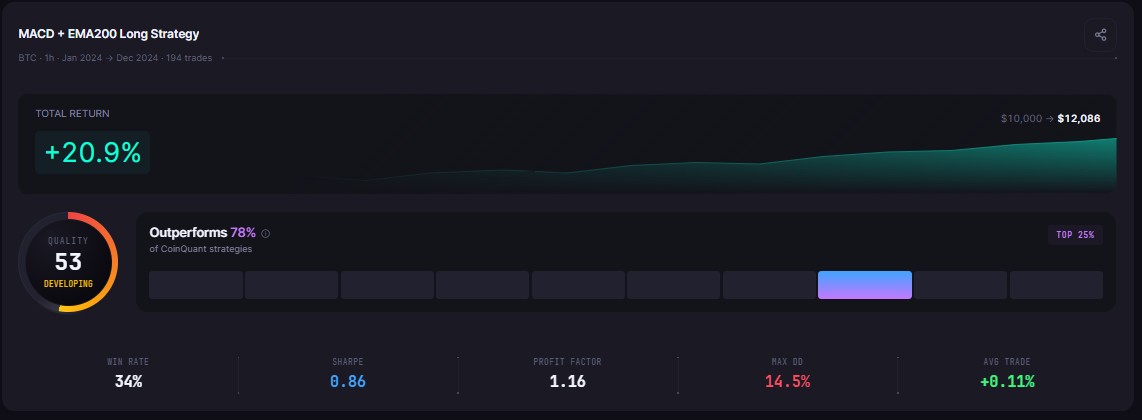

Cost Comparison
All four platforms offer some form of current access:
CoinQuant: ready to start, with access to the AI strategy builder and backtesting
TradingView: current pricing available; advanced features and full historical data require a paid plan (multiple tiers)
QuantConnect: cloud tier available; compute-intensive backtests or live trading require a paid plan
Backtesting.py: fully open-source, no cost
For traders who want to avoid a subscription before validating whether a platform meets their needs, CoinQuant's no-cost-to-start model allows a full strategy backtest on institutional data without upfront payment.
Who Each Platform Is Best For
CoinQuant is best for: traders with strategy ideas who want fast validation on institutional data, no coding required, and a full risk-adjusted metric set as default output.
TradingView is best for: traders who code or want to learn Pine Script, and who want to be part of a large community sharing scripts and strategy ideas.
QuantConnect is best for: algorithmic traders building multi-asset, portfolio-level strategies who need maximum flexibility and are comfortable with Python or C#.
Backtesting.py is best for: Python developers who want full customisation over their backtesting framework and provide their own data.
The distinction between CoinQuant and the code-first options is not just accessibility: it is the research workflow. CoinQuant is designed for fast iteration on strategy ideas. Code-first platforms are designed for building production-grade systems. Both have their place. Which one is right depends on where you are in the research process and whether you have coding skills.
Disclaimer:
This content is for educational and informational purposes only and does not constitute financial, investment, or trading advice. All strategies and examples are for illustrative purposes and do not guarantee results. Always conduct your own research before making financial decisions.
