
Affordable Crypto Backtesting Software: What Each Pricing Tier Actually Includes

Every backtesting platform search ends the same way: a wall of price pages, each describing its own plan structure, none of them telling you what the price actually buys in terms of trustworthy results. This article cuts through the pricing fog with a different structure. Instead of comparing subscription numbers, it compares value tiers: what free, mid-tier, and high-end options actually include for crypto strategy testing, and which tier is the real bargain for which trader.
The honest headline is that the most expensive tier buys institutional data and depth, the middle tier is where most serious retail traders should live, and the free tier is either a genuine developer tool or a trap, depending entirely on your skills.
The Free Tier: Open Source and Freemium
The free tier splits into two very different products.
Open-source frameworks: Backtrader and VectorBT. The license price is zero, and the total price is whatever your time is worth. You receive an engine and build everything around it: the data pipeline to source and clean historical crypto data, the cost model that applies realistic exchange fees, and the analysis code that turns raw outputs into metrics. For a developer with an existing environment, this is a legitimate free tier with no ceiling. For a trader without coding skills, it is the most expensive option in this article, paid in weeks of work for results that depend on your own data quality.
Freemium charting platforms with testers. The classic example is TradingView, whose free tier includes charting and access to its strategy tester with plan-dependent limits. What you actually get: testing on the platform's aggregated data, cost settings you must configure yourself, and a results panel that summarizes rather than validates. The free tier is a genuine tool for quick checks of simple ideas, and it is not a validation platform.
The free tier's shared rule: you are either contributing skills (open source) or accepting constraints (freemium). Free is a trade, not a gift.
The Mid Tier: Where Serious Retail Validation Lives
The mid tier is where crypto strategy validation actually happens: platforms that are not free but do not require an enterprise budget, offering maintained data, modeled costs, and complete metrics without a coding project attached.
What the mid tier should include, and what separates the honest entries from the expensive-looking ones:
Maintained exchange data. The platform sources, cleans, and updates historical data for the pairs you trade. You are paying to not run a data pipeline
Costs modeled by default. Fees and realistic execution assumptions are part of every run, not optional settings that silently default to zero
A complete metrics set. Total return, total trades, win rate, profit factor, Sharpe, max drawdown, and fees on every backtest, not a headline number
No-code strategy expression. The tier's whole point is that validation is not gated by programming
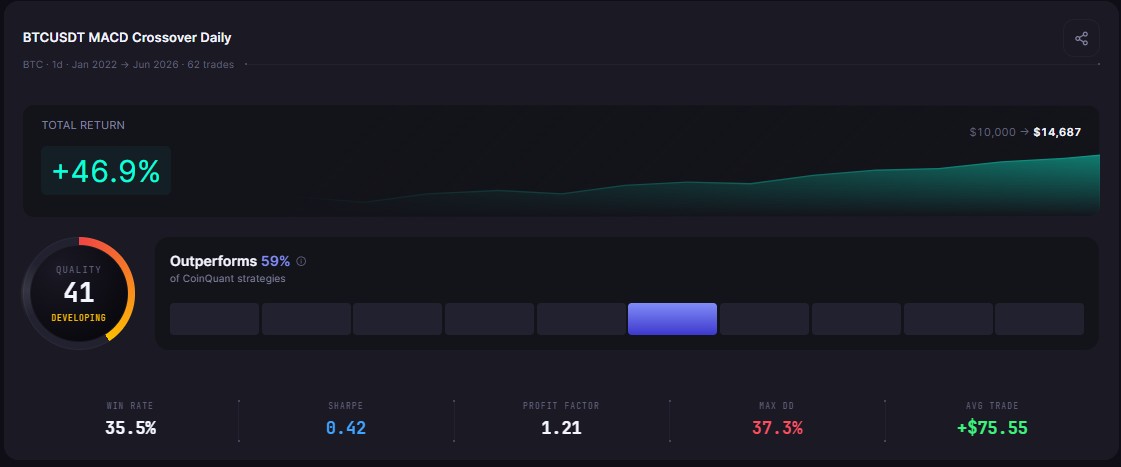
CoinQuant is the reference entry in this tier: Kaiko-collected exchange data, 0.1% taker modeled by default, the full metrics suite on every run, plain-English strategy descriptions, and credit-based pricing with no fixed cap on backtests. The pricing model matters here: credit-based plans mean you pay for the research you run rather than a flat subscription that charges the same whether you test once a week or five times a day.
The High Tier: Institutional Depth, Institutional Price
The top tier is built for professional firms: cloud platforms with institutional data feeds, global market coverage, API-scale infrastructure, and team collaboration. QuantConnect and its peers sit here, alongside enterprise data subscriptions.
What you actually get at this tier is real: deeper data history, more venues, infrastructure scale, and support contracts. What you also get is a cost structure designed for businesses with research budgets. A retail trader validating a personal Bitcoin strategy on institutional infrastructure is renting a warehouse to store a bicycle.
The Value Comparison Table
| Tier | What you get | What it costs you | Best for |
|---|---|---|---|
| Open source (Backtrader, VectorBT) | Full engine, total control | License free; your time for data, costs, code | Developers building custom research stacks |
| Freemium testers (TradingView and similar) | Charting plus quick testing | Plan limits, aggregated data, manual cost setup | Screening ideas, first looks |
| Mid tier (CoinQuant) | Maintained exchange data, costs by default, full metrics, no code | Credit-based research spend | Serious retail validation without infrastructure work |
| High tier (QuantConnect and similar) | Institutional data, infrastructure, support | Institutional subscription or credit scale | Firms with research budgets |
The Honest Tier Verdicts
Free tier, open source: the best deal in backtesting, only for developers. The engine is genuinely excellent and genuinely free. The pipeline is the price
Free tier, freemium: fine for screening, dangerous for funding. A quick-check result on aggregated data with unmodeled costs is not a funding decision
Mid tier: the value answer for most crypto traders. Institutional-grade data and honest cost modeling without the enterprise overhead, and without the engineering project
High tier: correct for firms, wasteful for individuals. The extra spend buys infrastructure most retail strategies never touch
Common Mistakes to Avoid
Comparing sticker prices instead of what each tier includes. A free tool that costs you a data pipeline is not cheaper, it is differently priced
Funding strategies validated on the free tier. If costs were not modeled, the strategy has not been tested, whatever the tier cost
Paying for institutional infrastructure you will not use. The high tier's value is scale, and scale you do not need is a donation
Assuming paid always means better. The mid tier is only worth its price when the data, costs, and metrics are the real thing
Ignoring the pricing model. A flat subscription and a credit-based plan charge very differently for the same research habit
The Practical Lesson
Value tiers are defined by what the price buys: maintained data, modeled costs, and complete metrics are the purchases that matter
Open source is free only for developers; freemium is for screening; the mid tier is where serious retail validation happens; the high tier is for firms
Match the tier to the research habit, and count your time in the price
The best value is not the cheapest tier, it is the tier where trustworthy results cost the least total
The affordable backtesting software question is really a question about what you are willing to build, accept, or pay. Build your own pipeline and open source is unbeatable. Accept aggregated data and freemium works for quick checks. Pay for maintained data, modeled costs, and complete metrics, and the mid tier delivers institutional-grade validation without institutional pricing.
Get institutional-grade validation without the institutional price tag or the engineering project. See the value tier on CoinQuant
Disclaimer:
This content is for educational and informational purposes only and does not constitute financial, investment, or trading advice. All strategies and examples are for illustrative purposes and do not guarantee results. Always conduct your own research before making financial decisions.
