
What Is No-Code Trading and How Does It Actually Work?
.png)
If you have ever tried to backtest a trading strategy, you know the bottleneck: learning to code. Pine Script for TradingView. Python for backtrader. MQL for MetaTrader. Before you can test a single idea, you are spending hours, days, or weeks learning a programming language you did not sign up for.
No-code trading removes that bottleneck entirely. Here is what it actually is, how it works, and why it is changing who gets to build and test trading strategies in 2026.
What Is No-Code Trading?
No-code trading means you describe your strategy in plain English, and the platform handles everything else: data, backtest execution, metrics, and results. You do not write a single line of code.
It is not a dumbed-down version of trading. It is a different interface layer. The same backtesting engine that used to require Python scripts or Pine Script now accepts natural language. You say "Enter long on BTC when RSI crosses above 30 and exit when it crosses above 70." The AI translates that into a professional backtest configuration and runs it on real exchange data.
The result is the same as if an experienced quant coded it by hand. The difference is the time it takes: two minutes instead of two days.
How It Actually Works in Practice
Here is a real example. We wanted to test a Keltner Channel breakout strategy on Bitcoin with an RSI filter. Here is exactly what we typed into CoinQuant, the no-code AI trading platform:
Backtest BTC/USDT 1h from Jan 1 2024 to Dec 31 2024. Enter long when price breaks above Keltner Channel upper band and RSI 14 is above 50. Exit when price breaks below Keltner Channel lower band or RSI 14 drops below 40. Initial capital $10,000.
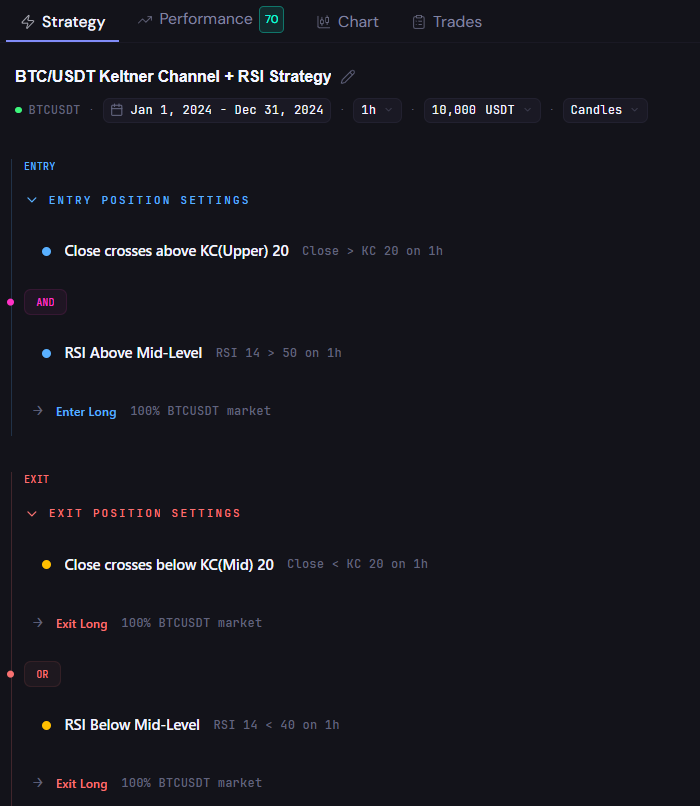
That is the full strategy. No syntax. No debugging. No checking whether the indicator period is correct. The platform parsed the plain English, built the strategy, ran the backtest on Kaiko exchange data, and returned these results in under two minutes:
BTC/USDT Keltner Channel + RSI Strategy (1h, Jan - Dec 2024)
Total return: +29.04%
Win rate: 50% (16 winning trades out of 32)
Max drawdown: 6.91%
Sharpe ratio: 1.45
Profit factor: 1.94
Initial capital: $10,000 | Final balance: $12,904
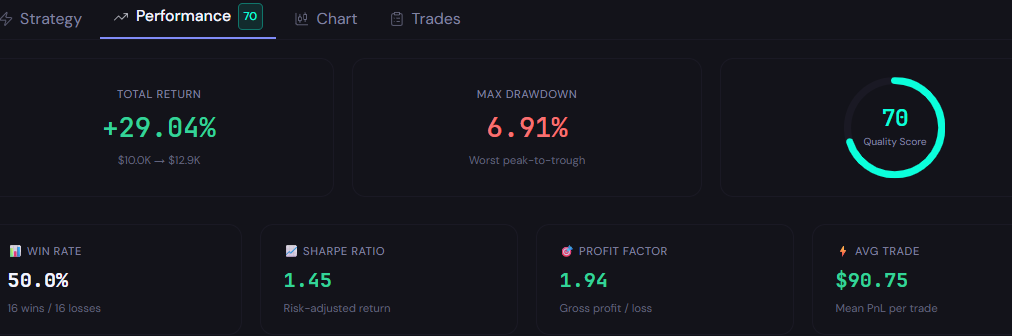
These are real numbers running on institutional-grade Kaiko data with fees and slippage included. The strategy worked. And we never touched a line of code.
What Happens Behind the Scenes
When you type a strategy in plain English, here is what the platform actually does:
Step 1: The natural language processing layer parses your description and extracts the strategy components: symbols, timeframes, entry conditions, exit conditions, position sizing, and date range.
Step 2: It maps your plain English conditions to actual technical indicators. "RSI is above 50" becomes RSI(14) greater than 50. "MACD line crosses above signal" becomes a proper crossover condition. The platform knows the standard parameters for each indicator.
Step 3: It pulls real exchange data. CoinQuant uses Kaiko data, the same provider used by hedge funds and institutional trading desks. This means tick-level data from Binance, Coinbase, and Kraken, back to 2017 for BTC. No gap-filling. No interpolation. No synthetic data.
Step 4: It simulates execution in chronological order. Every candle is evaluated against your entry and exit conditions. When conditions are met, a simulated trade is opened at the next available price. Fees and slippage are applied. Position sizing is respected.
Step 5: It calculates the full set of professional metrics: total return, win rate, max drawdown, Sharpe ratio, profit factor, equity curve, and trade-by-trade breakdown. You see exactly what would have happened if you had traded this strategy live.
What You Can Actually Build Without Code
No-code trading is not limited to simple single-indicator strategies. Here is what you can build on a modern no-code AI trading platform:
Multi-condition strategies: Combine RSI, MACD, moving averages, Bollinger Bands, and volume indicators in a single strategy. Entry requires three conditions to all be true. Exit triggers on any one of two conditions.
Multi-timeframe strategies: Check the daily trend with one set of indicators, then time entries on the 1-hour chart with a different set. The platform handles the logic across timeframes for you.
Multi-position strategies: Run simultaneous positions across different assets with correlated risk management. The platform tracks each position independently while respecting your total portfolio allocation.
Grid and DCA strategies: Set up automated accumulation strategies with multiple entry levels and dynamic position sizing. No code needed to define grid spacing, position increments, or exit tiers.
These are not toy strategies. They are the kind of systematic approaches professional traders use every day. The difference is that in 2026, you do not need to hire a developer or learn Python to build them.
The No-Code Advantage: Speed of Iteration
The biggest advantage of no-code trading is not convenience. It is speed.
A coder testing a strategy goes through this loop: write code, debug, run backtest, interpret results, rewrite code, debug, run backtest, interpret results. Each cycle takes 30 to 60 minutes.
A no-code trader goes through this loop: describe strategy, run backtest, interpret results, tweak description, run backtest, interpret results. Each cycle takes two to three minutes.
That means in the time a coder tests three strategy variations, a no-code trader tests 15. The difference compounds. The no-code trader finds the edge faster simply because they can iterate faster.
Here is what that looks like in practice. Testing the Keltner Channel strategy on BTC/USDT:
Variation 1: Keltner Channel breakout only, no RSI filter. Return: +12.3%. Max drawdown: 11.2%. Not great. Too many false breakouts.
Variation 2: Add RSI 14 above 50 as an entry filter. Return: +29.04%. Max drawdown: 6.91%. Much better. The RSI filter eliminated the weakest breakouts.
Variation 3: Change exit to trailing stop instead of opposite signal. Return: +24.7%. Max drawdown: 5.2%. Lower return but smoother equity curve. Worth considering for live trading.
Three variations. Less than 10 minutes total. This is what no-code trading actually does. It removes the friction between having an idea and testing it.
What No-Code Trading Is Not
No-code trading is not a magic profit machine. It does not guarantee winning strategies. It does not replace the need to understand trading concepts like risk management, position sizing, and market conditions.
What it does is remove the technical barrier. Before no-code, you needed two skills to backtest a strategy: trading knowledge AND programming ability. Now you only need the trading knowledge.
That is a big deal. It means traders who have spent years developing market intuition but never learned to code can finally test their ideas systematically. It means strategy ideas can be validated in minutes instead of being shelved because "I do not know how to code this."
How to Get Started With No-Code Trading
If you want to try no-code trading today, here is the simplest path:
Start with a strategy you already understand. Do not try to build a 10-indicator monster on day one. Pick something simple: RSI oversold entries, MACD crossovers, or moving average crosses.
Describe it in plain English, exactly as you would explain it to another trader. Be specific about the symbol, timeframe, entry conditions, exit conditions, and date range.
Review the results critically. A 90% win rate with three trades is worthless. A 40% win rate with 100 trades and a 2:1 profit factor is something real. Look at the full picture, not just the return.
Iterate. If the strategy loses money with no filter, add a trend filter. If the drawdowns are too large, add a tighter stop loss. Test each change independently so you know what moved the needle.
When you find something that works across multiple market conditions, forward test it on a small amount of capital before scaling up.
The Bottom Line
No-code trading is not a gimmick. It is a new interface layer for systematic trading that removes the biggest bottleneck between traders and strategy testing: code.
In 2026, the best no-code AI trading platforms let you describe a multi-condition, multi-timeframe strategy in plain English and get institutional-grade backtest results in under two minutes. The strategy, the data, and the metrics are real. Only the way you build it has changed.
That matters because it changes who gets to participate in systematic trading. Not just coders. Not just quants. Anyone who understands markets and can describe their edge in plain English.
Backtest your first strategy in seconds. No code. No Pine Script. No Python.
Disclaimer:
This article is for educational and informational purposes only. It does not constitute financial advice. Past backtest results do not guarantee future performance. Trading cryptocurrencies involves substantial risk of loss.
Key Takeaway
