
What Is No-Code Backtesting? How Modern Traders Test Strategies Without Writing a Line of Code
Every crypto trader has had this moment: you spot a pattern on a chart, or someone tells you about a strategy that printed money last year. You want to know: does it actually work?
The answer used to require learning Pine Script, Python, or hiring a developer. Today, you type your strategy in plain English and hit run. That is no-code backtesting, and it is changing who gets to build a data-driven edge in crypto.
What Is Backtesting, Exactly?
Backtesting is the process of running a trading strategy against historical market data to see how it would have performed. You define the rules, when to enter, when to exit, which assets, what position size, and the backtester replays those rules across months or years of price history.
The output is a report card for your strategy:
Total return: how much money you would have made or lost
Win rate: what percentage of trades were profitable
Max drawdown: the worst peak-to-trough loss you would have endured
Sharpe ratio: return per unit of risk (above 1.0 is good, above 1.5 is excellent)
Profit factor: gross profit divided by gross loss (above 1.5 is solid)
Expectancy: the average profit or loss per trade
Without a backtest, you are trading blind. You have no idea whether your strategy has an edge or just happened to win on the last three trades you noticed.
The Old Way: Coding Required
For years, backtesting was a coding problem. You needed:
Pine Script: TradingView's proprietary language. 40-80 lines of code for a basic strategy. Weeks to learn for non-programmers.
Python + QuantConnect/Backtrader: unlimited power, but you are building a full software project. Data pipelines, indicator calculations, execution logic, bug fixes.
Excel: manually tracking signals in a spreadsheet. Works for simple ideas but collapses under complexity or large datasets.
Most traders never backtested at all. The friction was too high. They traded on feel, or they tested strategies by watching charts, which is not testing, it is pattern-hunting with hindsight.
The New Way: Plain English, Real Results
No-code backtesting platforms let you describe your strategy the way you would explain it to another trader. CoinQuant, the no-code AI trading platform, generates the logic, fetches the data, runs the backtest, and scores the results: all automatically.
Here is what that looks like on CoinQuant:
You type: Backtest BTC/USDT daily from Jan 1 2019 to Mar 31 2026. Enter when the 50-day SMA crosses above the 200-day SMA. Exit when the 50-day SMA crosses below the 200-day SMA. Initial capital $10,000.

You hit run. The backtester processes 7+ years of Bitcoin daily data against your rules. In under 60 seconds, you get this:
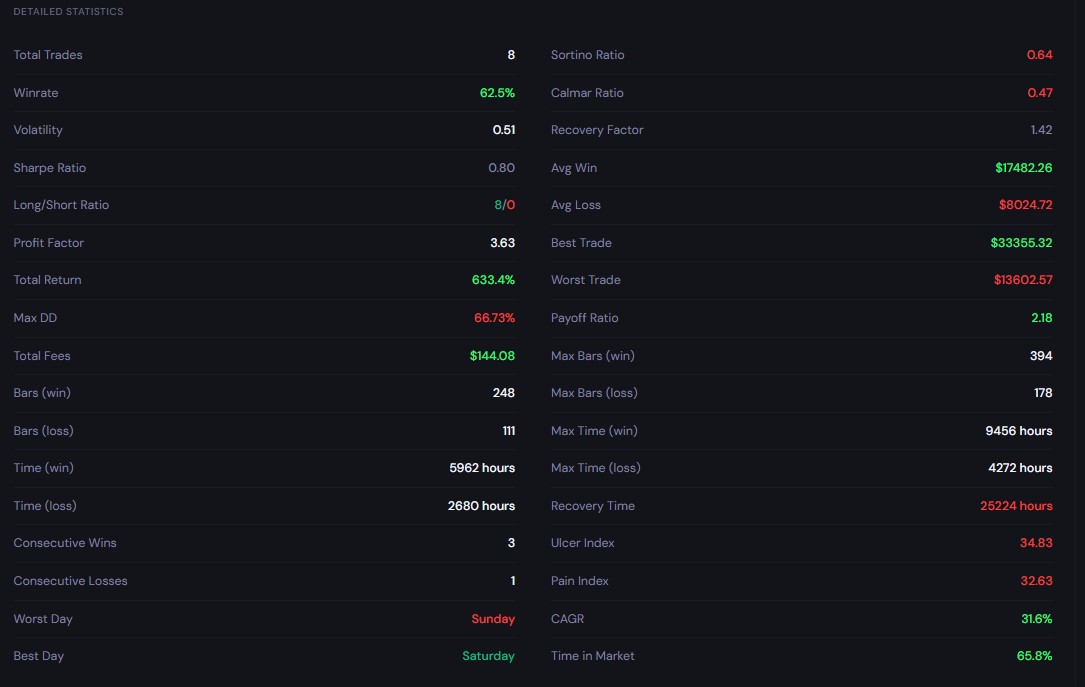
Golden Cross / Death Cross | BTC/USDT Daily | Jan 2019 - Mar 2026
Total Return: +633% ($10,000 to $73,337)
CAGR: 31.6% annualized
Sharpe Ratio: 0.80 (at the threshold of acceptable risk-adjusted return)
Win Rate: 62.5% (5 wins, 3 losses)
Max Drawdown: 66.7% (a brutal peak-to-trough decline)
Profit Factor: 3.63 (winners far outpaced losers)
Total Trades: 8 (only 8 signals in over 7 years)

Those eight numbers tell you everything you need to know. The strategy returned 6x your capital, outstanding. But it also drew down 67% at one point, meaning your $10,000 went to $33,000, then dropped to about $11,000 before recovering. Four out of five traders would not survive that. And you only got 8 trades in 7 years, a lot of sitting and waiting.
You know all of this in under a minute. No code. No debugging. No wondering if your data pipeline is correct.
What Makes No-Code Backtesting Different from Code?
There are two key advantages no-code brings:
1. You stay in trading mode
When you code a backtester, you switch between two completely different mental models: strategy logic (what should happen in the market) and programming logic (how to express that in code). Every syntax error, every API call, every data formatting issue drags you out of trading thinking and into debugging.
No-code keeps you thinking about edge, conditions, and risk, not semicolons and tracebacks.
2. Iteration speed is 10-20x faster
Traders rarely get a strategy right on the first try. The real edge comes from iteration: test, tweak, test again. In code, each iteration means rewriting lines of logic and debugging. In no-code, you change one condition or one parameter and re-run. A process that takes hours in code takes minutes in no-code. Over a day of research, you test 20 ideas instead of 3.
The Infrastructure That Runs Under the Hood
No-code does not mean simple underneath. CoinQuant's backtester runs on:
Tick-level data from Kaiko: covering Binance, Coinbase, Kraken, and other major exchanges
Realistic execution modeling: fees, slippage, and spread are simulated as they would occur in live trading
Multi-asset coverage: crypto, stocks, forex, and commodities via FMP
Professional validation tools: strategy optimization, walk-forward testing, and Monte Carlo simulations
This is the same infrastructure institutional quant funds use, just accessed through plain English instead of Python terminals.
When You Still Need Code
No-code backtesting covers 95% of what retail and pro traders need. But there are cases where code is still the right tool:
Proprietary indicators: if you have developed a completely novel indicator that no platform supports, you need code.
Live trading bots: no-code backtesting platforms are for research and validation. Automating live execution still requires code or a trading bot platform.
Custom research: if you are doing statistical analysis in a Jupyter notebook for academic or institutional purposes, code gives full flexibility.
For strategy testing and validation, which is what 95% of traders need, no-code has already won.
Start Backtesting
The gap between traders who make money and those who do not is rarely about intelligence or access to special information. It is about process. Backtesting is the process that separates conviction from guessing.
Test any strategy in plain English. No code, no Pine Script, real exchange data. ready to start.
Disclaimer:
This content is for educational and informational purposes only and does not constitute financial, investment, or trading advice. All strategies and examples are for illustrative purposes only. Past performance does not guarantee future results.
Key Takeaway
