
What Is AI Strategy Building? How Traders Turn a Plain-English Idea Into a Tested Strategy
.png)
AI strategy building in crypto is the process of turning a plain-English trading idea into a fully structured, tested strategy without writing any code. AI strategy building crypto tools handle the translation from idea to logic for you. You describe what you want in a sentence, an AI agent builds the logic, and a backtest on real data tells you whether the idea holds up. The barrier moves from programming to thinking, which is where it belongs.
This article explains the workflow end to end: how a rough idea becomes a structured strategy, how it gets tested against real market data, how to read the metrics that come back, and how to iterate. It closes with the common mistakes that make the whole process worthless if you get them wrong.
The Core Idea
Traditional strategy building forced a choice. Either you learned to code, in Python or Pine Script, or you spent time configuring a visual builder, dragging indicators and setting parameters by hand. Both put a technical wall between you and the simple question you actually wanted answered: does my idea work?
AI strategy building removes that wall. You state the idea in plain language, and the system handles the translation into testable logic. The skill that matters shifts from technical implementation to clear strategy thinking.
The Workflow, Step by Step
The path from idea to tested strategy has five stages. Each one is concrete.
1. Start With a Plain-English Idea
Write the strategy as one clear sentence. Include the asset, the timeframe, the entry, and the exit. Here is an example you could type directly:
"Buy BTCUSDT on the daily chart when the 50-day moving average crosses above the 200-day moving average, and sell when it crosses back below. No leverage."
That sentence has everything the system needs. If you can state it this cleanly, it can be built and tested.
.png)
2. Let the AI Structure It
The AI agent parses your sentence and turns it into structured strategy logic: it identifies the indicators (two moving averages), the conditions (the crossover), the direction (long only), and the risk rules (no leverage). What used to take an hour of configuration or a block of code now takes seconds.
This is the step that used to require a developer. Now it is a translation the AI handles, so you can focus on whether the idea is sound rather than how to encode it.
3. Backtest on Real Data
The structured strategy runs against real historical prices. On CoinQuant that means Kaiko institutional data, covering Binance, Coinbase, and Kraken, going back to 2017 for Bitcoin. Fees are included, so the result reflects real trading costs, not an idealized fantasy.
Deep history matters because it lets a single test cover the 2018 bear market, the 2021 bull run, and the 2022 drawdown. A strategy that only saw a calm recent stretch has not really been tested.
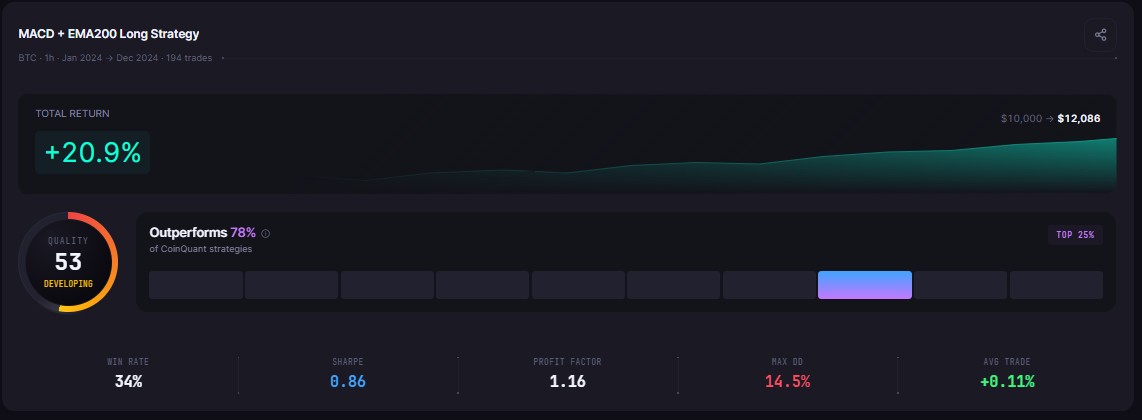
4. Read the Metrics
The backtest returns a full set of numbers. Learning to read them is the actual skill.
A strategy with a great return and a 60% drawdown survived on paper through a loss most traders would have bailed on. The metrics together tell you the real story.
5. Iterate
The first backtest is a starting point, not a verdict. Change one thing at a time and rerun.
Try a different exit condition
Test the same rules on a different timeframe
Add a filter to cut the worst entries
Run it across both a bull leg and a bear leg to check it holds up in more than one regime
Because building and testing take seconds, you can run many variations quickly and compare them directly. Iteration is where a rough idea becomes a strategy you actually understand.
A Concrete Example, End to End
Say you believe Bitcoin trends strongly once it gets going. In plain English: "Buy BTCUSDT daily when the 50-day moving average crosses above the 200-day, sell when it crosses below."
You type it in. The AI structures it into a moving-average crossover strategy. It runs against Kaiko data with fees included, and returns the metrics. You see the return, but you also see the drawdown and profit factor. Maybe the return is decent but the drawdown is uncomfortable. So you iterate: test it on the weekly timeframe, or add a condition. Within minutes you have gone from a hunch to evidence.
That loop, idea to structure to test to metrics to iteration, is AI strategy building.
Common Mistakes to Avoid
The workflow is only as good as how you use it. These errors quietly ruin the process.
Optimizing for the highest historical return. Tuning parameters until the past looks perfect is curve-fitting. Those strategies look brilliant on old data and fail on new data. Stability across conditions beats a peak number in one period.
Trusting win rate alone. A high win rate with a few oversized losses is still a losing strategy. Always read the profit factor and drawdown next to it.
Testing one short, calm period. A strategy that never saw a downtrend has not been stress-tested. Cover a bear leg too.
Vague strategy descriptions. "Buy when it looks good" cannot be built. Be specific about asset, timeframe, entry, and exit.
Treating the first result as final. One backtest is a hypothesis. Vary a parameter and confirm the edge holds before trusting it.
Why This Changes Who Can Test Strategies
Two years ago, getting institutional-quality metrics on a custom strategy meant either hiring a developer or spending months learning to code. That put systematic testing out of reach for most traders.
AI strategy building drops that barrier to near zero. If you can describe an idea clearly, you can test it properly. The advantage now goes to traders who understand what the metrics mean, not to those who can write the most code.
Describe a Strategy in Plain English on CoinQuant
You do not need Python, Pine Script, or any setup. Describe your idea in one sentence, run it on real Bitcoin data with fees included, and read the full metrics for yourself.
Disclaimer:
This content is for educational and informational purposes only and does not constitute financial, investment, or trading advice. All strategies and examples are for illustrative purposes and do not guarantee results. Always conduct your own research before making financial decisions.
Key Takeaway
