
What Is a Trading Strategy Backtest? A Beginner's Plain-English Guide
A trading strategy backtest is a simple idea with a lot of power: take a set of rules, run them against real historical prices, and see what would have happened. It turns "I think this works" into "here is what it did."
This is a plain-English guide to what a trading strategy backtest is, what it can and cannot tell you, and how to read one without fooling yourself. No maths degree required.
The Definition
A backtest simulates a trading strategy on past data. It steps through history one bar at a time, applies your entry and exit rules exactly as written, and records every trade the rules would have made.
At the end you get a result: how much the strategy made or lost, how often it was right, and how much risk it took to get there. It is a rehearsal of your idea against the market that already happened.
What a Backtest Is Not
This is where most beginners go wrong, so it is worth being blunt.
A backtest is not a prediction. It tells you what would have happened, not what will happen.
A backtest is not proof. A good historical result can still fail live if the market regime changes.
A backtest is not a single number. Total return alone hides the risk you took to earn it.
A backtest is a tool for rejecting bad ideas cheaply. That is its real value: it fails your weak strategies on a screen instead of in your account.
The Anatomy of a Backtest
Every backtest has the same moving parts:
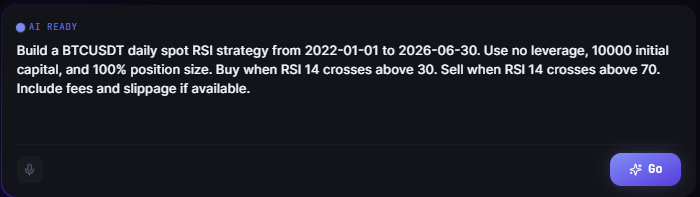
Rules. The entry and exit conditions, for example buy when RSI crosses above 30, sell when it crosses above 70.
Market and period. The asset, timeframe, and date range being tested.
Costs. Trading fees, and ideally slippage, so the result is realistic.
Results. Return, drawdown, win rate, and a risk-adjusted measure like the Sharpe ratio.
A Real Backtest, Read Properly
Here is a genuine backtest of a simple rule, run on CoinQuant with real data: buy Bitcoin when RSI(14) crosses above 30, sell when it crosses above 70. Daily, spot, 2022 to 2026, fees included, $10,000 starting capital.
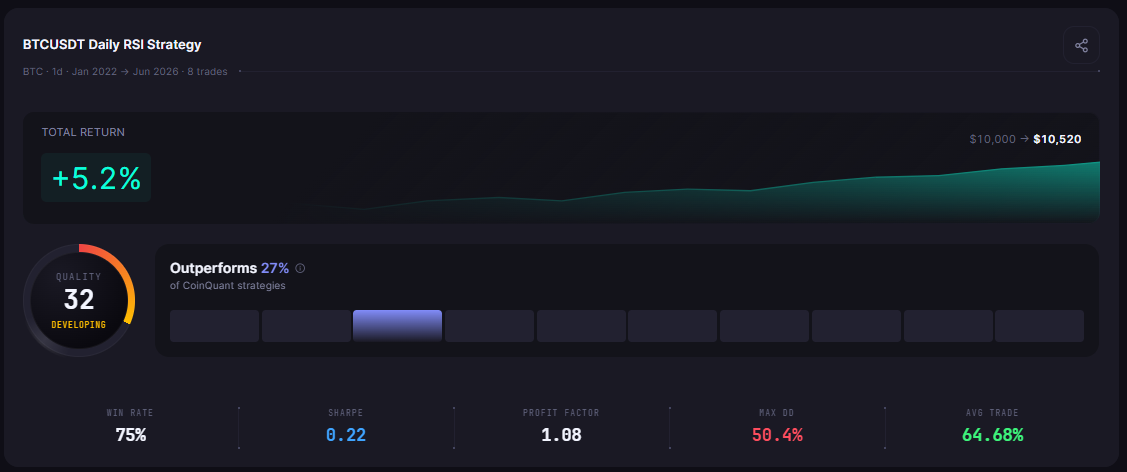
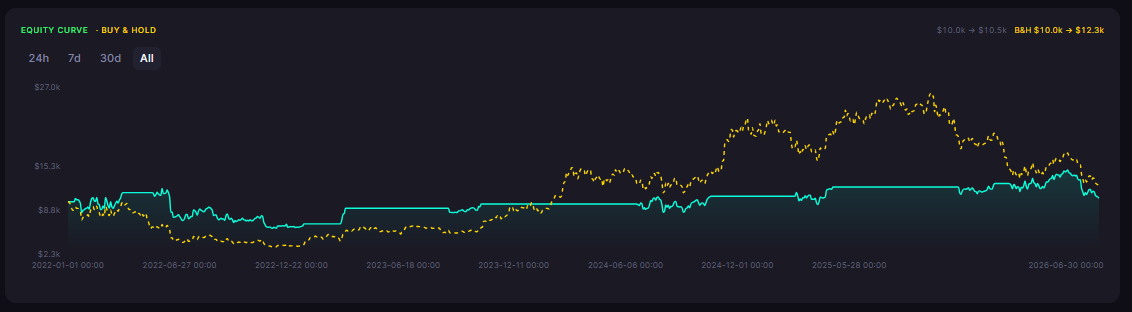
Read only the headline and this looks like a winning strategy: up 5.2% with a 75% win rate. Read the full picture and it looks far less appealing: you would have sat through a 50.4% drawdown for a modest return, and the low Sharpe confirms the return was not worth the risk. That contrast is the entire point of reading a backtest properly.
How to Read Any Backtest
Four questions, in order:
Did it make money, after fees?
What was the worst drawdown, and could you actually sit through it?
Is the sample big enough to trust, or is it a handful of lucky trades?
Does the risk-adjusted return (Sharpe) justify the risk?
A strategy has to pass all four, not just the first. Most do not, and finding that out on a backtest is exactly what saves your capital.
How to Run Your First One
You do not need to code. On a no-code platform you describe the strategy in plain English, choose the market and period, and run it. No Python. No Pine Script.
Start with one clear rule. Read all the metrics, not just the return. Then test the same rule on a different period to see if the result holds. That habit is the difference between trading on evidence and trading on hope.
The Takeaway
A trading strategy backtest is a rehearsal of your rules against real history. It cannot predict the future, but it can expose a weak idea before it costs you. Read the full picture, respect the drawdown, and test across more than one period. That is what a backtest is for.
A Backtest Versus a Forecast
The most useful mental model is this: a backtest is a rehearsal, not a prophecy. It tells you how a set of rules would have performed against history that already happened. It does not tell you what the market will do next.
This distinction sounds obvious and is constantly ignored. People run a backtest, see a good number, and treat it as a promise. It is not. It is evidence about the rules, useful for rejecting weak ideas, not a guarantee about the future.
Reading Our Example the Right Way
Take the simple RSI example: +5.2% return, 75% win rate, 50.4% max drawdown, Sharpe 0.22. A beginner reading only the first two numbers concludes this is a strong strategy. A trader reading all four concludes it is barely tradeable, because a 50% drawdown for a 5% return at a low Sharpe is a poor deal.
Same backtest, opposite conclusions, depending only on how many numbers you read. Learning to read all of them is the difference between being informed by a backtest and being fooled by one.
The Backtesting Workflow
Define the rules precisely. Vague ideas cannot be tested.
Choose the market and period deliberately, and plan to test more than one.
Run with fees included so the result is honest.
Read every metric, not just the return.
Re-test on unseen periods to check robustness before trusting anything.
Frequently Asked Questions
How many trades make a backtest trustworthy?
There is no magic number, but a handful of trades is not enough to distinguish skill from luck. More trades across more conditions gives more confidence. Our RSI example had only 8 trades, which is a caution flag on its own.
Can a backtest guarantee future profits?
No. It can only tell you how the rules performed on past data. Its real value is filtering out weak ideas before they cost you money.
Backtesting as a Habit, Not an Event
The traders who get the most from backtesting treat it as a routine, not a one-off. They do not run a single test, see a good number, and deploy. They test an idea, change one variable, test again, then test on a different period, building a picture of when the strategy works and when it breaks.
That habit is what separates a backtest that informs you from one that fools you. A single result on a single period is an anecdote. A pattern of results across many conditions is evidence. The goal is never a pretty equity curve on one chart, it is a strategy you understand well enough to trust, or to reject, on your own terms.
Run your first backtest free on CoinQuant
Describe a strategy in plain English and test it on real Kaiko data in minutes. No coding required.
Disclaimer:
This content is for educational and informational purposes only and does not constitute financial, investment, or trading advice. All strategies and examples are for illustrative purposes and do not guarantee results. Always conduct your own research before making financial decisions.
Key Takeaway
