
What Is a Trading Edge? How to Prove Yours With Backtesting (2026)

Every trading book, forum, and mentor says the same three words: find your edge. Almost none of them define it in a way you can check. So here is a version you can check.
An edge is not a feeling, a hot streak, or a story about a trade that worked. It is a measurable, repeatable expectation that a defined set of rules produces more value than it costs, across enough trades that luck stops being an explanation.
This article defines the concept precisely, then shows how to prove or disprove an edge using nothing but a backtest report and arithmetic.
What Is a Trading Edge, Concretely
Strip the mystique and an edge is a claim about a distribution. When the same rules are applied again and again, the average outcome is positive after costs.
That definition has four components, and a claim missing any of them is not an edge yet:
- A repeatable rule set. "Buy when I feel it" cannot have an edge, because it cannot be measured.
- A positive expectancy. The average result per trade, after fees, works out in your favor.
- Enough trades. Small samples produce streaks that look like edges and are not.
- Costs included. Fees and slippage are subtracted before the verdict, never after.
The edge in trading is the same object as the edge in any other repeated business: a small, durable advantage that compounds. The job of backtesting is to tell you whether you own one.
The Four Numbers That Prove or Bury an Edge
You do not need advanced statistics. Four figures from a standard report carry most of the load:
| Number | What it tells you about the edge | Warning sign |
|---|---|---|
| Win rate | How often trades end in profit | A high number hiding tiny average wins |
| Payoff ratio | Average win divided by average loss | Under 1.0, the wins must come very often |
| Profit factor | Gross profit per dollar of loss | Below 1.0 means the edge is negative |
| Total fees | What the activity cost to produce | Fast strategies paying more than they earn |
Then the arithmetic that combines them, expectancy: win rate times average win, minus loss rate times average loss, minus costs. Positive expectancy is the edge; everything else is commentary.
Three Real Profiles, Side by Side
The fastest way to internalize the idea is to look at actual tested strategies with very different edge profiles. All figures below come from CoinQuant library results on BTC daily data, 2021-2026, re-verified on 2026-09-22.
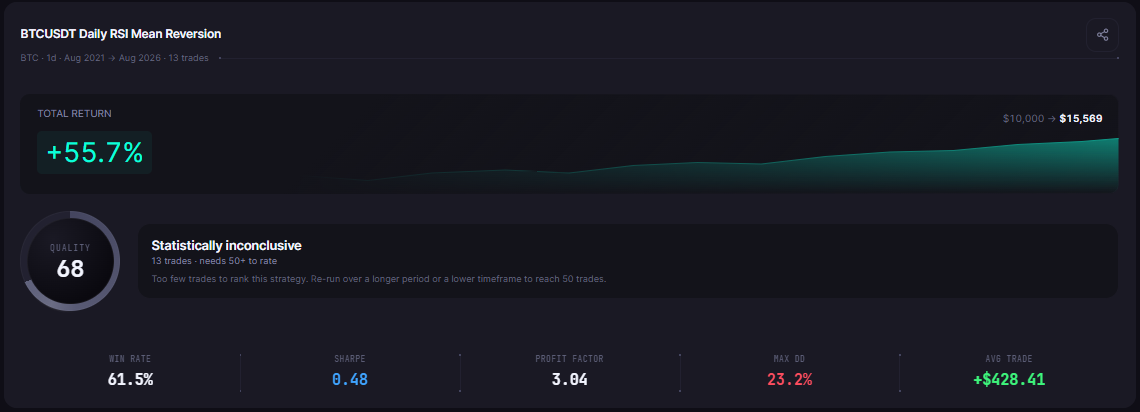
Profile 1: a clear edge. BTC RSI(14) Mean Reversion 1d returned +55.69% across 13 trades with a 61.5% win rate, a profit factor of 3.04, and a 23.19% maximum drawdown. Thirteen trades is a modest sample, but the profile is coherent: strong payoff, controlled drawdown, and costs of just $363.84.
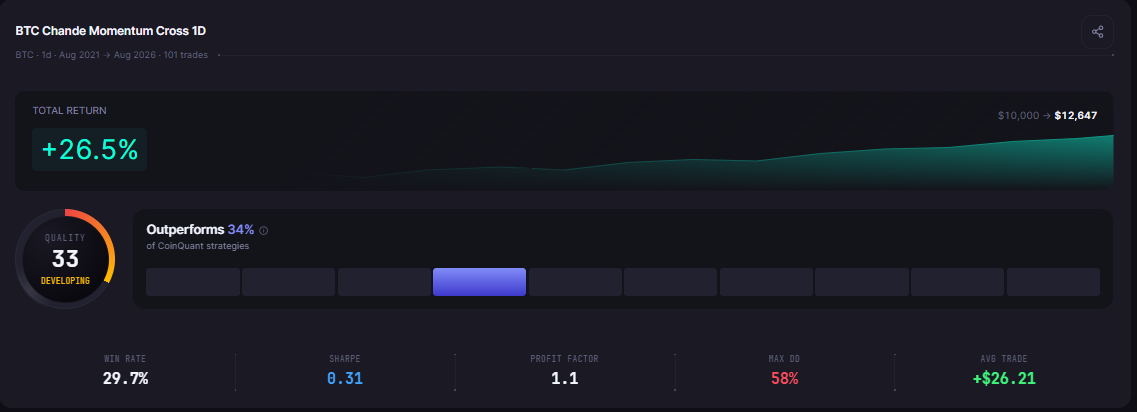
Profile 2: a thin edge under a cost tax. BTC Chande Momentum Cross 1D returned +26.47% across 101 trades, with a 29.7% win rate and a profit factor of 1.10. Notice the fee line: $2,309.19. The edge exists, and it spends most of its energy paying for its own activity.
Profile 3: no edge. A fast moving-average variant, ETH Hull MA Cross 1D 2021-2026, lost 50.15% across 202 trades with a profit factor of 0.89. That is what an honestly reported failed idea looks like, and it is just as valuable as the first two profiles.
Why Sample Size Sits Beside Everything
An edge is a statement about averages, and averages need samples. Thirteen trades can display a coherent profile; three trades cannot display anything. A common working filter: under ten trades, you have an anecdote with a chart attached.
More trades is not automatically better, though. Compare the three profiles above. Thirteen trades produced a cleaner edge than 101 trades did, because trade count and edge quality are different variables. What more trades do provide is confidence that the result is not one lucky sequence. When a strategy has both a large sample and a stable profit factor, the claim gets strong. When it has neither, the claim is a hope.
How to Prove Yours With Backtesting
The proof is a process, and it runs in seven steps. Each one is checkable in a single afternoon with a free trial.
- Write the rules down in plain English, exactly as you would trade them. If you cannot write them, you cannot test them.
- Test on a long window. Five years spanning different market regimes beats two comfortable ones.
- Read the costs. Fees should appear as a line item. Subtract them before believing anything.
- Compare against the baseline. Buy and hold is the bar. BTC buy and hold returned +57.33% over the same 2021-2026 window.
- Vary one setting. If the edge evaporates when a parameter moves slightly, it was precision, not principle.
- Confirm on untouched data. Split history, tune on one part, confirm on the other. The confirmation is the first honest test.
- Set pass criteria before the final run. Decide what "proven" means while you still cannot see the answer.
- One big win. A single trade can carry a whole result. Check whether the edge survives its removal.
- Fees as an afterthought. A strategy that flips positions often can be profitable gross and losing net.
- A friendly window. Hand-picked start and end dates flatter almost anything.
- A high win rate. Without payoff size, it is a beautiful stat on a fragile strategy.
- Certainty language. "This strategy works" is not a finding. "This strategy showed positive expectancy across a tested window" is.
- An edge is a repeatable positive expectancy after costs, not a feeling or a streak
- Win rate, payoff, profit factor, and fees together describe it; expectancy combines them
- Sample size decides whether the claim is an edge or an anecdote
- Backtesting proves or buries the claim, and the process matters as much as the number
How Traders Fool Themselves About Edge
The Practical Lesson
Backtest your strategy free and measure your edge on CoinQuant
Disclaimer:
Key Takeaway
