
8 Features Every No-Code Trading Platform Should Have
.png)
Choosing a no-code trading platform is not the same decision it was two years ago. The market has expanded, the feature gaps between platforms have grown, and the wrong choice costs you time, data quality, and capital. This article breaks down the eight features that separate a platform worth using from one that looks good in a demo but breaks down when you need real results.
The Eight Features That Decide Platform Quality
1. Historical Data Depth and Source
The most important infrastructure question: where does the data come from and how far back does it go? A platform backtesting on synthetic or aggregated data produces results that do not reflect real trading conditions.
Look for institutional data sources like Kaiko, which pulls tick data directly from major exchanges including Binance, Coinbase, and Kraken, going back to 2017 for Bitcoin. A platform that cannot tell you its data source is a red flag.
Data depth also matters in a second, less obvious way: the number of market regimes it covers. A strategy that looks excellent when tested only on 2020 to 2021 has been validated against a single bull market with almost no adversarial conditions.
The same strategy run on data from 2017 through 2026 includes two complete market cycles, multiple exchange crises, a pandemic shock, regulatory announcements, and two Bitcoin halving events. Backtests that span multiple regimes are meaningfully more reliable than backtests built on one favorable stretch.
If a platform limits its history to two or three years, its results carry a higher risk of overfit to conditions that may not repeat.
2. Backtest Metrics Depth
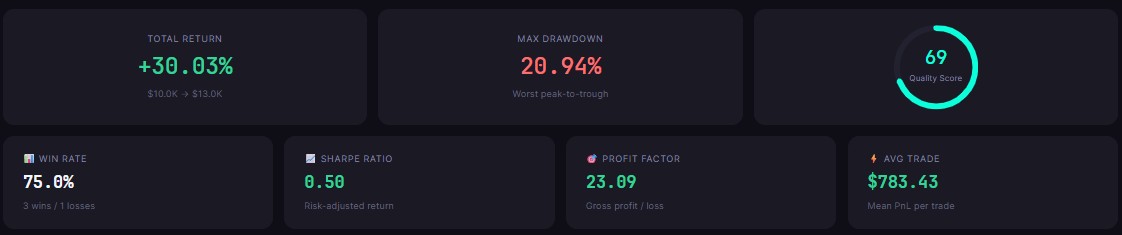
Win rate and total return are not enough. Any platform serious about strategy validation returns at minimum:
Each of these metrics answers a different question. Total return tells you what happened in absolute terms. Win rate tells you how often the strategy was correct.
Max drawdown tells you the worst peak-to-trough loss you would have endured: the number that determines whether you could have stayed in the trade psychologically. Sharpe ratio combines return and volatility into a single number: above 1.0 is acceptable for most active strategies, and above 2.0 is strong for crypto given the asset class volatility.
Profit factor is the ratio of gross profits to gross losses: anything above 1.5 is acceptable for a systematic strategy. If your platform does not show all of these automatically after every backtest, you are making decisions without the full risk picture. A platform that surfaces only win rate and total return is withholding the most important data.
3. AI-Powered Strategy Creation
Typing a strategy in plain English and having it translated into executable logic is the defining feature of the current generation of no-code platforms. CoinQuant does this natively. You describe the strategy, and the platform builds it without requiring Pine Script, Python, or any configuration.
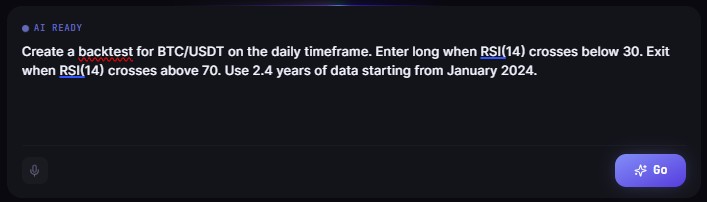
The alternative, dragging and dropping pre-built blocks, works but slows down iteration. The faster you can build, the faster you can test and discard strategies that do not work.
The quality of the AI translation matters as much as its speed. Check that the platform accurately renders compound conditions, for example entering only when RSI crosses above 35 AND price is simultaneously above the 200-day EMA.
Simple single-condition strategies are easy for any system to handle; the real test is whether multi-condition logic with multiple indicators is parsed correctly into the backtest engine.
Run a strategy you already understand manually (one you have traced on a chart yourself) and verify that the generated signals match your expectation before deploying it with real capital. If the platform misinterprets compound logic, you are backtesting a different strategy than the one you intended to test.
4. Multi-Indicator Support
Single-indicator strategies rarely survive realistic market conditions. The platform should support stacking multiple indicators with AND/OR logic. Check specifically for:
Trend indicators: EMA, SMA, HMA, DEMA
Momentum oscillators: RSI, MACD, Stochastic, CCI
Volatility indicators: Bollinger Bands, ATR, Keltner Channel
Beyond indicator variety, check how the platform handles signal logic. A trend indicator like the 200-day EMA should be combinable as an AND condition with a momentum entry like RSI, meaning the strategy only triggers when both conditions are true simultaneously.
Some platforms restrict you to a single indicator per entry rule, which forces workarounds or splits logic across separate rules in ways that reduce robustness. Genuine multi-indicator support means freely combinable conditions with AND and OR logic, not a fixed one-indicator-per-rule template.
This becomes important when you want to add a volatility filter like ATR to adjust exposure differently in high- versus low-volatility environments, a refinement that meaningfully improves how production strategies behave through regime changes.
5. Multi-Timeframe and Multi-Asset Testing
A strategy tested on one timeframe and one asset has not been stress-tested. The ability to run the same logic across 1-hour, 4-hour, and daily charts on multiple assets reveals whether the edge is genuine or specific to one narrow configuration.
A practical test: take any strategy and run it first on the 4-hour chart, then on the daily chart. If the results are structurally consistent (both profitable, with similar win rate and drawdown profiles): the edge is more likely genuine and not an artifact of parameter-fitting on one specific timeframe.
If the strategy only works on one narrow configuration, that is a warning: it suggests the parameters were tuned to that timeframe's noise rather than a real market dynamic.
Testing across ETH, SOL, or other liquid assets alongside BTC adds a second layer: does the same logic produce consistent results across different liquidity profiles and volatility levels? A platform that supports cross-asset testing in a single interface makes this validation fast and routine rather than a laborious manual exercise.
6. Strategy Automation
Backtesting confirms historical performance. Automation deploys the strategy live. These should exist on the same platform, not two separate tools with an export step between them. Look for direct exchange API integration with Binance and Coinbase.
The transition from backtest to live deployment is where most platforms introduce friction. Watch for whether the live trading engine uses the same signal logic as the backtest engine: some platforms have separate systems that can diverge in how they handle order timing or indicator calculation.
Also check monitoring capabilities: does the platform alert you when a trade executes, when a stop is triggered, or when a strategy stops running unexpectedly due to an API disconnection?
A platform with seamless deployment and real-time execution alerts keeps you informed without requiring manual position checks. That matters most during volatile sessions when conditions change faster than periodic manual review can catch.
7. Fees and Slippage Included
A backtest that excludes trading fees is not a backtest. It is a simulation of a world that does not exist. Every result should include fees at a realistic rate. 0.1% per trade is the standard Binance taker fee. Always test with fees on.
Slippage is the gap between the price at which a signal fires and the price at which the order actually fills. On lower-liquidity assets or during high-volatility events, slippage can match or exceed the trading fee itself.
A platform that lets you configure a slippage assumption alongside fees gives a more conservative and realistic return estimate. Even adding a 0.05 percent slippage assumption on both entries and exits can materially change the final return figure on a high-frequency strategy with tight per-trade margins.
If the platform does not allow slippage configuration, treat its backtest returns as slightly optimistic compared to what the same strategy would produce in live trading.
8. Browser-Based, No Installation
The platform should run in a browser. No Python environment, no local installation. If the onboarding requires a developer, it is not a no-code platform regardless of what the marketing says.
A second dimension of accessibility is iteration speed. Beyond zero installation, the platform should let you run a complete backtest within the first ten minutes of signing up, with no tutorials required before your first test.
If it requires reading documentation or watching setup videos before you can enter a strategy idea, that friction compounds: every hypothesis you want to test has the same entry barrier, slowing down the entire research process. The best platforms reduce the cycle from strategy idea to backtest result to under five minutes.
That speed matters because real strategy research is iterative:; you typically run 15 to 20 variations of a single idea before deciding whether to develop it further. A platform that adds friction at each iteration does not just slow one test; it slows the entire process of building a strategy you trust enough to deploy.
The Evaluation Checklist
Test all eight features on CoinQuant with your own strategy. Start free on CoinQuant
Disclaimer:
This content is for educational and informational purposes only and does not constitute financial, investment, or trading advice. All strategies and examples are for illustrative purposes and do not guarantee results. Always conduct your own research before making financial decisions.
Key Takeaway
