
Volatility Trading Strategy on Crypto: Does It Work? (Data-Backed)
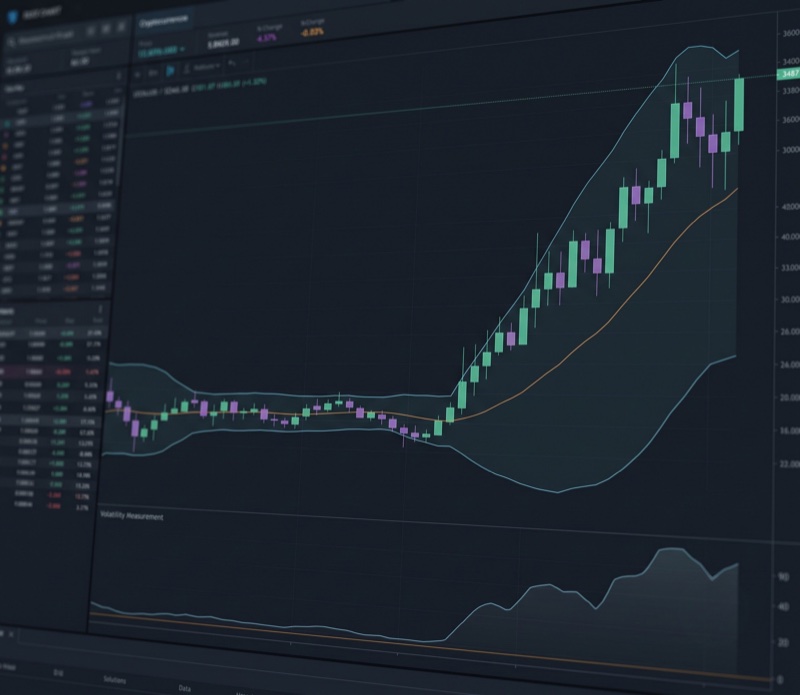
Volatility trading is one of the most appealing concepts in crypto strategy design. The idea: when Bitcoin's volatility expands, it is breaking out of a range and starting a new trend. Enter at the breakout. Ride the move.
The appeal is logical. After Bitcoin spends months consolidating, traders are primed for the moment the range resolves. Volatility-based strategies are designed to catch that moment.
But catching the breakout is harder than it looks. Most range breakouts fail. Price expands briefly, pulls back into the range, and the "breakout" trade ends as a small loss. Repeating that pattern enough times produces a losing strategy even if the market eventually makes a directional move.
This article tests two approaches to volatility on Bitcoin daily data and compares the results against the range-trading alternative traders often switch to when volatility strategies underperform.
What Volatility Strategies Are Actually Testing
A volatility trading strategy is not betting on direction. It is betting on expansion. The underlying assumption is that when price moves significantly outside its normal range, that move is more likely to continue than reverse.
Two common volatility tools:
ATR (Average True Range): measures the average distance between high and low prices over a period. When ATR rises sharply, volatility is expanding.
Bollinger Bands: use standard deviation to define the expected price range. When price closes above the upper band, it has moved significantly above recent norms.
The strategy tested here uses Bollinger Bands: enter long when Bitcoin closes above the upper Bollinger Band, exit when price falls back below the middle band (20-day SMA).
Test 1: Bollinger Band Volatility Breakout
Entry: Bitcoin daily close above the upper Bollinger Band (20-period, 2 standard deviations)
Exit: Bitcoin daily close below the 20-period middle band (SMA)
Direction: Long only, no leverage
| Parameter | Setting |
|---|---|
| Instrument | BTCUSDT (spot) |
| Timeframe | Daily (1D) |
| Period | Jan 2022 to Jun 2026 |
| Bollinger period | 20, 2 std dev |
| Direction | Long only, no leverage |
| Initial capital | $10,000 |
| Fees | Binance standard (0.1% taker) |
Backtest results:
| Metric | Result |
|---|---|
| Total Return | -14.20% |
| Total Trades | 39 |
| Win Rate | 25.6% (10W / 29L) |
| Max Drawdown | 41.85% |
| Period | Jan 2022 to Jun 2026 |
| BTC Spot (Buy & Hold) 2022-2026 | +22.80%, 1 trade, 66.95% DD |
All backtest data via Kaiko (Binance BTCUSDT spot).

The BB breakout strategy lost 14.20% over four and a half years, winning only 25.6% of its 39 trades.
Each "breakout" that failed pulled price back below the upper band, triggering an exit at a loss. This pattern repeated 29 times out of 39 trades. The 10 winning trades correspond roughly to the 2023-2024 trending periods. Those 10 wins were not large enough to compensate for 29 losing trades.

Why the BB Breakout Failed in This Period
The 2022 to 2026 Bitcoin period included a bear market, a genuine trend in 2023-2024, and an extended consolidation in 2025-2026.
In the bear market and consolidation phases, upper-band breakouts are false signals. Price moves above the upper band briefly, fails to follow through, and reverts. The strategy exits at a loss. This pattern repeated 29 times.
This is the honest result of a volatility breakout strategy in a market that spent much of the test period ranging rather than trending.
Test 2: Low-Volatility Alternative (Range-Bound Stochastic)
When a volatility breakout strategy fails, the natural comparison is the opposite approach: a range-trading strategy designed for low-volatility conditions.
The Stochastic Oscillator Range-Bound strategy buys when Bitcoin is oversold (Stochastic below 20) and exits when it reaches overbought levels (Stochastic above 80). It is designed for a market that is oscillating, not trending.
Backtest results (BTCUSDT daily, 2018-2026):
| Metric | Result |
|---|---|
| Total Return | +84.5% |
| Total Trades | 27 |
| Win Rate | 74.1% |
| Max Drawdown | 29.3% |
The contrast is stark. The volatility breakout strategy lost -14.20% with 25.6% win rate. The range-trading strategy gained +84.5% with 74.1% win rate over a partially overlapping period (extending back to 2018 vs 2022 for the BB strategy).
What This Tells You About Volatility Strategy Timing
Volatility breakout strategies on Bitcoin produce very different results depending on market regime.
During genuine trending periods (sustained directional moves), a volatility expansion at the upper Bollinger Band tends to be a real breakout signal. The 2023-2024 bull run would have produced stronger results.
During ranging and bear-market conditions, the upper-band breakout is a false signal generator.
The 2022-2026 window, dominated by two ranging phases and one genuine trend, produced a net negative result because false signals in the ranging phases outnumbered successful captures in the trending phase.
Volatility as a Filter vs. Volatility as a Signal
The practical takeaway is not that volatility-based tools are worthless. They serve a specific purpose when used as a filter rather than a signal.
Volatility as a signal (enter when BB breaks out): produced -14.20% in this period.
Volatility as a filter (only take range-trading signals when ATR is low): this is a testable alternative. When the 14-period ATR is below its 30-period average, the market is compressing. Range-trading signals in that environment have a higher expected win rate.
That filter combination is the logical next step for traders who want to use volatility information without relying on it as a primary entry signal.
The Verdict
The Bollinger Band volatility breakout strategy on Bitcoin daily data from 2022 to 2026 produced a -14.20% total return with 25.6% win rate and 41.85% max drawdown.
The comparison to the Stochastic range-trading approach (+84.5%) shows that the same historical period was significantly more favorable to mean-reversion logic than to volatility breakout logic. Market regime drove that difference.


The right approach is to test both on the period you are trading in before committing capital to either.
Disclaimer:
Key Takeaway
