
Test Your Crypto Strategy Before Going Live: No Code, Real Data

78% of retail crypto traders lose money. The #1 reason? Deploying strategies that were never tested on historical data. Backtesting simulates your strategy on real past market data, so you know if it works before risking a single dollar. If you're trading crypto without backtesting first, you're gambling.
What Backtesting Actually Does
A backtest takes three inputs: historical price data (OHLCV), your strategy rules (when to buy and sell), and trading parameters (fees, slippage, initial capital). It outputs five key metrics: total return, win rate, maximum drawdown, Sharpe ratio, and number of trades. The Sharpe ratio tells you the most, above 1.0 means you're earning more return than risk. Below 0.5? You'd be better off holding stablecoins.
Real Example: RSI Strategy on BTC
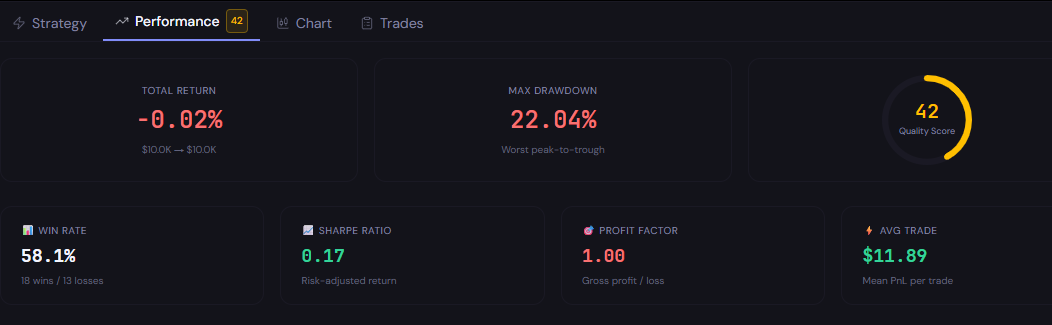
We tested a common beginner strategy on CoinQuant: buy BTC when RSI(14) drops below 30 (oversold), sell when it crosses above 70 (overbought). On BTC/USDT 1h for all of 2024 with a $10,000 starting balance:
Total Return: -0.02%, essentially break-even Win Rate: 58.1% (18 wins, 13 losses) Sharpe Ratio: 0.17, barely above zero risk-adjusted return Max Drawdown: 22.04%, at one point you were down $2,200+ Profit Factor: 1.00, gross profits equal gross losses
Without backtesting, you'd deploy this strategy thinking buy low, sell high, what could go wrong? With backtesting, you know in seconds that this exact setup broke even after 31 trades and 12 months. That's a full year of risk for zero gain. That's the power of backtesting. That's the point.
Why Emotion Destroys Crypto Returns
Crypto runs on FOMO and panic. Trader A buys the dip because RSI looks low. Trader B follows a system backtested at a 56.8% win rate with a Sharpe of 1.12. Over 100 trades, Trader B wins. Backtesting turns Trader A into Trader B.
What Backtesting Cannot Do
Backtesting has real limitations every trader must understand. Past performance does not guarantee future results, market regimes change. Slippage is hard to estimate precisely. Overfitting is a trap: optimize too aggressively on old data and your strategy will likely fail in live markets. A good backtest is honest about these limits and tests across multiple market conditions, not just the favorable ones.
How to Backtest on CoinQuant In Under a Minute
CoinQuant makes backtesting accessible to every trader regardless of coding ability. No Pine Script. No Python. No terminal. Pick your asset and timeframe. Choose your strategy from 10+ built-in indicators including RSI, MACD, SMA, Bollinger Bands, Grid, and DCA. Set your entry and exit rules using dropdown menus. Click Run Backtest. The entire process takes under a minute for your first test and under 10 seconds for subsequent iterations.
Disclaimer:
This content is for educational and informational purposes only and does not constitute financial, investment, or trading advice. Past performance does not guarantee future results.
Key Takeaway
