
Reliable Backtesting Software That Won't Break the Bank: What to Look For in 2026
.png)
Finding affordable reliable backtesting software in 2026 comes down to knowing which features actually make results trustworthy and which ones just inflate the price. Reliability is not a premium add-on. It comes from accurate data, honest cost modeling, and real risk metrics, and none of those has to cost a fortune. Meanwhile plenty of tools charge for polish that does nothing to make the numbers more believable.
This guide separates what reliability genuinely requires from what drives up cost. It shows where no-cost tiers are enough, where paying makes sense, and the red flags that make a cheap tool the most expensive choice of all. The goal is simple: get results you can trust without overpaying for things that do not improve them.
What Affordable Reliable Backtesting Software Actually Means
Reliable backtesting means the numbers you get would resemble what actually happened if you had traded the strategy. A reliable result is one you can act on. An unreliable result looks the same on screen but leads you to risk money on an edge that was never real.
Three things create reliability, and all three are foundational rather than luxury features.
Accurate, deep data. The test is only as good as the price history behind it. Shallow or low-quality data produces confident-looking nonsense.
Fee and slippage modeling. A backtest that ignores trading costs overstates returns for every strategy. Costs have to be in the model.
Real risk metrics. Return alone hides the risk you took. Sharpe, Sortino, profit factor, and drawdown are what tell you whether the return was worth it.
Notice what is not on that list: a flashy interface, dozens of exotic order types, or a marketplace of prebuilt strategies. Those can be nice, but they do not make a backtest more truthful.
What Drives Cost in Backtesting Tools
Backtesting tools price on a mix of what you need and what you do not. Knowing the difference is how you avoid overpaying.
The left column is where your money buys trustworthy results. The right column is where tools pad their pricing with things that look valuable but do not change whether the numbers are true.
What You Should Pay For
Some things are worth paying for because they directly protect you from acting on a false edge.
Data quality is worth paying for. This is the foundation, and it is the one place where cheap almost always means worse. Institutional data with deep history lets a single test cover multiple market regimes. CoinQuant runs on Kaiko data reaching back to 2017 for Bitcoin, so a test spans the 2018 bear market, the 2021 bull run, and the 2022 drawdown rather than a recent calm stretch.
Honest cost modeling is worth paying for. A tool that includes fees and slippage by default is protecting you from the single most common way backtests lie.
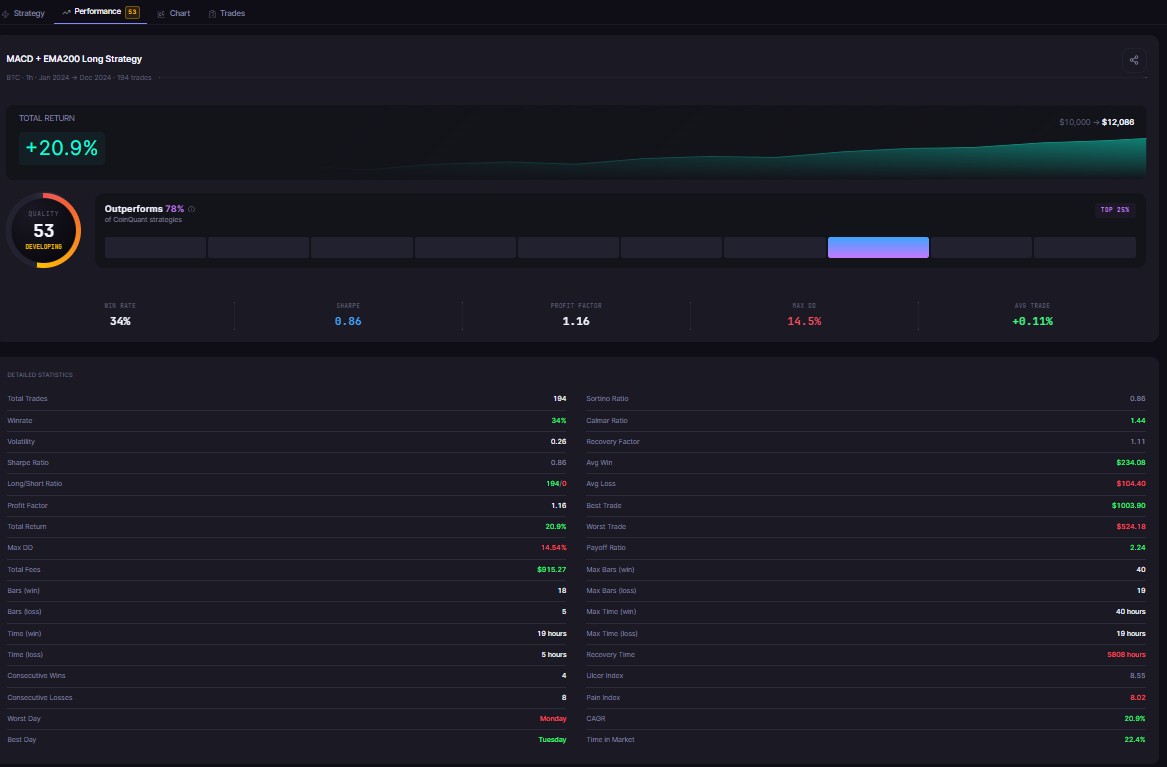
Metric depth is worth paying for. A platform that returns Sharpe, Sortino, profit factor, and max drawdown gives you the full picture. One that shows only return and win rate is cheaper to build and far more likely to mislead.
What You Should Not Overpay For
Other features are genuinely optional, and paying a premium for them rarely improves your results.
Large prebuilt strategy libraries sound valuable, but a hundred canned strategies do not help if you cannot trust the backtest behind them. Deep exchange integrations matter for live execution, not for validating whether an idea works. Heavily customizable dashboards are pleasant but do not make a single number more accurate.
The principle: pay for things that make results more truthful, not for things that make the product look more impressive. Reliability lives in the data and the math, not in the surface.
No-cost vs Paid: How to Think About Tiers
Cost tiers in backtesting tools tend to fall into three buckets, and each fits a different stage.
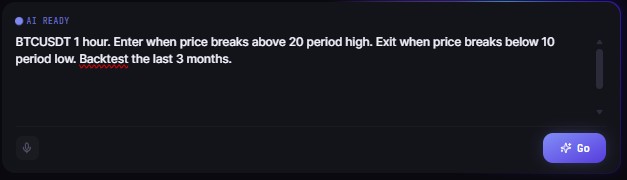
The important insight is that reliability should exist at the current pricing, not be gated behind the top plan. A current pricing that already gives you accurate data, fee modeling, and real metrics lets you prove an idea works before you pay anything. CoinQuant is ready to start for exactly this reason: you can describe a strategy, run it on real Kaiko data with fees included, and read the full metrics without opening your wallet.
Red Flags: When Cheap Gets Expensive
A cheap tool with bad data is not a bargain. It is a hidden cost, because it leads you to trade on an edge that never existed. Watch for these warning signs.
Vague or undisclosed data source. If a tool will not say where its price history comes from or how far back it goes, treat every result as suspect.
Idealized results with no fees. If returns look too clean and the tool never mentions costs, it is almost certainly ignoring them, which flatters every strategy.
Return and win rate only. A tool that hides drawdown and profit factor is hiding the risk you took. That is not a cheaper tool, it is a less honest one.
No sample-size warnings. A strategy with three trades that all won has proven nothing. A tool that presents that as solid is setting you up to overtrust it.
Prices you cannot verify. Be wary of tools that quote dramatic returns without showing the conditions behind them.
The math is blunt. A tool that costs a little less but produces one bad trade you would not otherwise have made has already erased its savings many times over. Reliability is the cheapest thing you can buy once you count the losses that unreliable results cause.
How to Choose Without Overpaying
Put it together into a simple decision process.
Start with a current pricing that includes real data, fee modeling, and full metrics. If reliability is no-cost, use it before paying for anything.
Verify the data source and its depth. Named institutional data with years of history beats an unnamed feed at any price.
Confirm the metrics are complete. Insist on Sharpe, Sortino, profit factor, and drawdown, not just return.
Only pay to remove a real limit. Upgrade when you hit a usage or asset cap that is slowing you down, not for cosmetic extras.
Ignore features that do not make results truer. Prebuilt libraries and fancy dashboards are optional. Data and metrics are not.
Reliable and affordable are not opposites. The most reliable features are the foundational ones, and the best tools make them available from the current pricing up.
Start Backtesting Now on CoinQuant
You do not need to code, and you do not need to pay to find out whether reliability is there. Describe your strategy in plain English, run it on real Bitcoin data with fees included, and read the full metrics for yourself.
Disclaimer:
This content is for educational and informational purposes only and does not constitute financial, investment, or trading advice. All strategies and examples are for illustrative purposes and do not guarantee results. Always conduct your own research before making financial decisions.
Key Takeaway
