
No-Code Trading vs Automated Trading: What's Actually the Difference?
.png)
The terms "no-code trading" and "automated trading" get used interchangeably across crypto forums, platform landing pages, and YouTube tutorials. They are not the same thing. Conflating them leads traders to buy the wrong tool, have the wrong expectations, and misunderstand what they are actually running. The no-code trading vs automated trading distinction is worth understanding precisely, because it clarifies exactly what each category of tool does and who it is for.
This article gives you clear definitions, explains how the two concepts relate, and explains why the distinction matters for your strategy development process.
Clear Definitions First
What Is Automated Trading?
Automated trading is any system that executes trades based on predefined rules without requiring you to manually place each order. The rules are set in advance. When those rules are met, the system acts. You are not clicking a buy button. The platform, bot, or algorithm is doing it.
Automated trading covers a wide spectrum: simple moving average crossover bots, professional quantitative hedge fund algorithms, and everything in between. What they share is that execution happens without manual intervention at the moment of the trade.
What Is No-Code Trading?
No-code trading describes how you build the rules, not whether the system executes automatically. A no-code trading platform lets you define your entry and exit conditions, strategy logic, and risk parameters without writing code. You use a visual interface, natural language, a structured form, or some combination of these instead of Python, C++, or a scripting language.
The key insight: no-code trading is a form of automated trading.
The "no-code" part tells you how the rules were constructed. The "automated" part tells you how trades are executed. These are two different dimensions.
You can have automated trading that requires code (most traditional algorithmic trading). You can have no-code tools that build strategies you then execute manually. The most powerful combination is no-code tools that also automate execution: you build the rules without coding, and the system runs them automatically.
No-Code Trading vs Automated Trading: Comparison Table
Why the Distinction Matters for Traders
Accessibility.
Traditional algorithmic trading is gated by coding ability. Learning Python well enough to write, test, and debug a trading strategy takes months. No-code platforms remove that gate entirely. You focus on strategy logic, not syntax.
Control and transparency.
No-code does not mean black box. A no-code strategy built on a serious platform is fully transparent: you can see every condition, every rule, and every reason a trade fired. This is different from AI black-box bots that make trading decisions based on signals you cannot inspect.
Speed of iteration.
Building a new strategy idea in code takes hours. Building the same idea on a no-code platform takes minutes. This matters because good strategy development is iterative: you have an idea, test it, see where it fails, adjust, and test again. Shorter iteration cycles mean faster learning.
What No-Code Trading Is NOT
Understanding the definition also means understanding what no-code trading excludes.
It is not signal copying. Signal services send you buy/sell alerts generated by someone else's analysis or algorithm. You copy the trade. No-code trading means you define your own rules. Your strategy, your conditions, your logic.
It is not social trading. Social trading platforms let you copy the trades of other traders in real time. No-code trading is independent. You build a strategy based on your research and backtest it before any capital is at risk.
It is not a black-box AI bot. Some platforms offer AI trading bots that make decisions based on opaque models. You deposit capital and the bot trades. No-code trading is transparent: you can see and modify every condition. The AI on a no-code platform helps you build your strategy, not replace your thinking.
It is not a trading indicator. RSI, MACD, and Bollinger Bands are indicators. A no-code platform uses indicators as inputs to a strategy. The strategy is the complete set of rules: when to enter, when to exit, how much to risk.
The Backtesting Connection
One of the most important things a no-code platform adds to the automated trading conversation is accessible backtesting.
Traditional algo trading developers backtest their code against historical data using libraries like backtrader, zipline, or Nautilus Trader. This requires setting up a development environment, handling data ingestion, writing test logic, and interpreting output. It is a significant technical undertaking.
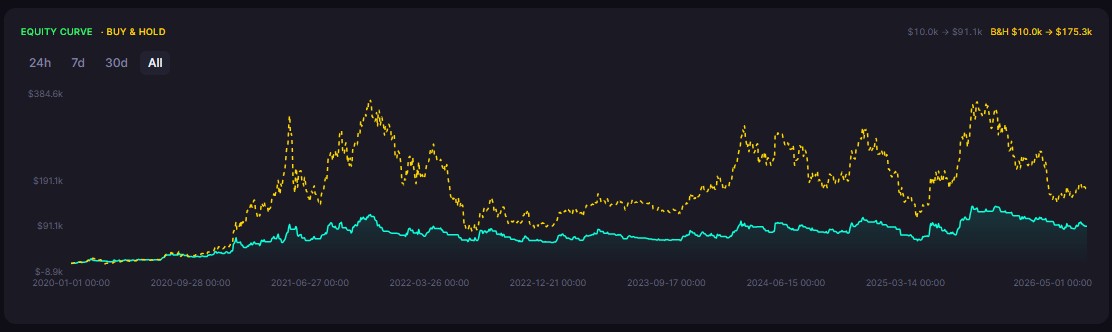
No-code platforms bring backtesting to traders who are not developers. You define your rules, set a date range and fee structure, and the platform runs the test against historical exchange data. You see results in seconds: total return, win rate, drawdown, Sharpe ratio, and fee impact.
This changes the development process. Instead of trading a strategy based on intuition and hoping it works, you test it first. You see how it would have performed across different market conditions. You identify the failure modes before real money is involved.
.jpeg)
How CoinQuant Fits: Natural Language to Backtest to Live Trading
CoinQuant is built around the complete no-code trading pipeline. The three stages are:
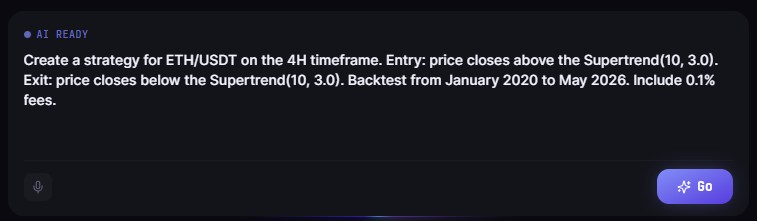
Natural language strategy building. Describe your strategy in plain English. The AI trading platform interprets your conditions and constructs the strategy logic. No code required. No Pine Script. No Python.
Backtesting on institutional data. Once your strategy is built, run it against historical data sourced from Kaiko. Kaiko provides tick-level exchange data used by institutional trading desks. Your backtest results reflect real market conditions including liquidity and fees.
Live trading deployment. Strategies that survive backtesting can be deployed live. Execution is automated based on the rules you defined.
This pipeline collapses what used to take a developer team weeks into a process any trader can complete in an afternoon.
The Bottom Line
No-code trading and automated trading are related but distinct. Automated trading describes execution without manual intervention. No-code trading describes how the rules are built without writing code. The most useful no-code platforms combine both: you build your strategy without coding, and the system executes it automatically.
The practical benefit is access. Strategy logic that previously required a developer to build and test is now accessible to any trader with a clear idea and a no-code platform. Backtesting, which was a technical undertaking, becomes a five-minute task.
If you have been avoiding automated trading because you cannot code, no-code trading platforms remove that barrier entirely.
Try No-Code Trading on CoinQuant
Build, backtest, and automate your trading strategy on CoinQuant with no coding required. Natural language strategy builder, Kaiko institutional data, and full performance analytics.
Disclaimer:
This content is for educational and informational purposes only and does not constitute financial, investment, or trading advice. All strategies and examples are for illustrative purposes and do not guarantee results. Always conduct your own research before making financial decisions.
Key Takeaway
