
No-Code Backtesting: What Makes One Platform Better Than Another?
.png)
Every platform in the no-code backtesting space claims to be the best option. Most of them list the same features: no coding required, multiple indicators, live trading support, paper trading mode. The real question is not which platform has the longest feature list.
It is which features actually change the quality of your strategy research, and how do you evaluate them before committing time or money to any single tool? This article identifies the five features that create meaningful differences between platforms and provides a practical framework for applying them.
The Features That Actually Differentiate Platforms
Data Provenance and Depth
The single most important differentiator is the underlying data. Two platforms can run the exact same strategy on the same date range and return different results if they use different data sources. Before trusting any backtest, you need to know where the price data came from, which exchanges it represents, how it handles gaps or illiquid periods, and whether it accounts for exchange-specific order book dynamics.
A platform that aggregates data from obscure exchanges produces a different BTCUSDT price history than one sourcing directly from Binance or Coinbase. That difference matters for every metric in the output.
Ask three specific questions:
What is the data source? (Named institutional provider vs proprietary feed vs aggregated)
How far back does the data go? (2017 minimum for Bitcoin to include the full 2018 bear market)
Which exchanges are included? (Binance and Coinbase at minimum for representative fills)
CoinQuant uses Kaiko institutional data sourced directly from major exchanges back to 2017 for Bitcoin. This is the same data tier used by professional trading desks and institutional liquidity providers, not aggregated retail feeds.
For the purposes of backtesting, this means the price history includes the March 2020 crash, the 2021 peak, and the full 2022 bear market at exchange-level accuracy. Strategies tested on this data have been validated against every significant market regime of the past seven years.
Metric Completeness
Platforms compete on feature lists. What they often do not show in the marketing is whether the backtest output gives you the full picture of strategy performance. A complete backtest result requires six core metrics:
Total return: the magnitude of gain or loss over the test period
Win rate: directional accuracy across all trades
Max drawdown: the worst-case capital hit from peak to trough
Sharpe ratio: return per unit of risk taken
Profit factor: the ratio of gross profit to gross loss
CAGR: return normalised for the length of the test period
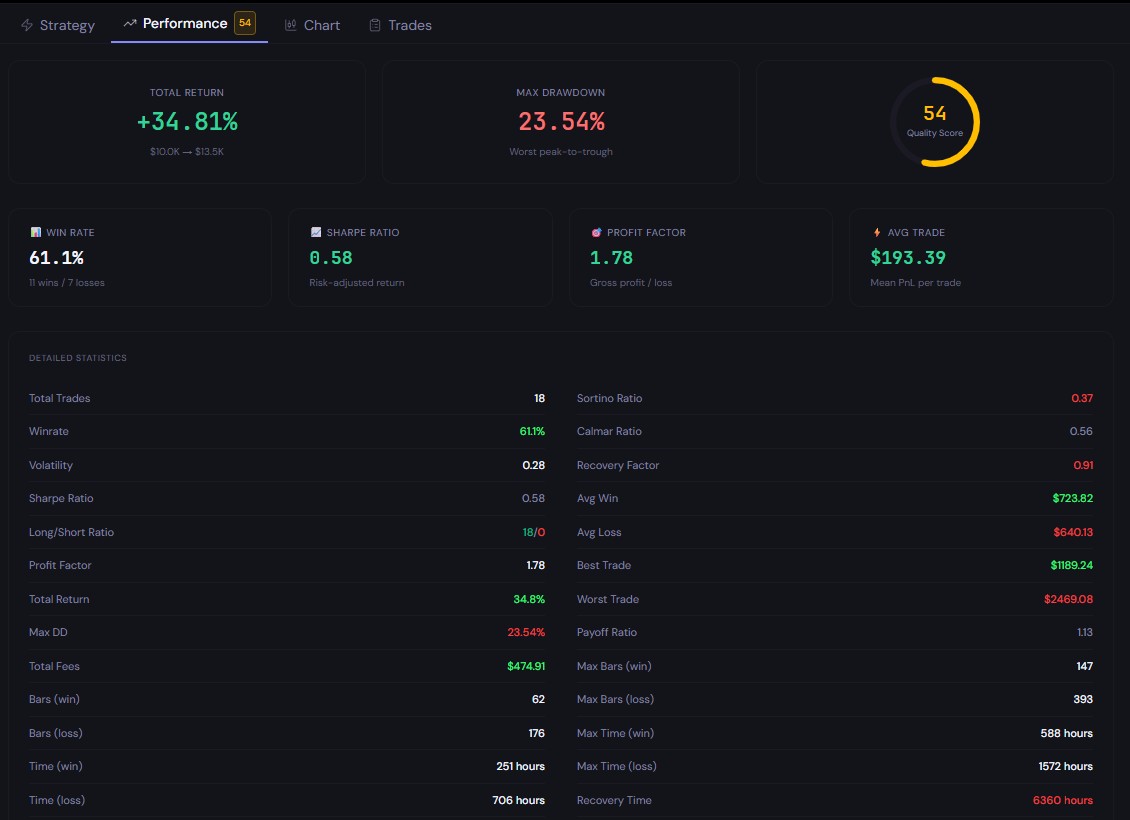
Any platform that returns only return and win rate is giving you two of the six key metrics. The other four change the decision completely in many cases.
A strategy with 80% win rate and a Sharpe of -0.5 is taking on more risk than it is generating in return. A strategy with 40% win rate and a profit factor of 2.1 is capturing large winners on small losers, and is structurally sound. You cannot distinguish between these two outcomes without the full metric set.
Strategy Creation Method
There is a meaningful difference between:
Natural language AI builders: describe the strategy in plain English, the AI builds it. Fast, accessible, no config required.
Visual block builders: drag and drop indicator components, define logic through a UI. More manual, but still no-code.
Template libraries: choose from pre-built strategies. Fast to start, limited to available options.
For traders who want to test original strategies rather than deploying community templates, natural language builders offer the fastest path from idea to backtest. You do not need to map your idea onto the available template logic or learn the UI conventions of a visual block builder.
You describe the strategy in the same terms you think about it, and the platform builds the executable version. For strategy development volume (the number of distinct ideas you can test in a given afternoon), natural language input has a structural advantage over all other no-code methods.
Iteration Speed
The quality of a strategy research process correlates directly with the number of tests you run before choosing a configuration. If changing one parameter takes 30 seconds to rebuild and rerun, you can test 50 variations in an afternoon. If it takes 10 minutes to rebuild after each change, you test five.
The difference is not just speed. It is the depth of exploration possible before you commit to a configuration. A trader who tests 50 variations of the same strategy finds parameter sensitivity patterns that a trader testing five cannot. Those patterns are what separate a robust configuration from a cherry-picked one.
Iteration speed is a platform quality signal, not just a convenience feature. Platforms that run backtests in seconds versus platforms that take minutes enable meaningfully different levels of strategy development. The faster platform is not just more convenient. It changes the type of research you can do.
You can run sensitivity analyses, test adjacent parameter values, and verify that good results are stable across nearby configurations rather than being a single-point outcome. This distinction becomes more important the more seriously you take systematic strategy development.
Live Automation Integration
The best backtesting workflow ends with deployment. A platform that requires you to export your strategy, reconfigure it in a separate automation tool, and manually replicate the logic introduces risk at every step. Each manual translation is a place where the live execution can diverge from the tested version.
The closer the backtest environment is to the live execution environment, the smaller the implementation gap, and the higher the confidence that the strategy running live is actually the one you validated. This integration between development and deployment is underweighted in most platform evaluations, because it only becomes visible once you are trying to go live.
CoinQuant's architecture is built around this principle: the strategy you describe in plain English becomes the strategy that runs live. There is no export step, no manual reconfiguration, and no translation layer between the backtest environment and the execution environment.
The parameters tested are the parameters deployed. This is not a convenience feature. It is a risk-reduction feature. Every manual step between tested and live introduces a new opportunity for the live execution to differ from the validated version.
Applying the Framework
Use these five criteria as a checklist before evaluating any no-code backtesting platform:
Data quality: non-negotiable. The reliability of every result depends on it.
Metric completeness: determines what questions you can answer about a strategy.
Creation method: determines how fast you can move from idea to result.
Iteration speed: determines how much research depth you can reach.
Live integration: determines whether what you tested is what you actually run.
CoinQuant meets all five, and the framework above maps directly to it.
Apply this framework to CoinQuant with your own strategy. Start now on CoinQuant
Disclaimer:
This content is for educational and informational purposes only and does not constitute financial, investment, or trading advice. All strategies and examples are for illustrative purposes and do not guarantee results. Always conduct your own research before making financial decisions.
Key Takeaway
