
How to Choose the Right AI Agent Backtesting Tool for Your Trading Strategy
.png)
Knowing how to choose an AI agent backtesting tool matters more than picking the one with the flashiest dashboard. The wrong tool gives you clean-looking numbers built on bad data or shallow metrics, and those numbers get you into trades that fail live. The right one tells you the truth about your strategy before you risk a dollar.
This guide walks through the decision step by step. Each step is an action you can take today, with a plain-English example you can copy, the common mistakes that trip traders up, and a checklist of what actually separates a serious tool from a toy.
Step 1: Define What You Are Testing First
Before you evaluate any tool, write down the strategy in one plain sentence. If you cannot state the idea clearly, no tool will save you.
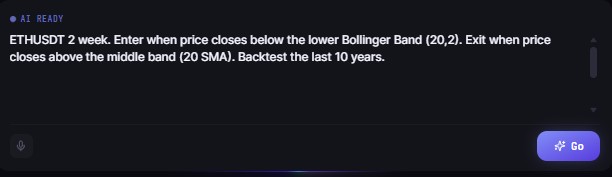
Here is an example you could type directly into an AI agent backtesting tool:
"Buy BTCUSDT on the daily chart when RSI(14) crosses below 30, and sell when RSI(14) crosses above 70. No leverage, one position at a time."
That sentence contains everything a good tool needs: asset, timeframe, entry condition, exit condition, and risk rules. Start with the idea, then find the tool that can test it faithfully.
Step 2: Check the Data Source
A backtest is only as honest as the data underneath it. Two tools running the "same" strategy can return very different results because their price history differs.
Ask where the crypto data comes from. CoinQuant uses Kaiko institutional data covering Binance, Coinbase, and Kraken, going back to 2017 for Bitcoin.
Longer history matters. Data back to 2017 lets you test across the 2018 bear market, the 2021 bull run, and the 2022 drawdown, not just a recent stretch that flatters everything.
Avoid tools that are vague about their source or rely on thin, aggregated feeds. If you cannot tell where the numbers come from, do not trust them.
Step 3: Confirm Fees and Slippage Are Modeled
An idealized backtest that ignores trading costs will always look better than reality. That gap is where live results disappoint.
Make sure the tool includes fees at realistic rates and accounts for slippage. A strategy that trades often is especially sensitive: dozens of small edges can evaporate once real costs are applied. A tool that hides this is selling you a fantasy.
Step 4: Demand Depth in the Metrics
Return and win rate are the easiest numbers to show and the easiest to misread. A tool that stops there is not giving you enough to judge risk.
Look for the full set:
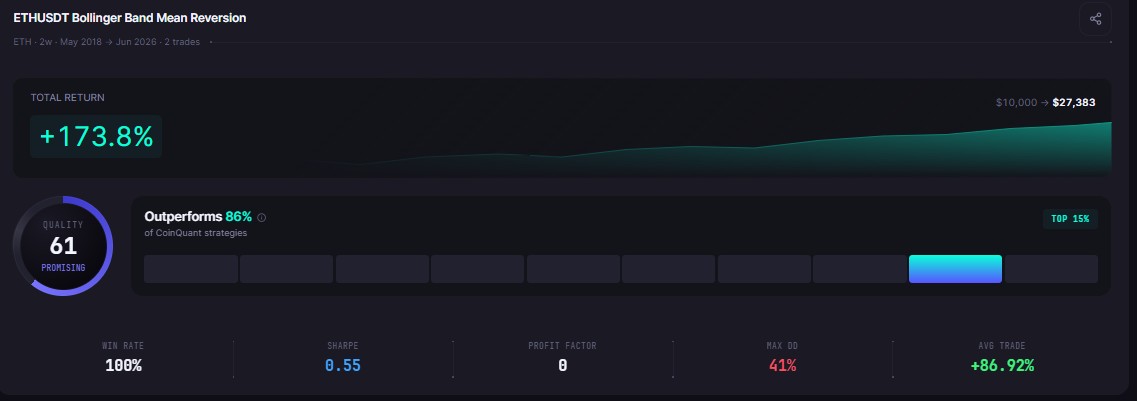
Sharpe ratio and Sortino ratio for risk-adjusted return
Profit factor to see how much you made per dollar lost
Max drawdown for the worst peak-to-trough loss you would have sat through
CAGR for the compounded annual growth rate
A 66% win rate with a profit factor below 1.0 is a losing strategy, and only the deeper metrics reveal that. Depth is not a luxury here. It is the difference between a real verdict and a comfortable illusion.
Step 5: Prioritize No-Code and Iteration Speed
An AI agent backtesting tool should let you describe the strategy in plain English and get results back fast, so you can test variations without friction.
No coding required. You should not need Python or Pine Script to test an idea.
Fast iteration. Changing one parameter, say RSI 30 to RSI 25, and rerunning should take seconds, not an afternoon. Testing is an iterative process, and slow tools kill iteration.
The point of an AI agent is to move the barrier from technical setup to strategy thinking. If you are still wrestling with configuration, the tool is not doing its job.
Step 6: Test Across More Than One Regime
A single quiet period proves nothing. The strongest signal a tool can give you is whether a strategy holds up across different market conditions.
Run the same rules through at least one bull leg and one bear leg. Multi-timeframe support helps here too: a strategy that works on the daily chart but falls apart on the 4-hour chart is fragile. A good tool makes this comparison easy.
The Checklist: What to Look For
Use this table to score any tool before you commit.
A Worked Example: Scoring Two Tools
Say you are choosing between a popular trading bot dashboard and a dedicated no-code backtesting platform. Run both through the checklist with the RSI strategy from Step 1.
The bot dashboard scores two out of six. It can run the strategy, but it cannot tell you whether the strategy is worth running. The no-code platform scores six out of six, because its entire job is validation.
That gap is the whole point. A tool that only executes will happily run a losing idea. A tool built for testing tells you the idea is losing before you fund it.
Common Mistakes to Avoid
The tool matters, but how you use it matters more. These are the errors that turn a good backtest into a bad trade.
Optimizing for the highest historical return. Tuning parameters until the past looks perfect is curve-fitting. Those strategies fail on new data. Stability across conditions beats peak performance in one period.
Trusting win rate alone. A high win rate with oversized losses is still a losing strategy. Always read the profit factor and drawdown next to it.
Testing one short period. A strategy that only saw a bull market has not been stress-tested. Cover a downtrend too.
Ignoring fees. If the tool lets you turn costs off, the pretty number is not real.
Stopping at the first good result. One backtest is a starting point, not a conclusion. Vary a parameter, rerun, and confirm the edge holds.
Put It Into Practice
Choosing the right AI agent backtesting tool comes down to honest data, realistic costs, deep metrics, no-code speed, and multi-regime testing. A tool that delivers all six tells you the truth. A tool missing any of them tells you a story.
CoinQuant is built around exactly these criteria: plain-English strategy input, Kaiko data with fees included, and the full risk metric set returned in seconds. No Python, no Pine Script, no installation.
Try AI-Assisted Backtesting Free on CoinQuant
Describe your strategy in plain English, run it on real Bitcoin data with fees included, and read the full metrics before you risk anything.
Disclaimer:
This content is for educational and informational purposes only and does not constitute financial, investment, or trading advice. All strategies and examples are for illustrative purposes and do not guarantee results. Always conduct your own research before making financial decisions.
Key Takeaway
