
How to Ask ChatGPT to Help Build a Crypto Trading Strategy (and Backtest It)

Traders are using ChatGPT, DeepSeek, and other AI tools to brainstorm trading strategy ideas. The queries are specific: "give me a Bitcoin strategy using RSI and moving averages," or "design a Stochastic oscillator entry condition for a range-bound market."
The AI will produce an answer. The answer will sound coherent and include specific parameters. The problem is that ChatGPT cannot tell you whether that strategy actually works on historical data. It can describe a strategy. It cannot test it.
This guide shows how to use AI to build a strategy idea, and then how to move that idea from a chatbot response to a backtested result on CoinQuant.
What AI Tools Are Good At (and Not Good At) for Trading Strategy
AI language models are useful for the ideation stage of strategy development. They can:
Explain how an indicator works and what its standard settings are
Suggest combinations of indicators that are commonly used together
Describe the logic of well-known strategy types (mean reversion, breakout, trend-following)
Translate a plain-English strategy description into structured rules
What they cannot do:
Run a backtest on real price data
Tell you the win rate, drawdown, or total return of the strategy they describe
Verify whether a strategy would have worked in the specific market conditions you are trading in
The gap between "here is a strategy idea" and "here is whether that idea works" is the backtesting step. No AI assistant can close that gap without executing the test against real historical data.
Step 1: Use AI to Define Your Strategy Logic
Start with a clear question. Vague prompts produce vague answers.
Less useful: "Give me a good crypto trading strategy."
More useful: "I want a long-only Bitcoin strategy for daily timeframe that uses RSI and a moving average. Oversold RSI entry, trend filter using the 50-day SMA. What would the entry and exit conditions be?"
The more specific prompt forces the AI to describe rules that can be directly translated into a backtest. The response should give you:
Entry condition: RSI (14) crosses above 30 AND price is above the 50-day SMA
Exit condition: RSI crosses above 70 (overbought)
Direction: Long only
Timeframe: Daily
Write down these rules exactly as the AI states them. Do not adjust them yet.
Step 2: Check the Logic Makes Sense
Before testing, do a quick sanity check on the rules the AI gave you.
Ask yourself:
Does the entry condition describe a real market signal, or is it circular?
Are the parameters standard and well-defined? (RSI 14 and 50-day SMA are both standard)
Is there an exit condition, or does the strategy have no way to close a trade?
Is there a conflict between the conditions?
If any of these fail, go back to the AI with a follow-up. "The exit condition needs to be more specific. How would I exit this strategy if price breaks below the 50-day SMA instead of waiting for RSI overbought?"
The AI will revise. Keep iterating until the rules are precise and complete.
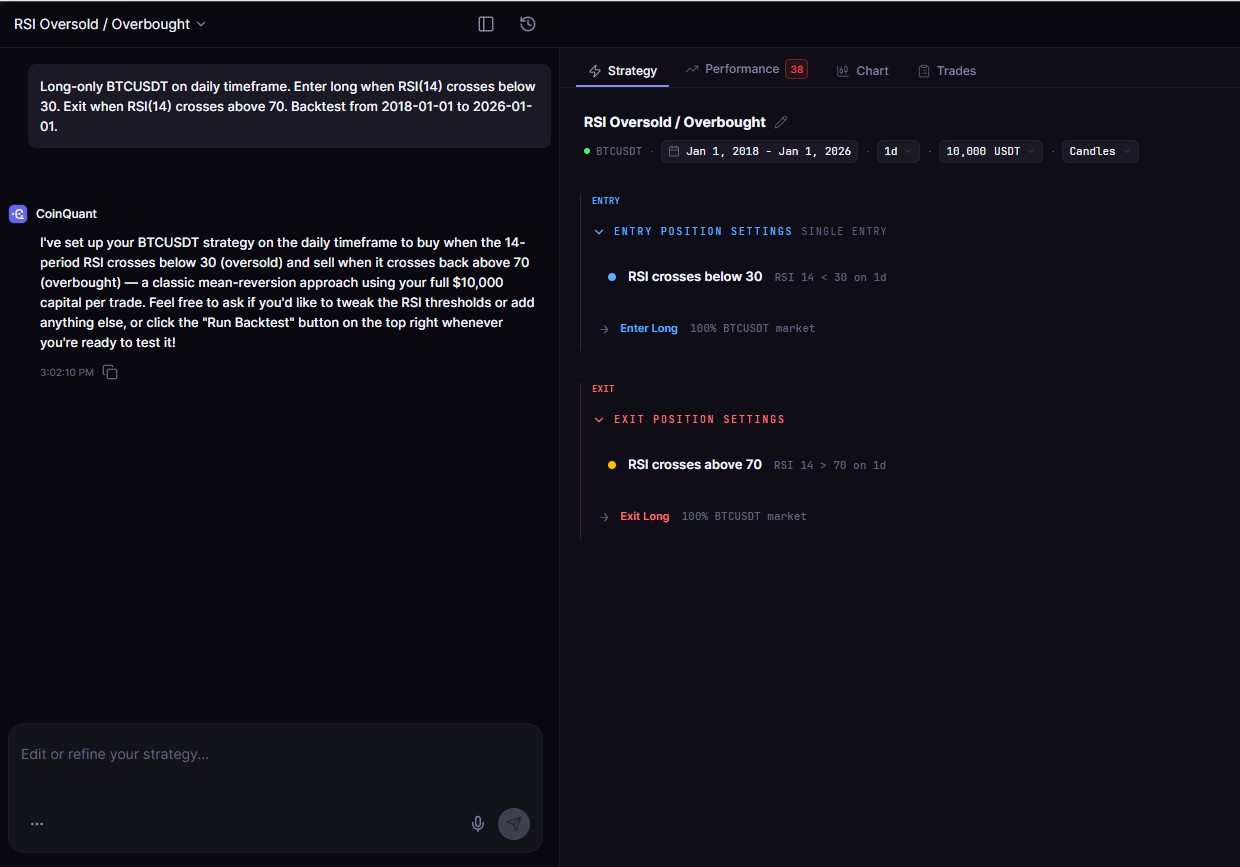
Step 3: Set Up the Strategy on CoinQuant
Once you have clean rules, building the strategy on CoinQuant takes minutes.
Log in and go to the strategy builder
Select BTCUSDT and daily timeframe
Add the entry condition: RSI (14) crosses above 30, plus a second condition that price is above the 50-day SMA
Add the exit condition: RSI (14) crosses above 70
Set position size: 100% of equity per trade to isolate the strategy logic
Set the backtest period: 2018 to 2026 to capture multiple market cycles
You can also use CoinQuant's AI input layer: type the strategy description in plain English and the platform converts it automatically into the condition schema.
Step 4: Run the Backtest and Interpret the Results
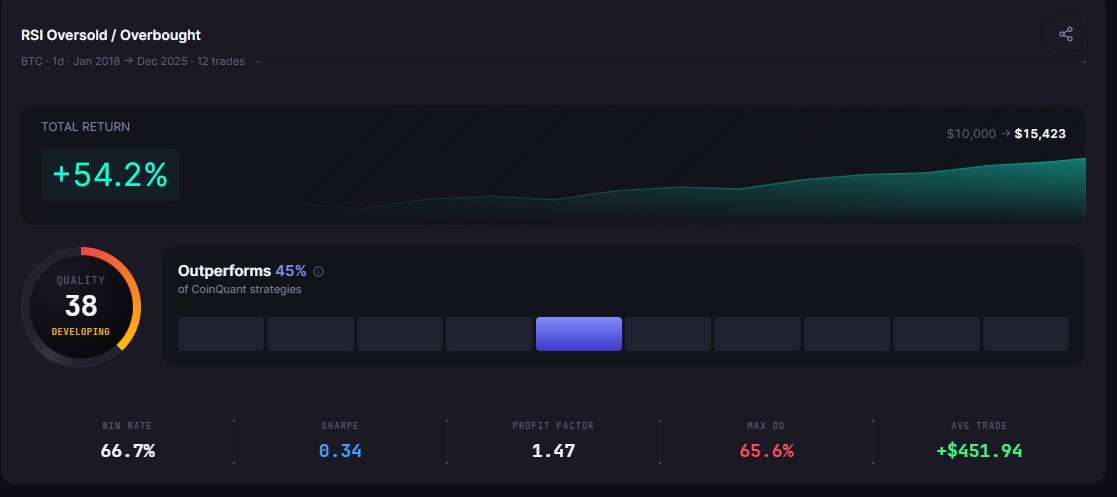
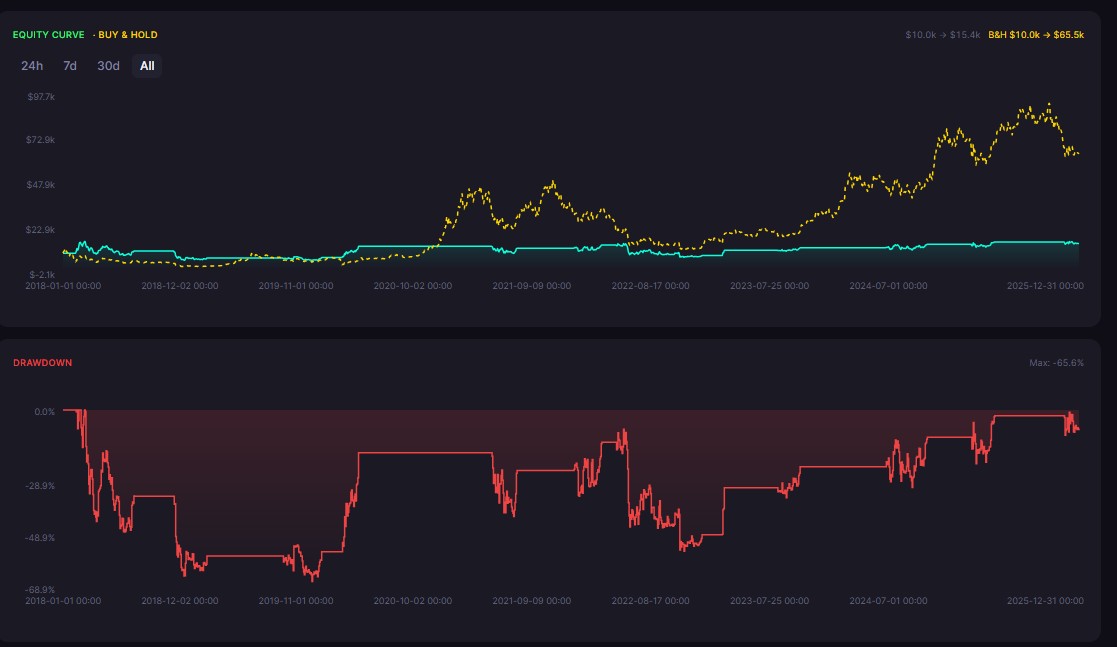
Click "Run Backtest." The results appear within seconds.
The four numbers to check first:
| Metric | What You're Looking For |
|---|---|
| Total Return | Is the strategy profitable over the full period? |
| Win Rate | Does the strategy win more trades than it loses? |
| Max Drawdown | How bad was the worst losing streak? |
| Total Trades | Are there enough trades to trust the result? (fewer than 10 is too few) |
For the RSI + SMA strategy the AI described, the result might be positive or negative. Either outcome is useful. A positive result is evidence the logic has historical merit. A negative result tells you the specific rules do not work on this data, which is valuable before you trade it live.
Step 5: Go Back to the AI with the Results
Once you have real numbers, the conversation with the AI becomes more productive. Share the results and ask for analysis.
Example follow-up: "My RSI + SMA strategy produced 8% total return, 12 trades, 58% win rate, and 42% max drawdown over 2018-2026. The drawdown seems large relative to the return. What adjustments to the exit rule might reduce drawdown?"
The AI can suggest modifications: tighter stop loss, adding a trailing stop, reducing position size, requiring a minimum RSI level at entry. Each suggestion is a new hypothesis to test.
This loop, AI ideation, CoinQuant backtest, AI refinement, is the practical workflow for traders using AI in strategy development.
Common Mistakes When Using AI for Strategy Building
Trusting the AI's hypothetical performance claims. Some AI tools will generate example backtest numbers. These are pattern-matched estimates, not real backtests.
Deploying without testing. The hypothesis might be excellent. The specific rules might not work. Test before deploying.
Over-optimizing after seeing the results. Adjusting parameters until numbers look better produces curve-fitting, not improvement.
Not specifying the timeframe and instrument. "RSI strategy on crypto" is not testable. "RSI (14) below 30 on BTCUSDT daily, exit when RSI crosses above 70" is testable.
What CoinQuant's AI Does Differently
Unlike a general-purpose AI assistant, CoinQuant's built-in AI strategy builder has access to the actual strategy schema. When you type a description in plain English, the platform converts it directly into a structured condition set that can be backtested immediately.
This removes the manual translation step. A general AI gives you a description; CoinQuant's AI gives you a testable strategy.
The Workflow in Summary
Use ChatGPT or any AI to define strategy logic in plain English
Refine the prompt until the rules are specific and complete
Enter the strategy into CoinQuant (manual or AI input)
Run the backtest and record the results
Share results with the AI for refinement suggestions
Retest with each adjustment
When the results are satisfactory, consider live deployment
The AI is the brainstorming layer. CoinQuant is the validation layer. Neither step replaces the other.
Disclaimer:
Key Takeaway
