
How Much Does No-Code Trading Cost in 2026? Free vs Paid Platforms

No-code trading used to mean one thing: renting a bot. In 2026 the category has split, and the price of no-code trading depends entirely on what you are actually buying. Execution bots, strategy builders, and backtesting platforms all call themselves no-code, and they charge very different amounts for very different jobs.
This guide breaks down what no-code trading costs in 2026, what each type of platform charges, and where the money actually goes. The pricing facts for CoinQuant were verified directly from the live pricing page on August 24, 2026.
What No-Code Trading Means in 2026
The term covers three distinct products, and the confusion between them is why "no code trading cost" searches return such different numbers:
Execution bots: platforms that connect to exchanges and run preset bot types like DCA, grid, or signal bots on your account
Strategy builders: tools where you describe a rule in plain language and the platform turns it into a runnable strategy
Backtesting platforms: tools that test a strategy on historical data before any live money is involved
A bot platform charges for execution capacity. A backtesting platform charges for validation capacity, credits that buy historical data and compute. They are not the same product, and their prices reflect different costs.
Plan access at CoinQuant
Access terms differ across platforms. Compare the current plan terms and research allowances before choosing a workload.
CoinQuant offers Pro and Elite paid subscriptions for strategy research and backtesting. Pro plans start at $12.99 per week billed weekly, $39.99 per month, or $33.25 per month on the yearly plan ($399 billed yearly), with 13,000 credits per week on weekly billing and 50,000 per month on monthly billing.
Bot platforms also start at $0, but the free tier usually means demo bots or capped trade volume, with revenue coming from per-trade fees or premium plans. Execution and strategy validation are different services, so compare their access terms separately.
CoinQuant Pricing in Detail
The following table is verified from the live pricing page on August 25, 2026.
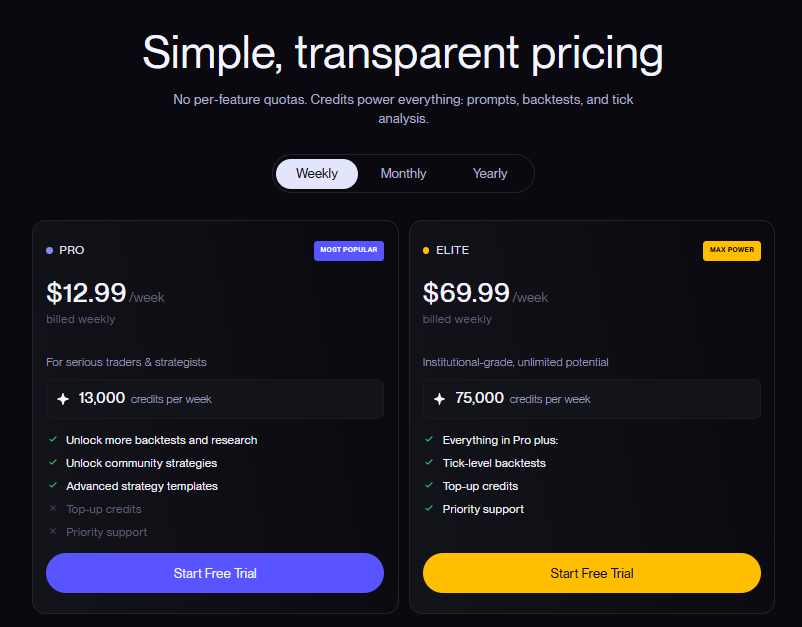
| Plan | Price | Credits | What unlocks |
|---|---|---|---|
| Free | $0 | 1,000 one-time | First backtests, core pairs, 1H to 1M candles |
| Pro weekly | $12.99 / week | 13,000 per week | 15m to 1M candles, all crypto pairs, commodities |
| Pro monthly | $39.99 / month | 50,000 per month | Everything in Pro plus top-up credits |
| Pro yearly | $33.25 / month ($399 / year) | 55,000 per month | Everything in Pro, yearly billing |
| Max Power weekly | $69.99 / week | 75,000 per week | Tick-level backtests, all resolutions 1m to 1M |
| Max Power monthly | $220 / month | 300,000 per month | Tick-level backtests, top-up credits, priority support |
| Max Power yearly | $166.58 / month ($1,999 / year) | 300,000 per month | Everything in Max Power, yearly billing |
A useful rule of thumb: on CoinQuant, 1,000 credits roughly corresponds to one daily-timeframe backtest over a multi-year window on a core pair, so check the plan’s current credit allocation against your intended workload.
What the Credits Actually Buy
Credits are the unit that makes no-code trading pricing comparable across platforms, because they buy the expensive part: historical data and compute.
Pro includes 500K bars per backtest, all crypto pairs, all supported commodities, and candle resolutions from 15 minutes to 1 month
Elite adds tick-level backtests with a 6-month tick range and all candle resolutions from 1 minute to 1 month
Top-up credits are available on monthly and yearly plans, and on all Elite plans
Both paid tiers include community strategy access, premium templates, and priority support on monthly and yearly billing
The pattern is consistent across the industry: weekly plans cost more per credit and are for testing, monthly and yearly plans are for regular research, and the top tier exists for tick-level work that retail backtests rarely need.
How CoinQuant Pricing Compares With Bot Platforms
| Platform type | Typical pricing | What you pay for |
|---|---|---|
| Bot platforms (3Commas, Cryptohopper, Bitsgap, Coinrule) | Free tiers, paid plans from roughly $20 to $100+ per month | Live execution, bot types, exchange connections |
| Execution-focused free bots (Pionex) | Free bots, revenue from trading fees | Built-in bot types, no strategy validation |
| Backtesting platforms (CoinQuant) | Pro from $12.99 per week; check current plan terms | Historical data, backtest compute, metrics, validation |
The distinction matters more than any single number. A $50 monthly bot plan buys you a machine that places orders. A $40 monthly backtesting plan buys you the evidence about whether the strategy behind those orders works. Most traders who have been burned by bots were not underpaying, they were paying for the wrong layer.
Common Pricing Mistakes
Three mistakes show up constantly in no-code trading cost research:
Comparing monthly bot plans with credit-based backtesting plans as if they were the same unit. They are not, and the comparison will mislead you
Ignoring access terms. Check current plan credit allowances against your first research cycle
Assuming the most expensive plan is needed. Tick-level backtests and 300,000 credits per month are for high-frequency work; check Pro’s current plan terms for daily-strategy research
The Practical Lesson
No-code trading in 2026 costs between $0 and about $220 per month depending on the layer you buy. The rational purchase order is: check access terms, validate on a suitable research plan, and only then consider execution.
The money in no-code trading is not saved by picking the cheapest bot. It is saved by testing the strategy before deploying it, which is exactly what backtesting credits buy.
Explore strategy research and backtesting on CoinQuant.
Disclaimer:
Key Takeaway