
How Much Does No-Code Backtesting Cost in 2026? Free vs Paid Platforms

How much does no code backtesting cost in 2026? The honest answer is a range: genuinely free to about $220 per month at the top end of dedicated no-code platforms. Most traders who backtest without writing code end up paying somewhere between nothing and $40 per month, and the biggest cost in the category is not the subscription. It is the strategy that looked profitable in the backtest and failed live because the platform did not model reality.
No Code Backtesting Cost: The 2026 Price Range
The table below shows the verified pricing picture for the main no-code platforms in August 2026. Free tiers exist almost everywhere; the differences are in what they let you do.
| Platform | Free tier | Paid plans (from) | Top tier |
|---|---|---|---|
| CoinQuant | 1,000 one-time credits | Pro $39.99/mo monthly or $33.25/mo billed yearly ($399/yr) | Max Power $220/mo monthly or $166.58/mo billed yearly ($1,999/yr) |
| TradingView | Basic plan, free | Essential about $12.95 to $14.95/mo | Ultimate $239.95/mo monthly |
| QuantConnect | Free cloud backtesting | From about $60/mo for live trading | Scales with compute and data |
| TrendSpider | Trial-based | Roughly $40 to $100/mo for mid tiers | Roughly $100 to $240/mo for advanced tiers |
| Composer | Free tier with backtester | Trading Pass from about $24/mo billed yearly | Single paid tier |
| Backtrex | Free plan, 5 backtests | From about EUR 29/mo | Higher tiers for more runs and assets |
Two notes on reading this table. First, TradingView requires Pine Script for strategy testing, so it is only partially no-code. Second, ranges are used where vendor pricing varies by billing cycle and region; exact figures are only cited where verified in August 2026.
Access Terms Across Platforms
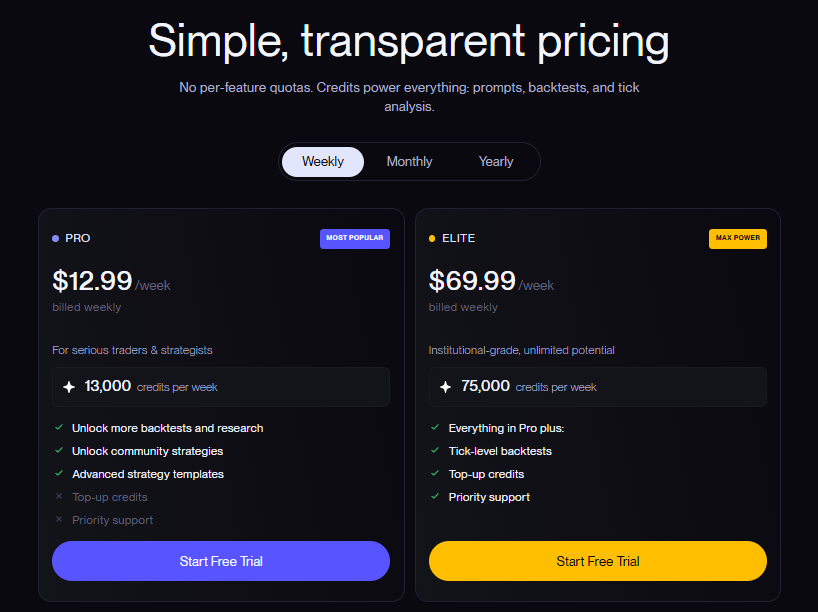
Access terms differ across platforms. CoinQuant offers Pro and Elite paid subscriptions for no-code strategy research and backtesting.
TradingView Basic includes Pine Script strategy backtesting on daily and weekly timeframes with basic report metrics, but historical data depth is limited and the free plan caps charts at two indicators. QuantConnect's free plan covers cloud-based Python backtesting with minute-resolution data, but live trading is not included. Backtrex's free plan limits you to five backtests per account, which disappears fast when you are iterating on an idea. Composer offers a free tier with access to its backtester.
Where the Hidden Costs Hide
The subscription price is only the first layer. The costs that actually decide whether a platform is expensive are:
Credits and usage: some platforms meter every backtest run, so heavy iteration can exceed a plan's included allowance
Data depth: longer history and higher resolution cost more. Tick-level data is the clearest example: CoinQuant includes it in its Elite tier, and TradingView gates tick-level features behind its top plans
Bars per backtest: the available history matters for multi-year tests on low timeframes; evaluate it when comparing CoinQuant’s Pro and Elite paid subscriptions.
Live deployment: paper testing and live execution are often paid upgrades even when backtesting is free
When Free Is Enough
A free tier is enough when you are learning indicators, sketching rules, or testing simple ideas on daily data. If the question is whether an idea is worth investigating, a free tool can answer it.
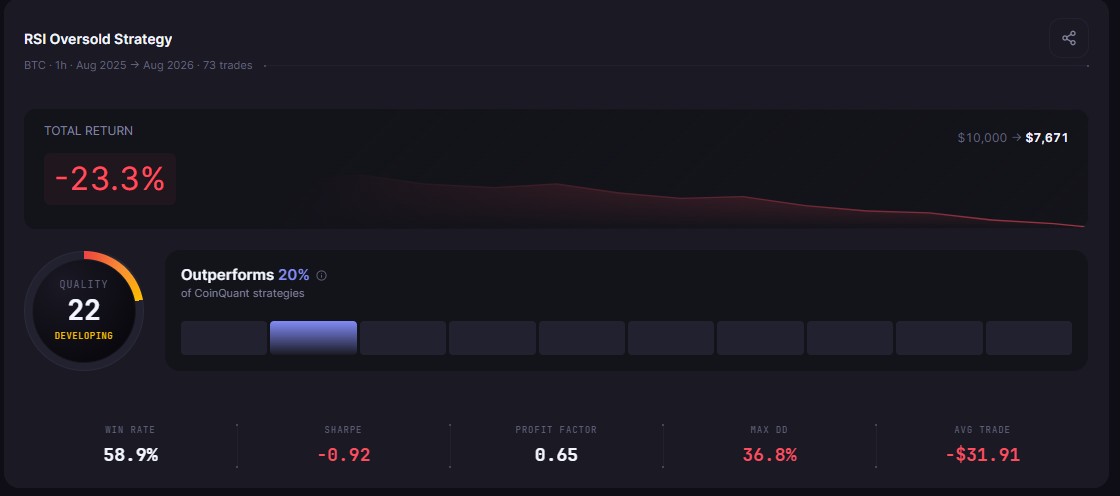
Free is not enough when the result will decide real capital. At that point you need fees and slippage included in every run, deep history, drawdown clarity, and the ability to test across assets and timeframes. That is validation, and validation is a different job from exploration.
CoinQuant's Pricing in Context
CoinQuant's pricing, verified August 12, 2026, sits at the competitive end of the category. The free tier provides 1,000 one-time credits. Pro costs $39.99 per month on monthly billing or $33.25 per month billed yearly ($399 per year), and includes all supported crypto pairs, commodities, 500,000 bars per backtest, and community strategy access. Max Power costs $220 per month on monthly billing or $166.58 per month billed yearly ($1,999 per year), and adds tick-level backtesting over a six-month range plus all candle resolutions from one minute up.
For a no-code trader, the deciding question is not the sticker price but what each plan proves. A platform that shows you gross return, fees, slippage, and net return separately, scores robustness, and lets you test out-of-sample windows is cheaper at $40 per month than a free tool that makes a fragile strategy look investable.
How Credits Change the Math
Usage-based pricing changes the cost equation in one important way: the price of a plan is not the price of a month of work. CoinQuant offers Pro and Elite paid subscriptions for strategy research and backtesting. If you iterate heavily, the allowance, not the sticker price, is what you should compare.
The same logic applies across the category. Some platforms meter backtests per run, others by data consumed, and others by compute time. Before comparing monthly prices, check what the allowance actually covers at your iteration rate.
The Real Cost Question: What Are You Validating?
The right way to budget for no-code backtesting is to start from the decision you are making, not from the feature list. If you are testing a casual idea, a free tier is fine. If the result will size real capital, then the platform needs to answer four questions: does it include fees and slippage in every run? Does it show drawdown clearly? Does it let you test out-of-sample windows? Does it let you test across assets and timeframes? A platform that cannot answer those questions is expensive at any price, because a false positive in a backtest costs far more than any subscription.
FAQ: No-Code Backtesting Cost
Is free no-code backtesting reliable?
Free tiers are reliable for learning and simple exploration. They usually limit data depth, resolution, asset coverage, or iteration volume, so results from a free tier should not be the basis for real capital decisions.
Which platform is cheapest for crypto backtesting without code?
CoinQuant Pro ($39.99 per month) is one paid option for no-code strategy research. Check the current Pro and Elite plan terms and credit allowances before choosing a workload.
What is the most expensive hidden cost in backtesting?
False confidence. A platform that ignores fees, hides drawdown, or rewards over-optimized settings can make a fragile strategy look investable, and that mistake costs more than any plan in this article.
What are CoinQuant’s current paid plan options?
CoinQuant offers Pro and Elite paid subscriptions for strategy research and backtesting. Check current plan terms before choosing a workload.
The Bottom Line
No-code backtesting costs between $0 and about $220 per month in 2026, and most traders land in the lower half of that range. Budget for what you are validating, not for what looks cheapest: the most expensive backtest is the one that gives confidence without evidence.
Disclaimer:
Key Takeaway
