
How Compounding Works in Crypto Trading (And Why Most Traders Misuse It)

Compounding is the most cited word in trading and the least understood. Most traders hear it as a promise, "profits grow on profits", and never look at the arithmetic behind it. The arithmetic is simple, and the behavior it demands is not.
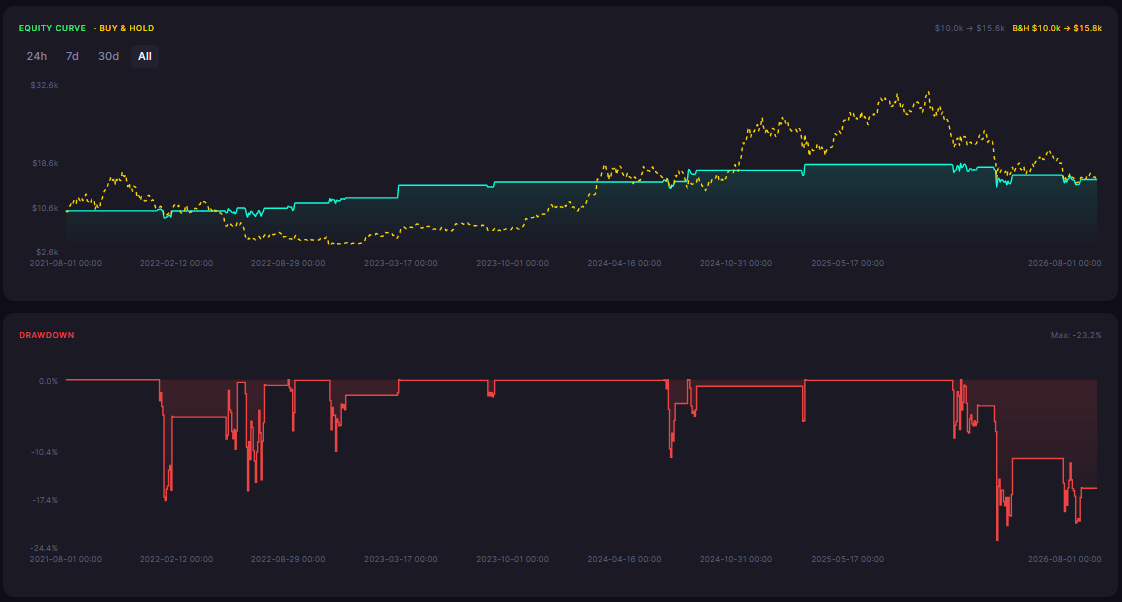
This article explains compounding with a real equity curve from the CoinQuant strategy library. The BTC RSI(14) Mean Reversion 1d strategy was backtested on daily Bitcoin from August 2021 to August 2026, and its 13 closed trades, exported from the verified backtest, show exactly how compounding builds a $10,000 account into $15,575.61.
What Compounding Actually Is
Compounding means your position size grows with your account. When a strategy deploys 100% of current equity on every entry, each win is calculated on a larger base than the last, and each loss shrinks the base for the next trade.
The alternative is fixed sizing: bet the same dollar amount on every trade. Compounding is what turns a consistent percentage edge into exponential account growth, and it is also what turns a losing streak into a fast drawdown.
The key number is the sequence, not the average. Ten trades averaging +5% each can produce very different final accounts depending on the order of wins and losses. That is why a compounding equity curve is the honest picture of a strategy, not a table of averages.
The Real Compounding Sequence
The table below is the actual trade sequence of BTC RSI(14) Mean Reversion 1d, exported from the verified CoinQuant backtest. Every trade deploys 100% of the current balance, so the equity column is compounding in action.
| Trade | Date closed | Net P&L | Account after |
|---|---|---|---|
| 1 | 2022-02-04 | -$18.26 | $9,981.74 |
| 2 | 2022-05-30 | +$529.71 | $10,511.46 |
| 3 | 2022-07-18 | -$45.63 | $10,465.83 |
| 4 | 2022-09-09 | +$942.57 | $11,408.39 |
| 5 | 2022-12-08 | +$908.60 | $12,316.99 |
| 6 | 2023-03-13 | +$2,241.48 | $14,558.47 |
| 7 | 2023-08-29 | +$567.94 | $15,126.41 |
| 8 | 2024-07-14 | +$96.22 | $15,222.63 |
| 9 | 2024-08-21 | +$1,978.83 | $17,201.45 |
| 10 | 2025-03-02 | +$1,048.73 | $18,250.19 |
| 11 | 2026-01-02 | -$475.42 | $17,774.77 |
| 12 | 2026-03-04 | -$1,404.38 | $16,370.39 |
| 13 | 2026-07-05 | -$794.78 | $15,575.61 |
What the Sequence Shows
Three compounding facts are visible in this real sequence.
First, the big wins are the engine. Trade 6 alone added $2,241.48, and trades 6 and 9 together added $4,220.31, more than the total final profit of $5,575.61. The compounding effect matters most on large wins, because they grow the base for everything after them.
Second, the order of losses matters. The three losing trades, 11, 12 and 13, came at the end of the sequence. If those same losses had happened at the start, the account would have ended lower, because the base was smaller. Same trades, different order, different result.
Third, the strategy's win rate of 61.5% is not what made the money. It was the size of the wins relative to losses, an average win of $1,039.26 against an average loss of $547.69, applied to a growing base.
Why Most Traders Misuse Compounding
The misuse is behavioral, and it comes in four common forms:
Withdrawing profits. Taking money out of the account after every win resets the base and converts a compounding curve into a linear one, which defeats the entire mechanism
Over-leveraging to force it. Leverage amplifies the same compounding curve in both directions, and a 23.21% drawdown becomes a margin call at high leverage
Compounding the wrong strategy. Compounding only amplifies what is already there. A strategy with a negative edge, like the same RSI rules on Ethereum, which lost 57.25% in the same window, compounds faster into ruin
Confusing win rate with compounding power. A 90% win rate with tiny wins and one huge loss can compound downward faster than a 40% win rate with a strong payoff ratio
The core mistake is treating compounding as a strategy. It is not. It is an amplifier, and amplifiers are neutral.
How to Use Compounding Correctly
The disciplined version follows from the arithmetic:
Validate the edge first with a backtest that includes fees and drawdown, on the exact rules you will trade
Size positions as a fixed percentage of current equity, which is what the library strategies do at 100%, and what CoinQuant position sizing settings control
Decide in advance how much of the account you will let a drawdown take before reducing size
Test the compounding plan on historical data before risking capital
Review the equity curve, not the trade count, as the measure of progress
Step one is the one most traders skip. Compounding a backtested edge is how the $10,000 account above became $15,575.61. Compounding an untested idea is how accounts go to zero faster than linear math predicts.
The Practical Lesson
Compounding is sequence arithmetic. The same trades in a different order produce a different final balance
The amplifier is neutral. It grows edges and it accelerates losses, so the strategy quality decides whether compounding helps
The real curve is the equity curve. CoinQuant shows it after every backtest, with the drawdown panel underneath, which is where compounding behavior is actually visible
Validate before you compound. The BTC RSI(14) Mean Reversion 1d run is a validated edge on BTC, and the same rules on ETH are a validated loss, and compounding cannot tell the difference
See compounding on your own equity curve
Disclaimer:
Key Takeaway