
Crypto Strategy Testers in 2026: How Non-Programmers Test Before They Trade

Somewhere between a good idea and a live trade there should be evidence. A crypto strategy tester exists to produce exactly that, and 2026's versions are the first generation that non-programmers can actually use.
That last part is new, and it changes the stakes. If you cannot write code, your only defense against a bad strategy used to be discipline you probably would not keep. Now it can be a test.
This guide covers what a strategy tester does, what it can and cannot prove, and how to run your first test without writing a line of code.
What a Crypto Strategy Tester Should Do for You
Strip away the marketing and a tester has six jobs. Judge any tool against this list.
- Use real market data. Historical prices that came from actual exchanges, traceable by name.
- Model fills honestly. Your order fills at a realistic moment, not at a price the future revealed.
- Charge fees per trade. Every fill pays a cost, and the report totals them.
- Report the full picture. Total return, trade count, win rate, profit factor, Sharpe ratio, and maximum drawdown belong together.
- Make runs reproducible. Same strategy, same settings, same result, on demand.
- Skip the code requirement. Rules go in as plain English; the platform handles the rest.
A tool that does all six is a tester. A tool that does three is a chart with opinions.
What It Can and Cannot Verify
Understanding the boundary is what separates testing from superstition.
A tester can verify that your exact rules, applied to real historical data with real costs, produced a specific sequence of trades and a specific outcome. It can show how sensitive that outcome is to a small change in settings. It can compare your idea with the simplest alternative, buying and holding.
A tester cannot tell you the future. It cannot capture your own behavior under a live drawdown. It cannot prove a strategy will keep working when market structure changes, only how it behaved in the conditions it saw. And it cannot rescue a rule set that was tuned to look good rather than built to make sense. The tester supplies evidence; you supply judgment.
How Non-Programmers Test: A Walkthrough
Here is the full loop, from idea to evidence, exactly as it runs for a trader who has never written code.
Step 1: Write the Rules in Plain English
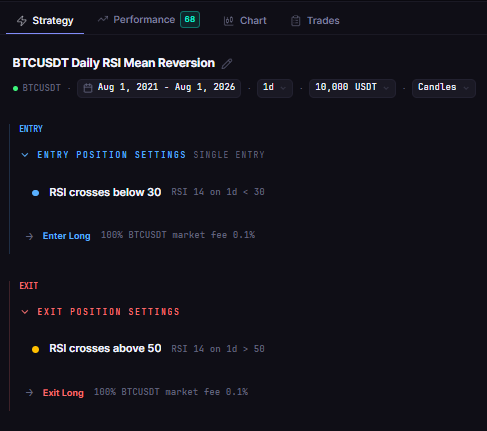
One sentence, readable, decisive. For example: "Buy BTC when RSI(14) crosses below 30, exit when RSI(14) crosses above 50, long only." If you cannot say the strategy out loud like this, you are not ready to test it.
Step 2: Define It on the Platform
On CoinQuant, you type that sentence and the platform builds the strategy, no Python and no Pine Script. This construction matches a tested strategy already in the library, BTC RSI(14) Mean Reversion 1d, so you can compare your version against a documented one.
Step 3: Read the Report Like a Trader
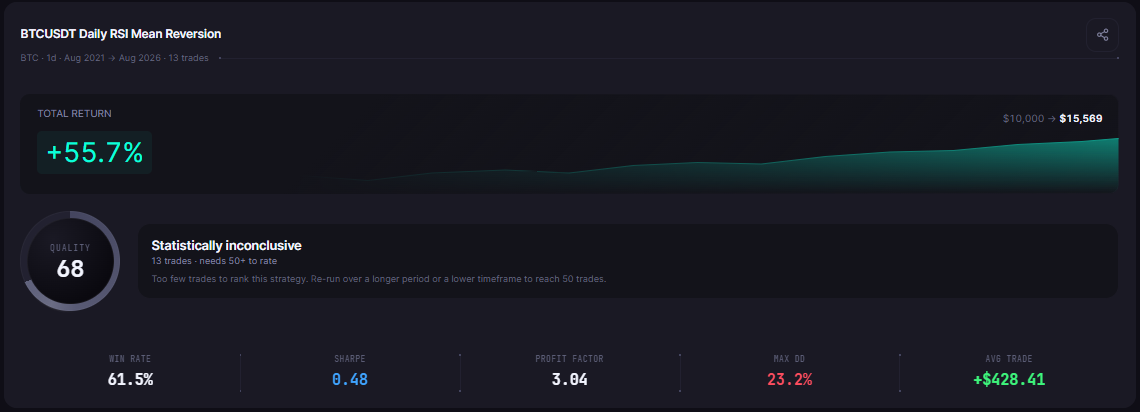
The result of that library strategy over 2021-2026: +55.69% total return, 13 trades, a 61.5% win rate, a profit factor of 3.04, and a 23.19% maximum drawdown. Notice what the numbers describe together: a small number of trades, a strong payoff, and a drawdown less than a third of the asset's own, since buy-and-hold BTC over the same window saw a 76.63% drawdown. The tester does not tell you the strategy is good. It shows you exactly what "good" would have to mean.
Step 4: Change One Thing
The second run is where testing becomes a habit. Adjust a single parameter, keep everything else frozen, and compare. If the result shrugs, you learned the setting is not fragile. If it collapses, you learned the first number was luckier than it looked.
Step 5: Compare Against the Baseline
Every serious test needs a benchmark. For crypto, that is usually buy and hold. A strategy that cannot beat holding after fees, or cannot beat it on risk terms such as drawdown, is not yet earning its complexity.
Red Flags in Strategy Testers
- No fee line anywhere. Without costs, every result is inflated and fast strategies are flattered most.
- You cannot inspect the trades. A number you cannot drill into is a headline, not evidence.
- The data source is unnamed. Real market data has a provenance. Ask for it.
- Results that cannot be re-run. Reproducibility is the minimum standard of a serious tool.
- "No-code" with an asterisk. If the workflow quietly requires scripting for anything beyond a toy, that is not a non-programmer tool.
- Win rate theater. A single flattering statistic, with the drawdown and payoff conspicuously missing.
Common Mistakes to Avoid
- Testing a vague idea. "Buy dips" is not a rule set. Thresholds and conditions are.
- Skipping the baseline. Beating your own expectations is easy; beating buy and hold is the bar that matters.
- Judging on one run. Single runs are anecdotes. Small deliberate variations are evidence.
- Ignoring trade count. Under ten trades, you are reading a coincidence.
- Trusting the tool more than the process. The tester answers what happened. What should have happened is still your call.
The Practical Lesson
- A strategy tester converts rules into evidence: real data, honest fills, fees included, full metrics
- It can verify historical behavior with specific rules and costs; it cannot predict the future
- The non-programmer loop is five steps: write, define, read, change one thing, compare to baseline
- Red flags are consistent: no costs, no trades, no provenance, no reproducibility
Start your first backtest on CoinQuant
Disclaimer:
Key Takeaway
