
CoinQuant vs MetaTrader 5: Crypto Backtesting Beyond CFDs and Forex

MetaTrader 5 is the most-searched backtesting tool in the world, and for good reason: it is free with most brokers, battle-tested, and its Strategy Tester has run millions of backtests. For crypto traders, though, the question is whether the tool that dominates forex and CFDs is the right tool for spot crypto research.
The short answer is that MT5 is built around broker infrastructure, CFD-style pricing, and the MQL5 language, while CoinQuant is built around exchange data, spot markets, and plain-English strategy building. This comparison walks through what each does well and where the difference actually matters.
What MetaTrader 5 Does Well
MT5 is a complete trading terminal. It is free to use with a participating broker, it connects to thousands of brokers worldwide, and its Strategy Tester runs MQL5 strategies against historical data with reasonable speed. The charting is mature, and the MQL5 ecosystem has decades of published code.
For forex and CFD traders, MT5 is a legitimate choice. The tester models the CFD-style instruments those brokers offer, the terminal handles execution and risk management in one place, and the price is hard to argue with. That combination is why it remains the most-used backtesting tool globally.
The Crypto Problem in MT5
The gap appears the moment the instrument is crypto. MT5's crypto exposure runs through brokers offering crypto CFDs, not through exchanges. That has three practical consequences for backtesting:
CFD pricing is not exchange pricing. The historical series comes from the broker's feed, which reflects CFD spreads and markups rather than the raw exchange order book. A strategy validated on that series is validated on a proxy.
The venue is the broker. You cannot backtest against Binance or Coinbase spot data directly in the standard MT5 setup. Your results depend on which broker's feed you happened to connect.
Spot-specific behavior is invisible. Funding, exchange liquidity events, and venue-level volume patterns do not exist in a CFD feed. Strategies that depend on them cannot be tested at all.
None of this is a bug in MT5. It is a design consequence of a broker-centric terminal. The tester is built for the instruments the brokers offer, and crypto spot is not one of them.
The Strategy Expression Gap
The second difference is how strategies are written. MT5 uses MQL5, a C-like language. Every strategy, every indicator, every exit rule is code. The power is real, and so is the barrier: debugging, compiling, and maintaining a strategy in MQL5 is a programming job.
CoinQuant takes the opposite route: strategies are described in plain English. A trader types the rules, the platform validates them into a strategy schema, and the backtest runs on exchange data. No code, no compiler, no language to learn.
| Capability | MetaTrader 5 | CoinQuant |
|---|---|---|
| Strategy expression | MQL5 code | Plain-English prompt |
| Crypto data source | Broker CFD feed | Exchange spot data (Kaiko: Binance, Coinbase, Kraken) |
| Typical crypto instrument | Crypto CFDs | Spot pairs |
| Data history | Broker-dependent | Bitcoin back to 2017, multi-cycle coverage |
| Fees and slippage modeling | Configurable in tester | Modeled by default in every backtest |
| Backtest metrics | Trade list, equity curve, per-trade stats | Full suite: Sharpe, profit factor, max drawdown, win rate, per-trade output |
| Community strategies | MQL5 marketplace and forums | Tested strategy library with published results |
| Live execution | Built in via brokers | Research-first workflow |
| Learning curve | Programming required for custom logic | No coding required |
| Pricing model | Free terminal, broker-dependent costs | Credit-based plans, no fixed backtest cap |

CoinQuant strategy builder
Where Each Tool Wins
The honest comparison is not about which is better in the abstract. It is about which fits the job.
MetaTrader 5 wins on: live execution integration with brokers, a mature terminal experience, and the largest pool of legacy MQL5 code. If you trade forex or CFDs and want the terminal and the tester in one place, MT5 remains a strong choice.
CoinQuant wins on: crypto spot data that matches the exchange you actually trade, no-code strategy building, fees and slippage modeled by default, and a tested strategy library to start from. If your market is crypto and your background is not MQL5, the research workflow is shorter and the results are grounded in spot market reality.
The Migration Scenario That Matters
The clearest case for the comparison is the trader moving from crypto CFDs to spot, or from a broker terminal to exchange-native research. That trader's MT5 library of MQL5 strategies is tied to CFD feeds and broker instruments. Rebuilding the same ideas for spot means restating the rules anyway.
That restatement is exactly where the two tools differ. In MT5, it means rewriting MQL5. In CoinQuant, it means describing the rules in plain English and running them against spot data. The strategy logic survives the migration; the expression language does not have to.
Common Mistakes to Avoid
Backtesting spot ideas on CFD data. The feed is a proxy, and the proxy flatters or punishes strategies for reasons that have nothing to do with the exchange market.
Assuming MT5 covers crypto. It covers crypto CFDs through brokers, which is a different instrument with different pricing, venues, and behavior.
Equating MQL5 skill with strategy skill. Knowing how to code a tester is not the same as having a validated edge. The validation still requires data quality, cost modeling, and out-of-sample discipline, which the language does not provide.
Choosing by price alone. Free MT5 costs your time in MQL5 and your data quality in CFD feeds. The real price of a research tool is what it costs to get a trustworthy answer.
The Practical Lesson
MT5 is a powerful broker-centric terminal whose tester is built for forex and CFDs, not exchange spot data
CoinQuant is a crypto-native research platform: exchange data, plain-English strategies, fees and slippage modeled by default
The choice is about the instrument and the workflow: spot crypto and no-code research point to CoinQuant, broker-connected CFD trading points to MT5
Whatever you choose, the strategy still needs validation on data that matches the market you actually trade
The test for any backtesting tool is whether the data matches the market you trade and whether the workflow gets you to a verified answer. For crypto spot, that test points away from CFD feeds and toward exchange-native data.
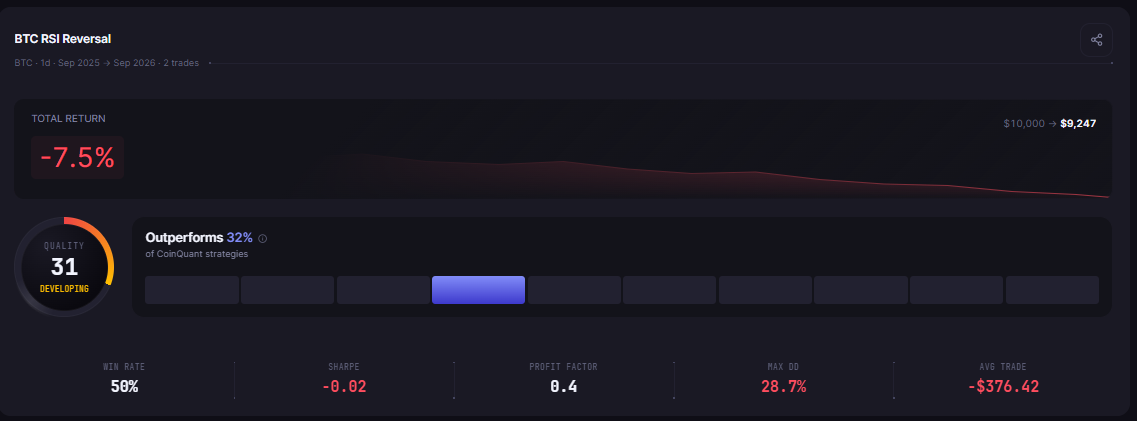
CoinQuant backtest panel
Backtest crypto-native spot data free and see the difference from a CFD feed. See why traders choose CoinQuant
Disclaimer:
Key Takeaway