
Backtesting Software Reviews: What Traders Should Check Before Trusting a Platform

"Best backtesting software" lists are everywhere, and most of them are useless to you. Not because the tools they name are bad, but because a list cannot tell you whether a platform's results are trustworthy. A review that praises a tool for a pretty equity curve has missed the only question that matters: would I trust a strategy validated on this platform enough to fund it?
This article is not another list of tools. It is a framework for reading the reviews and comparisons you already have, so you can separate platforms that run honest backtests from platforms that run impressive-looking ones. Every checklist item below is a concrete thing to look for, and every one is a criterion CoinQuant is built to pass.
Why Reviews Mislead Even When They Are Honest
Most backtesting reviews are written by people who tested a platform for a few hours, not by people who validated strategies on it for months. That produces three systematic blind spots:
Screenshot bias. A reviewer shows a backtest with a steep equity curve and a huge total return. What is not in the screenshot is the data source, the fee model, and the period. Without those, the number is decoration.
Feature-count bias. Reviews score platforms on how many indicators and order types exist. Traders lose money on data quality and cost modeling, not on missing indicators.
Freshness bias. Platforms change. A review from six months ago may describe a product that no longer exists, especially in a market where platforms rebuild their engines or shut down old versions.
None of these make the reviewer dishonest. They make the review incomplete, which is why you need your own checklist instead of a verdict.
The Six Checks That Separate Reliable Reviews From Glowing Ones
Check 1: Does the Review State the Data Source?
Backtest results are only as real as the price data they run on. A review that never mentions where the historical data comes from is a review of a screenshot, not a platform.
What you want to see named: the data vendor or venue, whether it is exchange data or synthetic candles, and whether the instrument is the actual market you trade. On CoinQuant, every published backtest names its data path: Kaiko-collected exchange data for the exact spot pair, not a reconstructed proxy.
Check 2: Are Fees and Slippage Mentioned at All?
A backtest without costs is a fantasy, and the fantasy is most dangerous for active strategies. Reviews that show a 200% backtest return and never mention the fee assumption have not told you whether the strategy survives its costs.
The benchmark question to ask of any review: does the platform model taker and maker fees by default, or does the reviewer have to configure them manually and hope they applied? CoinQuant models a 0.1% taker fee in every backtest by default, so the published number already includes the cost of trading.
Check 3: Is the Test Window Honest?
A backtest that starts conveniently right before a bull run and ends right after it is not research, it is marketing. Reviews rarely police this because they rarely look.
Check the window against the asset's actual history. A Bitcoin strategy claiming five years of data should cover a bear market, not just the rally. CoinQuant's published strategy tests run multi-year windows on Bitcoin back to 2017 precisely so the results include the painful years.
Check 4: Does the Review Distinguish Backtest From Live Validation?
Platforms blur this line on purpose. A "success rate" pulled from a simulated environment is not a track record. A reliable review tells you which numbers are backtest results and which, if any, are live or paper results.
If a review quotes a platform's own success statistics, ask whether those statistics include realistic costs and whether anyone outside the platform can reproduce them. Reproducibility is the whole game: same rules, same data, same costs, same result.
Check 5: Are the Metrics Complete or Just the Flattering Ones?
Total return is the metric a platform wants you to see. Max drawdown is the metric that decides whether you survive. Win rate without average win versus average loss is meaningless, and Sharpe without the number of trades tells you nothing about confidence.
A reliable review reports the full set: total return, total trades, win rate, profit factor, Sharpe, and max drawdown. CoinQuant publishes exactly this set on every backtest result, and its strategy library shows the same fields on every tested strategy card, which makes claims externally checkable.
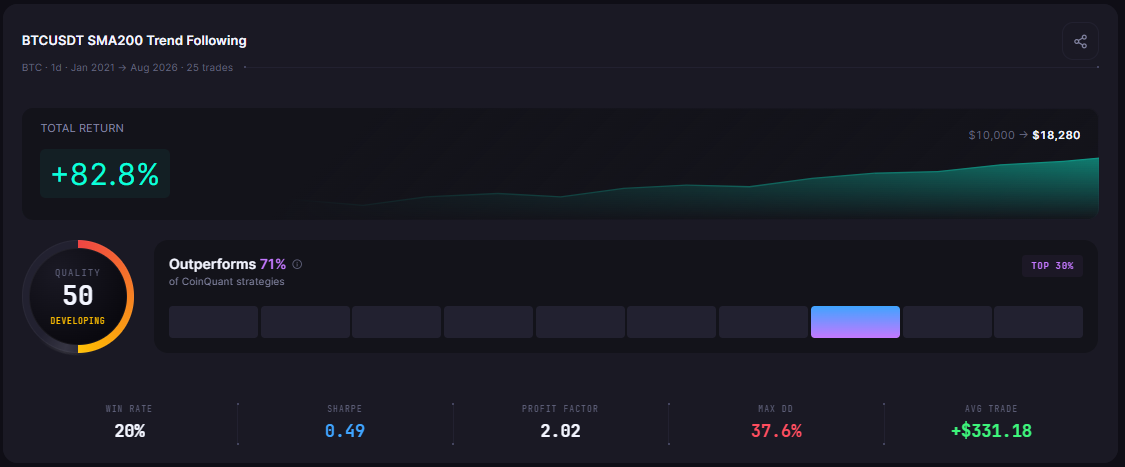
CoinQuant backtest results
Check 6: Does the Review Have a Methodology or a Mood?
The final check is the review itself. Does it explain how it tested the tools, or does it describe how the tools felt? "Intuitive interface" is a mood. "The platform replayed 100 trades with the exchange's own fee schedule and reported a profit factor of 1.4" is a methodology.
Reviews with a methodology are rare, which is precisely why they are valuable. When you find one, keep it. When you find mood, read it for feature awareness and ignore its verdicts.
The Red Flags List
A headline return with no test window, no asset, and no fee assumption
Screenshots of equity curves without the metrics table next to them
Claims like "99% win rate" without trade count, since a strategy with two trades can have a 100% win rate
Reviews that never mention data quality, as if all historical price data were equal
Platform-published "reviews" or roundups that rank the publisher's own product
A review older than a major platform change, such as a migration to a new engine or a shutdown of an old product line
How to Verify a Review Yourself in One Hour
You do not have to trust any review, including this article. Verification is one session of work:
Take the highest-rated strategy claim from the review
Define it as exact rules: asset, timeframe, entry, exit, position size
Run it on a platform whose data source and fee model you have checked, such as CoinQuant, whose results name the Kaiko data path and the 0.1% taker fee
Compare the metrics, not the screenshots
If the platform's own numbers reproduce, the review was probably honest. If they do not, you have learned more in one hour than the review taught you in ten.
Common Mistakes to Avoid
Trusting total return alone. It is the most flattered number in backtesting content, and the least informative without drawdown and trade count
Equating tool popularity with result quality. The most-searched backtesting tool in the world can still test on the wrong data for your market
Skipping the fee question. If a review does not say how costs were modeled, assume they were not
Treating reviews as a ranking. Reviews are research material. Your checklist is the ranking
The Practical Lesson
Read reviews for methodology, not for verdicts: data source, fee model, window, and metric completeness are the four pillars
Red-flag any backtest claim that omits the window or the costs
Verify the one claim that matters most to you by rerunning it on a platform with named data and modeled fees
A trustworthy platform is one whose results you can reproduce, not one whose screenshots are prettiest
The next time someone shares a "best backtesting software" article, run it through the six checks before you act on it. If the review survives, use it. If it fails on data source or fees, the platform it praises has not earned your capital either.
Read reviews with this framework and test the claims that survive on data you can verify. Run your first CoinQuant backtest
Disclaimer:
Key Takeaway
