
ATR Strategy Backtest on Bitcoin: Does Volatility Filtering Improve Entries?

The Average True Range is the standard measure of volatility in technical analysis, and one of its most popular uses is as a filter: only take a trade when volatility is high enough to matter. The logic sounds disciplined. A breakout during quiet, low-ATR conditions is more likely to be noise, so waiting for ATR to expand should improve the quality of entries.
Sound logic is not a result. This article runs the test on Bitcoin: the library's Donchian 20 breakout strategy against the same breakout gated by an ATR filter that only allows entries when ATR(14) is above its own 20-day average. Same asset, same window, same fees, one variable changed. The question is direct: does volatility filtering improve entries, and what does it cost?
The Two Strategies
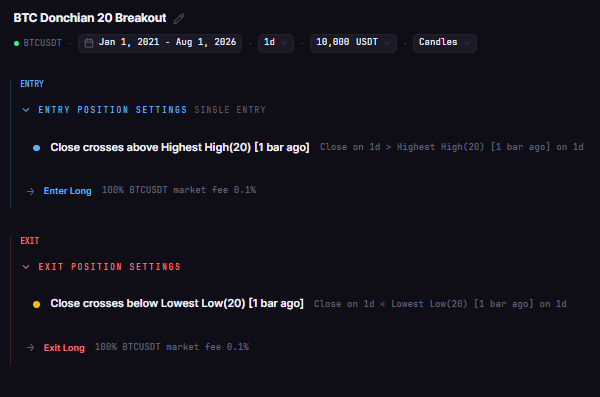
BTC Breakout 1D 2021-2026
The unfiltered baseline, matching the tested library definition:
Entry: close crosses above the highest high of the prior 20 bars (Donchian upper band)
Exit: close crosses below the lowest low of the prior 20 bars (Donchian lower band)
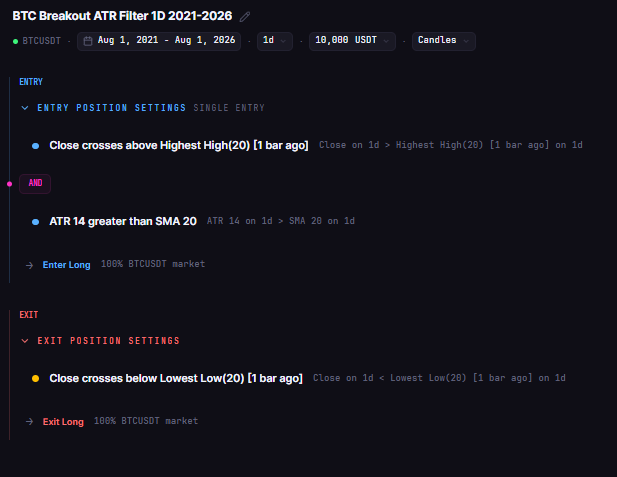
BTC Breakout ATR Filter 1D 2021-2026
The filtered variant, identical in every way except one:
Entry: close crosses above the highest high of the prior 20 bars, AND ATR(14) is above its own 20-period simple moving average (volatility expansion filter)
Exit: close crosses below the lowest low of the prior 20 bars
Both are long only, one position at a time, 100% of equity per entry, 0.1% taker fee modeled, on BTCUSDT daily from August 2021 to August 2026.
Test Setup
| Parameter | Unfiltered Breakout | ATR-Filtered Breakout |
|---|---|---|
| Strategy | BTC Donchian Breakout 1D 2021-2026 | BTC Breakout ATR Filter 1D 2021-2026 |
| Instrument | BTCUSDT (spot, Binance) | BTCUSDT (spot, Binance) |
| Timeframe | Daily (1D) | Daily (1D) |
| Tested window | 2021-08-01 to 2026-08-01 | 2021-08-01 to 2026-08-01 |
| Entry | Close crosses above Donchian upper (20) | Close crosses above Donchian upper (20) AND ATR(14) above SMA(20) of ATR |
| Exit | Close crosses below Donchian lower (20) | Close crosses below Donchian lower (20) |
| Direction | Long only, no leverage | Long only, no leverage |
| Initial capital | $10,000 | $10,000 |
| Position size | 100% of equity per entry | 100% of equity per entry |
| Fees | 0.1% taker, modeled | 0.1% taker, modeled |
| Data source | Kaiko via CoinQuant | Kaiko via CoinQuant |
The Backtest Results
The ATR filter did what filters do: it removed trades. The surprise is what the removed trades were worth.
| Metric | Unfiltered Breakout | ATR-Filtered Breakout |
|---|---|---|
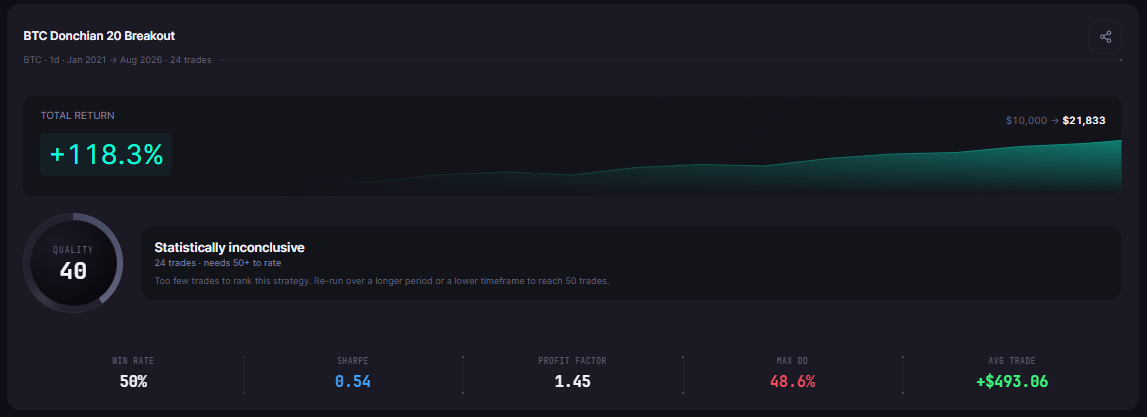
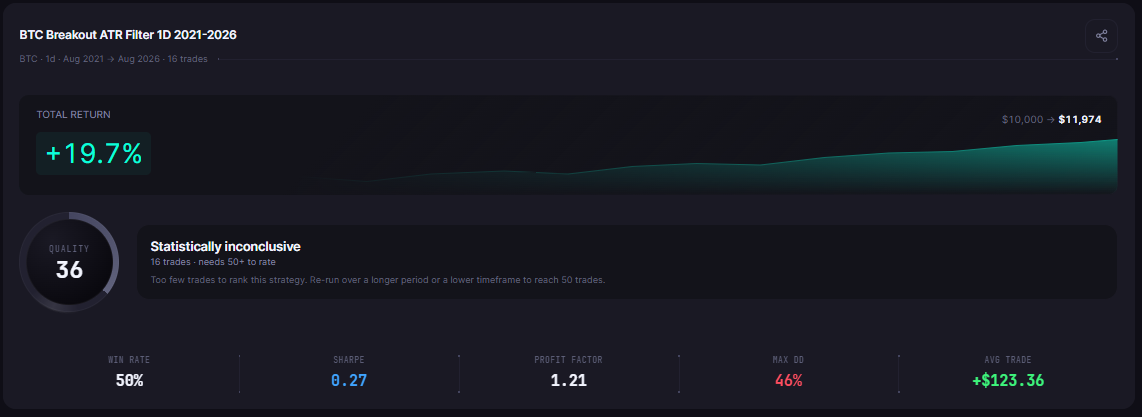
| Total Return | +118.33% | +19.74% |
| Final Balance | $21,833.33 | $11,973.72 |
| Total Trades | 24 | 16 |
| Win Rate | 50.0% (12W / 12L) | 50.0% (8W / 8L) |
| Profit Factor | 1.45 | 1.21 |
| Sharpe Ratio | 0.54 | 0.27 |
| Sortino Ratio | 0.82 | 0.40 |
| Max Drawdown | 48.60% | 46.00% |
| Average Win | $3,170.92 | $1,433.91 |
| Average Loss | $2,184.81 | $1,187.20 |
| Best Trade | +$9,582.43 | +$4,461.02 |
| Worst Trade | -$3,946.79 | -$1,946.98 |
| Time in Market | 60.23% | 40.67% |
| Total Fees | $1,005.42 | $76.13 |
What the Data Shows
The filter removed eight trades out of 24 and reduced the total return by almost 100 percentage points: from +118.33% to +19.74%. The win rate did not move, 50% in both versions. The filter did not remove bad entries, it removed entries of both kinds evenly and, because the average win collapsed from $3,170.92 to $1,433.91, the trades it removed were disproportionately the good ones.
That is the counterintuitive core of the result. Breakouts that fired while ATR was below its 20-day average were not noise, they were the early entries into the quiet phases that later became the strongest trends. By requiring volatility to expand first, the filter waited for confirmation, and confirmation arrived after most of the move.
The drawdown improvement is real and small: 48.60% down to 46.00%. The filter also cut fees from $1,005.42 to $76.13 and time in market from 60.23% to 40.67%, because it traded less. But the cost of that capital efficiency was the return itself: the filtered version made 16 trades and roughly broke even in per-trade quality terms, with a profit factor of 1.21 against the unfiltered version's 1.45.
Why the Volatility Filter Backfired on This Window
The ATR filter's assumption is that high volatility precedes good breakouts. On Bitcoin from 2021 to 2026, the opposite pattern dominated: the best trend phases of the window began from compressed, low-volatility bases, and the Donchian breakout fired early in those phases, while ATR was still quiet. The filter systematically excluded the strategy's best entries.
This is a window-specific finding, not a universal law. ATR filters are context-dependent tools, and their value depends on whether the market's strong trends start from quiet or volatile conditions. What the backtest establishes is that on daily Bitcoin over this five-year window, the filter's cost exceeded its benefit by a wide margin.
The Practical Lesson
The ATR filter cut trades from 24 to 16 and total return from +118.33% to +19.74% on the same Bitcoin window
Win rate was unchanged at 50%, which means the filter removed good and bad entries evenly, and the removed trades were worth more on average
The drawdown improvement was marginal: 46.00% versus 48.60%, not worth a 98-percentage-point return gap
Volatility filters are context tools, and on this window the best Bitcoin trends began from quiet bases where the filter was still blocking entries
The ATR volatility filter question is answered for this window: on daily Bitcoin from August 2021 to August 2026, requiring ATR expansion before entries removed the strategy's best trades and cut the return by roughly 98 percentage points for a barely visible drawdown improvement. The next tests are the natural variations: a filter that blocks entries only when volatility is extremely low, an ATR filter on a shorter timeframe, or volatility-scaled position sizing instead of a binary gate. Each needs its own backtest before it earns a place in a live strategy.
Run the ATR filter comparison yourself and test your own volatility rules on CoinQuant. Backtest ATR strategies free on CoinQuant
Disclaimer:
Key Takeaway
