
API for Crypto Strategy Backtesting: How Programmatic Testing Works in 2026

A dashboard makes you the operator. An API lets something else operate, and that "something else" is increasingly an AI assistant working on your behalf.
That shift is why "api for crypto strategy backtesting" stopped being a developer-only phrase. Traders who will never read a stack trace still benefit when their tools can talk to a platform directly.
This guide explains what programmatic testing actually enables, how the full loop works in practice, and where the honest limits sit.
What an API for Crypto Strategy Backtesting Unlocks
Programmatic access turns four manual habits into automatic ones:
- Creation at the speed of thought. A strategy is defined by a prompt, not a form-filling session.
- Testing without babysitting. Backtests are submitted, polled, and collected by the machine, not clicked.
- Iteration as a loop. Change one parameter, re-run, compare, repeat, without losing context between runs.
- Reproducibility on demand. Every run returns identifiers (strategy, version, backtest), so any result can be traced and re-run later.
The practical difference shows up in iteration count. A trader clicking through a UI might test three variants in an evening. A trader with an assistant driving an API tests thirty, and the discipline of out-of-sample testing becomes a matter of scripting rather than willpower.
The Full Loop, Step by Step
Here is the complete programmatic cycle, as it runs on CoinQuant today. Each step maps to a documented public endpoint, and the official skills pack gives an agent the exact contract for every call.
Step 1: Generate a Service-Account Token
You create a service account in platform settings and generate an access token. The token is the credential every later call carries. Treat it like a key: store it outside public code, and know that it expires after 30 days by design.
Step 2: Describe the Strategy in a Prompt
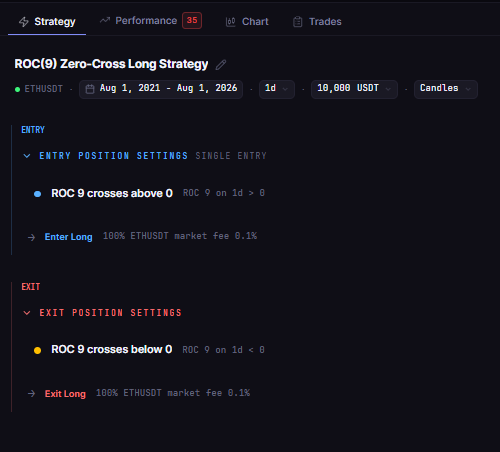
The agent sends a natural-language description to the strategy-generation endpoint. The platform streams progress updates and returns a strategy draft, including the parsed rule set and the chat identifier that anchors the conversation.
Step 3: Finalize the Strategy
The draft becomes a real strategy when it is finalized. The response carries the strategy version identifier, the exact object every later action references. No version id, no testable strategy; that is the gate to respect.
Step 4: Run the Backtest
The agent submits a backtest against that version identifier. The run goes to a queue, executes against historical exchange data with fees and slippage modeled, and reports back when complete.
Step 5: Read the Metrics
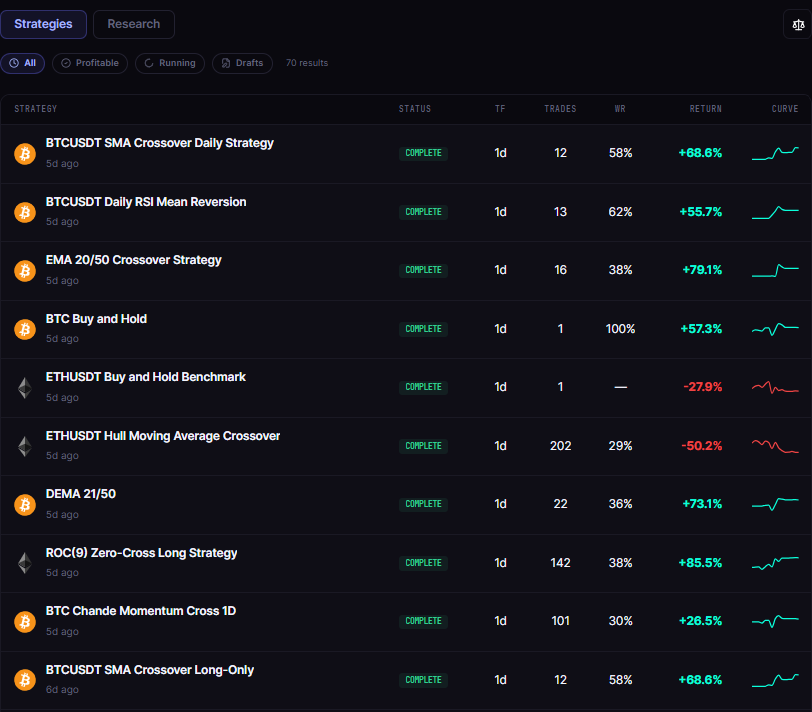
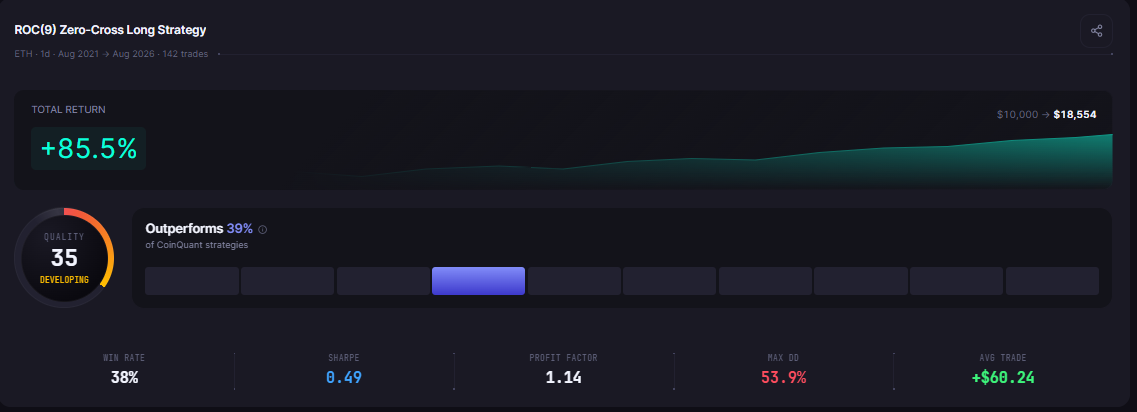
Completed runs return the full metric set: total return, trade count, win rate, drawdown, profit factor, Sharpe ratio, and total fees. One verified example produced by exactly this loop: ETH Rate of Change Cross 1D 2021-2026, +85.54% across 142 trades over 2021-2026, with $4,427.09 in fees, all readable straight from the API response.
Step 6: Iterate
Change one thing, submit the next version, compare the two runs. The loop is intentionally cheap to repeat, which is what makes disciplined iteration possible instead of aspirational.
What Programmatic Testing Enables That a Dashboard Cannot
Three capabilities only exist once the platform is programmatic.
- An agent that owns the whole loop. With the public API plus the skills pack, an external assistant creates, finalizes, backtests, and reports without a human relaying each step. CoinQuant is research-scope on this path: the agent validates strategies, it does not trade them.
- Parameter sweeps. Instead of testing settings one at a time, a script runs the grid and reports which results hold across neighboring values, the practical test for whether a setting is real or lucky.
- Your own pipeline. Results can flow into your own spreadsheets, dashboards, or review notes, because they arrive as data rather than as screenshots you transcribe.
Honest Limits of API-Driven Testing
- Tokens expire. Service tokens have a 30-day lifetime. A well-built agent workflow asks for a fresh token at expiry; a poorly built one dies silently, which is a monitoring problem more than a platform problem.
- Scope is research, not execution. On CoinQuant, the programmatic path validates strategies. Putting capital behind them remains a separate, deliberate decision.
- The agent cannot supply judgment. Fast loops make it easier to overfit fast. The confirmation window and the pass criteria still have to come from you.
- Your security is your security. A token lives wherever you put it. Keep it out of public repositories and rotate it when in doubt.
How to Start
You do not need to be a developer to begin, but you do need to be organized:
- Create the service account and generate the token in platform settings.
- Download the official skills pack from the CoinQuant documentation and let your agent read it before its first call.
- Validate the token, then run the loop once with a simple strategy to see the full cycle: prompt, finalize, backtest, metrics.
- Add one iteration on top: change a single setting, re-run, compare.
- Save the identifiers from every run. They are your audit trail and the fastest way to reproduce any result.
Common Mistakes to Avoid
- Storing tokens in code or notes. Keep credentials in a dedicated secrets file, never alongside the script that uses them.
- Skipping the skills pack. An agent improvising endpoints invents them. The pack exists so it does not have to.
- Testing without a frozen confirmation window. Speed multiplies whatever discipline you bring, including the lack of it.
- Ignoring failed runs. A queued backtest that errors is information. Log it, do not retry blindly.
- Treating the API as a black box for live decisions. Research-grade evidence still needs human review before capital moves.
The Practical Lesson
- Programmatic testing moves strategy work from clicking to looping, and loops compound
- The full cycle is six steps: token, prompt, finalize, backtest, metrics, iterate
- Sweeps and agent-owned workflows are the two capabilities a dashboard cannot offer
- The limits are token lifetimes, research-only scope, and the judgment only you can provide
Backtest your strategy free and try the documented API workflow on CoinQuant
Disclaimer:
Key Takeaway
