
AI Agent Backtesting Explained: What It Is, How It Works, and Why Crypto Traders Need It

Ask an AI assistant how to test a trading idea and you will get advice. Ask a properly built AI agent backtesting system and you will get a result: a strategy definition that was translated from your description, run against real historical data, and returned with real metrics. The difference between advice and results is the entire story of AI agent backtesting.
The term is new and the confusion around it is not accidental. This article defines AI agent backtesting from first principles, separates it from the things it is often confused with, and explains why it matters specifically for crypto traders who do not code.
What AI Agent Backtesting Actually Is
AI agent backtesting is a workflow where an AI system converts a trader's natural-language strategy description into a structured, backtestable rule set, and then executes the backtest on historical market data with realistic costs.
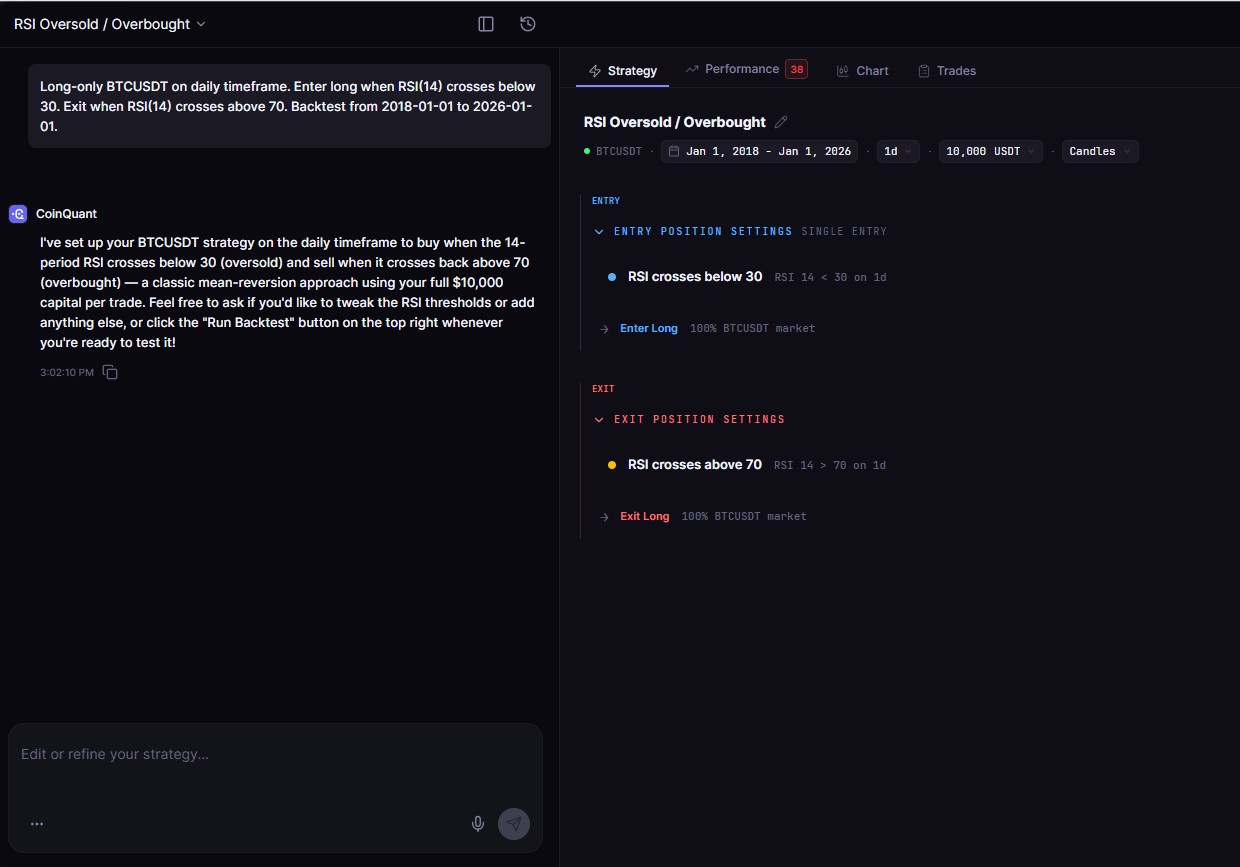
The key word is structured. A chat response that says "you could try buying oversold bounces" is not a strategy. An AI agent backtesting system produces the machine-readable equivalent of: enter long when RSI(14) with Wilder smoothing crosses below 30 on BTCUSDT daily, exit when it crosses above 50, long only, 100% of equity per entry, 0.1% taker fee. That rule set is testable, and testing it produces the metrics that turn an idea into evidence.
So the pipeline has four stages: description, translation, validation, and results. The AI handles translation. The backtest engine handles validation. The trader keeps the part that matters most, deciding what to test and what the results mean.
How It Differs From What People Confuse It With
AI agent backtesting is not a chatbot giving trading tips
Chatbots generate text. An AI agent backtesting system generates a strategy schema tied to a backtest engine. One produces sentences about the market, the other produces a reproducible test.
It is not an automated trading bot
A trading bot places live orders. AI agent backtesting ends at validation. It tells you whether the idea has an edge in history; it does not risk your capital. This separation is a feature: you test first, automate later, and only with evidence.
It is not traditional backtesting software wearing an AI costume
Traditional platforms require you to express rules yourself, in code or in a visual builder. The AI layer removes the expression barrier: you describe the idea in plain English, and the system does the translation into valid, engine-ready rules. The backtest itself still runs on real data with real costs, which is the part that keeps the result honest.
It is not a signal generator promising profits
No backtest, AI-assisted or not, promises profits. What the AI adds is speed and accessibility to the testing process, not a guarantee of edge.
Why Crypto Traders Specifically Need It
Crypto is the most natural fit for AI agent backtesting for three structural reasons:
The market never closes. 24/7 trading produces enormous history on every pair, which is exactly the raw material a backtest needs
The barrier to entry was coding. Crypto's best-known strategy content is written in Python and Pine Script. AI translation removes that filter, which is why no-code crypto backtesting has become a category of its own
The costs are brutal and specific. Crypto exchange fees and slippage behave differently from equities, so the translation stage matters: a rule set that forgets fees is worthless, and an agent built for crypto backtesting models them by default
How It Works End to End on CoinQuant
CoinQuant is the reference implementation of this workflow, so the stages map to real product steps:
Describe. You type the strategy in plain English, including asset, timeframe, entry logic, exit logic, and position sizing
Translate. The platform validates your description into a structured strategy definition. If your phrasing is ambiguous, the definition it returns shows you exactly what it understood, before anything is run
Validate. The backtest engine runs the rule set on Kaiko-collected exchange data for the exact spot pair, with fees and realistic market behavior modeled
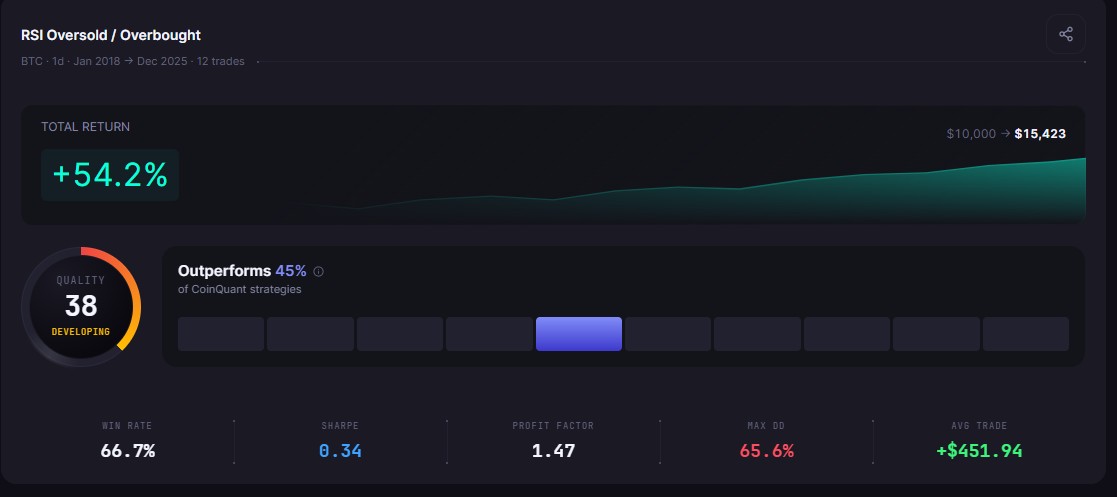
Results. You get the standard metrics set: total return, total trades, win rate, profit factor, Sharpe ratio, max drawdown, and total fees
The product result is that a trader who cannot write Python can still run a Python-grade research cycle: hypothesis, test, read metrics, revise, retest.
What AI Agent Backtesting Cannot Do
The honest section. AI agent backtesting cannot:
Guarantee live performance. A backtest is historical evidence, not a prophecy. The same rules that demand honest data and modeled fees also demand out-of-sample discipline after the backtest
Replace your judgment. The AI translates and tests, but the decisions, what to test, which metric matters, whether to fund the strategy, remain yours
Fix a bad idea. Translation makes a vague idea precise, and precision often reveals that the idea was weak. That is a feature, because it fails you on historical data instead of with live capital
Why Traders Keep Hearing the Term
The term is everywhere in 2026 because the underlying workflow, natural language to tested strategy, is genuinely new at the consumer level and genuinely useful. Platforms that previously required coding now accept descriptions, and the result is that strategy validation is no longer gated by programming skill.
It is also a term competitors use loosely, so the practical question for a trader is never "does it use AI?" It is "does the AI produce a structured, testable rule set, and does the backtest run on real data with real costs?" If the answer to either is no, the AI is decoration.
The Practical Lesson
AI agent backtesting is description to translation to validation to results, with the AI handling the translation and the engine handling the evidence
It is not a chatbot, not a live trading bot, and not a profit promise
Crypto is its natural home because 24/7 markets produce the data and no-code removes the barrier
Judge any implementation by two tests: does it produce a structured rule set, and does the backtest use real data with modeled costs?
The next time you hear about AI agent backtesting, you will know what to look for: a system that turns your description into a real, testable rule set and returns real metrics on real data. That workflow, and only that workflow, deserves the name.
Describe your strategy in plain English and let the platform translate, validate, and backtest it. See AI agent backtesting in practice on CoinQuant
Disclaimer:
Key Takeaway
