
When will Bitcoin rally again?
As of February 5, 2026, BTC trades around $66,700, down roughly 47% from its October 2025 all-time high of approximately $126,200. The average US spot ETF cost basis sits near $84,000, meaning institutional holders are significantly underwater. This isn't a setup for hope. It's a setup for discipline.
.jpg)
Most people answer this question with chart patterns. That's backwards.
Bitcoin doesn't rally because an RSI crosses a line. It rallies when the regime flips: policy, flows, and macro aligning. Understanding this distinction is the difference between reacting to price and anticipating it.
As of February 5, 2026, BTC trades around $66,700, down roughly 47% from its October 2025 all-time high of approximately $126,200. The average US spot ETF cost basis sits near $84,000, meaning institutional holders are significantly underwater. This isn't a setup for hope. It's a setup for discipline.
Here's the framework.
What is a "Regime"?
A market regime is the dominant force driving price over three to six months. It's not noise, it's the underlying gravitational pull that determines whether rallies stick or fade, whether dips get bought or sold.

Right now, Bitcoin sits in a risk-off drawdown regime. ETF flows have been net negative for months. Macro headwinds are stacking up. Institutional capital is in systematic de-risking mode.
Regimes don't flip on a single candle. They flip on catalysts. And to identify those catalysts, you need to understand the three pillars that drive Bitcoin's price action.
The Three Pillars
Think of Bitcoin's price as driven by three forces:
Policy is the rulebook: regulation, legislation, and the frameworks that determine who can participate and how capital can flow into the asset class.
Flows are the fuel: ETF inflows, fund allocations, and stablecoin supply growth that physically move capital into or out of the market.
Macro is the weather" real yields, USD strength, global liquidity conditions, and risk appetite that create the environment in which Bitcoin either thrives or struggles.
A durable rally needs at least two of these three pillars turning green. One green light isn't enough. The November-December selloff proved that: even with policy progress (the GENIUS Act), negative flows and hostile macro conditions overwhelmed the bullish case.
"Flows are the fuel. Macro is the weather. Policy is the rulebook."
Pillar one: Policy
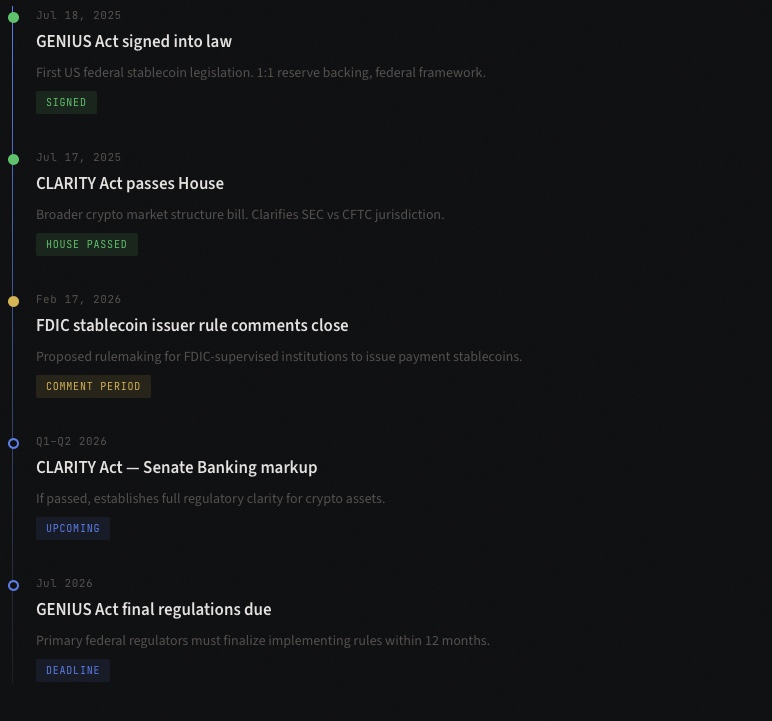
The GENIUS Act became law on July 18, 2025, the first major US stablecoin legislation. This was a genuine structural unlock for the crypto ecosystem.
The law requires permitted payment stablecoin issuers to maintain 1:1 reserve backing with qualifying assets: insured deposits withdrawable on demand, US Treasury securities with maturities of 93 days or less, and certain repurchase agreements. Critically, payment stablecoins issued by these permitted issuers are excluded from the SEC's "security" definition and from the CFTC's "commodity" definition.
This is important to understand precisely: the exclusion is scope-limited. It applies specifically to payment stablecoins issued by permitted payment stablecoin issuers, not to all stablecoins broadly. Other digital assets remain subject to existing regulatory frameworks and the ongoing jurisdictional debate between the SEC and CFTC.
But GENIUS was chapter one. The CLARITY Act, a broader crypto market structure bill that clarifies SEC vs. CFTC jurisdiction over digital assets more generally, passed the House in July 2025 but still needs Senate action. Senate Banking Committee Chair Tim Scott has signaled intent to move on it, but until market structure legislation is signed, institutional allocators face jurisdictional ambiguity that caps capital inflows.
The FDIC is actively implementing GENIUS, with a comment period on stablecoin issuer rules closing February 17, 2026. Final GENIUS regulations are due by July 2026.
Policy timeline to watch:
Pillar two: Flows
Flows are the single most reliable three-to-six-month signal for Bitcoin direction. When institutional capital is flowing in, through ETFs, fund allocations, and stablecoin supply growth, price follows. When it's flowing out, no amount of bullish sentiment can sustain a rally.
The flow picture right now is stark.
November and December 2025 saw $4.57 billion in net outflows from US spot Bitcoin ETFs, the worst two-month stretch since their January 2024 launch. January 2026 added another $1.61 billion in redemptions. That's over $6 billion in cumulative outflows across three months. Institutional money has been in systematic de-risking mode.
But context matters. Despite the outflows, ETFs still hold roughly 1.3 million BTC, only about 5% below their all-time peak. The average ETF cost basis sits near $84,099, while spot trades at roughly $66,700. That gap creates pain for holders, but also a coiled spring: when flows reverse, the re-entry could be aggressive as underwater positions look to average down or as new capital sees opportunity.
On February 2, 2026, spot ETFs recorded $562 million in single-day inflows, the largest since January 14, led by Fidelity's FBTC and BlackRock's IBIT. One day isn't a trend. But it's a signal worth monitoring for persistence.
ETF Flow Snapshot (Monthly, Estimated)
- September 2025: +$1.2B
- October 2025: +$2.8B
- November 2025: -$3.5B
- December 2025: -$1.1B
- January 2026: -$1.6B
- February 2026 (through Feb 2): +$0.3B
Sources: SoSoValue, Farside Investors, CoinDesk
Beyond ETFs, stablecoin total supply acts as a leading indicator. When stablecoin market cap expands, it signals fresh capital entering crypto rails, money that's been converted into on-chain form and is ready to be deployed. When it contracts or stalls, the ecosystem is losing fuel.
The GENIUS Act's implementation, with full regulatory clarity by mid-2026, could catalyze a new wave of stablecoin supply growth in the second half of the year, bringing institutional capital off the sidelines.
Pillar three: Macro
Bitcoin is a liquidity-sensitive asset. This isn't opinion; it's the consistent pattern across every major BTC cycle.
What does "liquidity-sensitive" mean? It means Bitcoin rises when financial conditions ease and capital seeks risk, when central banks are accommodative, when real yields are falling, when the dollar is weakening, when investors feel comfortable moving out on the risk curve. And it falls when liquidity tightens, when rates rise, when the dollar strengthens, when risk appetite contracts.
Right now, the macro picture is mixed-to-hostile.
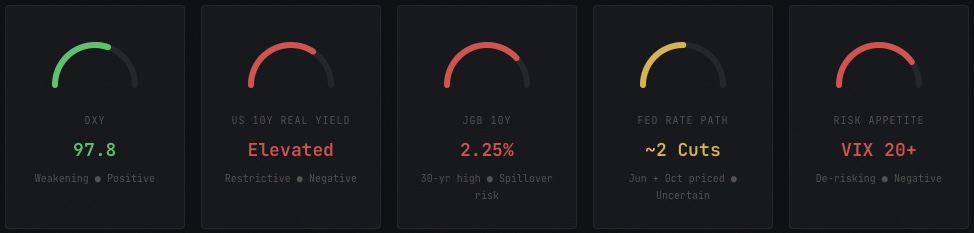
The Dollar: A Green Light
The DXY has dropped sharply from 108 to roughly 97.8, its weakest level since early 2022, a roughly four-year low. That's normally BTC-positive: a weaker dollar eases global financial conditions and makes risk assets more attractive to international investors.
This is the one green light in the current macro environment.
Real Yields: A Red Light
The US 10-year Treasury yield sits around 4.27%. More importantly, real yields, nominal yields minus inflation expectations, remain elevated. When real yields are high, capital has attractive risk-free alternatives to speculative assets like Bitcoin. Until real rates meaningfully decline, this headwind persists.
Tha Japan spillover: The Under-Discussed Risk
The biggest under-discussed risk is what I call the "liquidity vise" emanating from Japan.
Prime Minister Sanae Takaichi's pledge to suspend Japan's consumption tax on food, with no clear funding source, has triggered the sharpest Japanese Government Bond (JGB) selloff in decades. Japan's 40-year bond yield rocketed past 4% for the first time since 2007, and the 10-year hit levels not seen since February 1999, roughly a 26-year high.
Why does this matter for Bitcoin?
Japan is the world's largest creditor nation. Japanese institutions hold enormous amounts of US Treasuries and other global bonds. When JGB yields spike, it creates pressure for Japanese investors to repatriate capital, selling foreign assets to buy domestic bonds that now offer competitive yields. This drains liquidity from global markets.
Additionally, the yen carry trade, borrowing in low-yielding yen to invest in higher-yielding assets elsewhere, begins to unwind when Japanese rates rise. This creates cascading deleveraging across risk assets globally.
The Bank of Japan has signaled it won't come to the rescue with unlimited bond buying, the costs and yen-weakening risks are too high. Japan's snap election on February 8 is a genuine near-term catalyst. If Takaichi wins a landslide (as polls suggest), the market will need to reprice for sustained fiscal expansion.
FED Policy: A Yellow Light
Fed Chair nominee Kevin Warsh has signaled a preference for a smaller Fed balance sheet. Markets currently price roughly two rate cuts this year (June and October). This is neither aggressively hawkish nor dovish, it's a holding pattern.
Until real rates meaningfully decline OR global liquidity expands, BTC's macro headwind stays intact.
MACRO DASHBOARD
- DXY (Dollar Index): 97.8: Weakening → GREEN
- Real Yields: Elevated: Restrictive → RED
- JGB 10Y: 2.25%: 26-year high → RED
- Fed Rate Path: ~2 cuts priced: Uncertain → YELLOW
- Risk Appetite (VIX): 20+: De-risking → RED
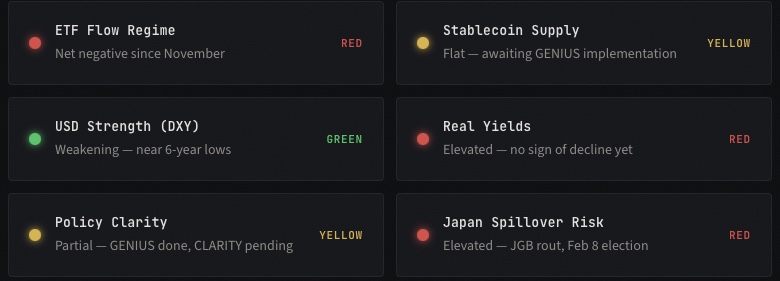
The Regime Cheklist
Six indicators, three colors. A durable rally requires at least four greens. We currently have one.
The Trigger Map
What would make the regime flip bullish? These are the specific catalysts to track, not vague hopes, but measurable events.
1. ETF flows turn net positive for 3+ consecutive weeks
This is the strongest signal that institutional capital is rotating back in. One-day pops don't count, sustained conviction does. Watch for persistence, not spikes
2. CLARITY Act passes Senate
Full regulatory clarity for digital assets would remove the single largest barrier to institutional capital deployment, potentially unlocking a wave of allocation that dwarfs anything seen in 2024–2025.
3. Fed signals accelerated easing or balance sheet pivot
Any shift toward faster rate cuts or slowed quantitative tightening would directly ease financial conditions for risk assets. This could come from deteriorating economic data or financial stability concerns
4. Japan bond volatility stabilizes post-election
The February 8 outcome is key. If JGB yields stabilize without BOJ emergency intervention, the global duration shock fades from the risk map. This would remove a major headwind for all liquidity-sensitive assets
5. Stablecoin supply breaks to new all-time highs
The clearest proxy for new capital entering the crypto ecosystem. Rising supply equals rising fuel for a rally.
Where technicals fit (and where they don't)
Technicals don't predict regime shifts. Fundamentals and catalysts do that.
No moving average crossover signaled the GENIUS Act. No RSI divergence predicted the November ETF exodus. No Fibonacci level warned of the Japan bond rout.
But after a regime flips, technicals become indispensable. They help you time entries, set stops, confirm momentum, and manage risk within the new trend.
The right order is: identify the regime first (using this framework), then use technicals to optimize your execution. Use them as a tool, not a thesis.
The monitoring plan:
What to check, and when. A simple, disciplined cadence for staying ahead of the regime shift, not chasing it after it happens.
Daily checks:
- BTC spot price and intraday range
- ETF net flows (Farside Investors or SoSoValue)
- DXY (US Dollar Index)
- US 10-Year Treasury yield
- Japan 10-Year JGB yield
Weekly reviews:
- CoinShares digital asset fund flows report
- Stablecoin total market cap (DeFiLlama)
- Fed and BOJ official commentary
- CLARITY Act legislative status updates
- BTC on-chain metrics: exchange balances, long-term holder supply
Risk scenarios
BEARISH SCENARIOS
1. JGB rout deepens into global duration shock
If Japan's bond selloff accelerates post-election without BOJ stabilization, it could trigger cascading deleveraging across global fixed income and risk assets. The yen carry trade unwind alone could drain significant liquidity from crypto markets.
2. ETF cost basis triggers sustained redemptions
With the average US spot ETF cost basis at $84K and BTC at roughly $67K, extended underwater positions could trigger systematic stop-loss selling by institutional allocators, creating a self-reinforcing downward cycle.
3. Government shutdown clouds Fed path
The partial US government shutdown delayed key economic data (jobs report, CPI). Without clear signals, the Fed remains on hold for longer, and markets can't properly price the rate path, a form of liquidity paralysis for risk assets that need direction.
BULLISH SURPRISES
1. Fed emergency balance sheet pivot
If the Japan spillover or financial conditions tighten faster than expected, the Fed could reverse course on quantitative tightening or signal a more aggressive easing stance, a direct injection of liquidity into the system that would benefit all risk assets.
2. CLARITY Act fast-tracked through Senate
Full regulatory clarity for the digital asset class would remove the single largest barrier to institutional capital deployment, potentially unlocking a wave of allocation from pensions, endowments, and sovereign wealth funds that have been waiting on the sidelines.
Conclusion
Bitcoin doesn't need hope. It needs a regime change.
Right now, the checklist is mostly red. Three of six indicators are negative, two are neutral, and only one, the weakening dollar, is flashing green. That's not a setup for a durable rally. It's a setup for patience.
But regimes can shift faster than consensus expects. The February 8 Japan election, the February 17 FDIC comment deadline, the February jobs and CPI prints, any of these could be the catalyst that flips one or more lights from red to green.
And when multiple pillars align, BTC moves fast.
Build your watchlist. Track the pillars. Act when the lights turn green.
Run your own backtest and read every metric yourself, for free, on CoinQuant. Read your own backtest report free on CoinQuant
Disclaimer:
This analysis is for educational and informational purposes only. It does not constitute financial, investment, or trading advice. All data is sourced from publicly available reports and may contain errors or delays. Past performance is not indicative of future results. Cryptocurrency markets are highly volatile and carry substantial risk. Always conduct your own research and consult a qualified financial advisor before making investment decisions.
Key Takeaway
